As investors debate whether and when the Federal Reserve will raise interest rates, market expectations for further tightening are building around the world — and spelling trouble for bonds.
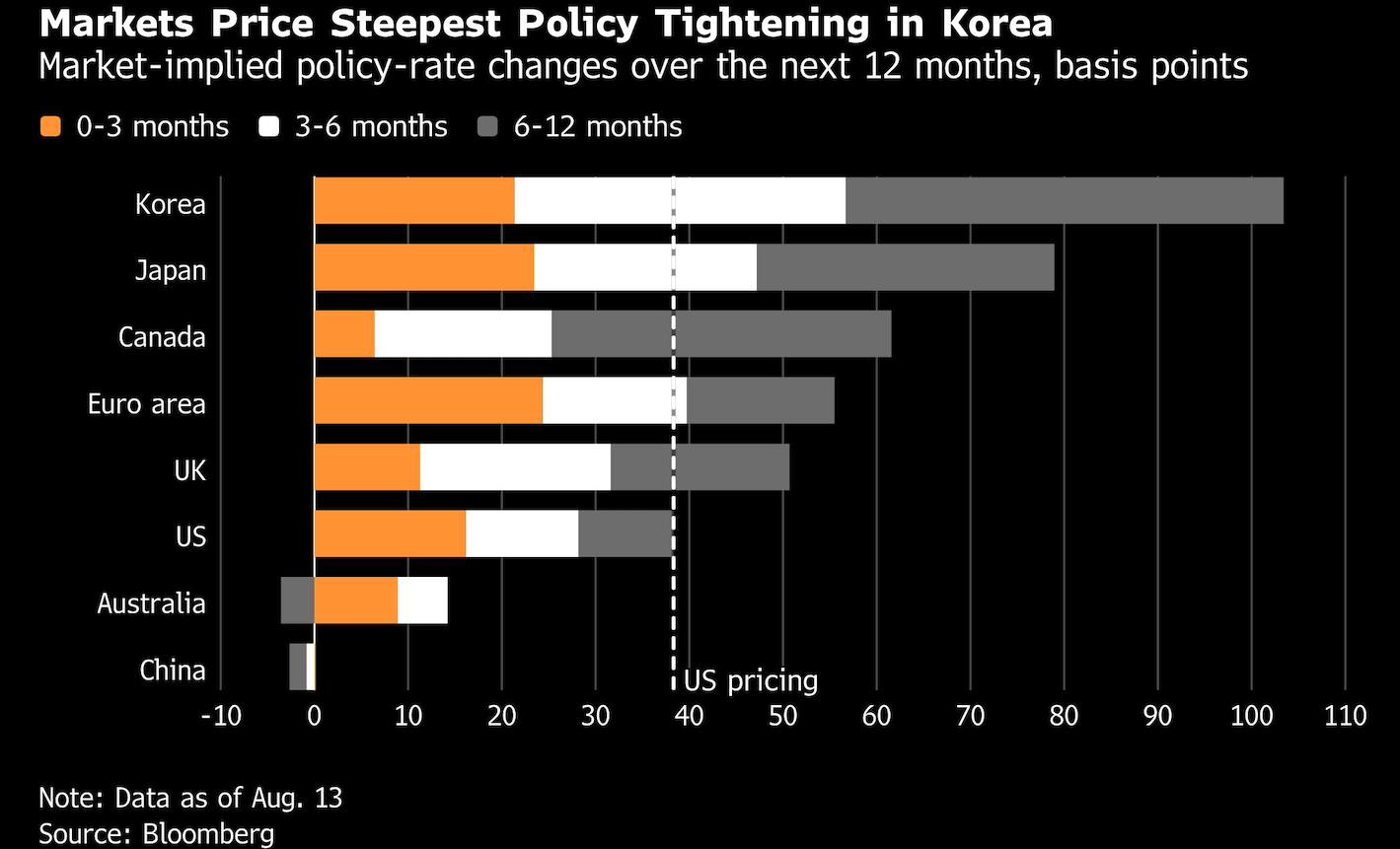
Traders see borrowing costs rising faster in Japan, Canada, the euro zone and the UK than in the US over the next year. Of the 32 swap markets tracked by Bloomberg, two-thirds are priced for rate hikes, with South Korea leading the pack at more than 100 basis points.
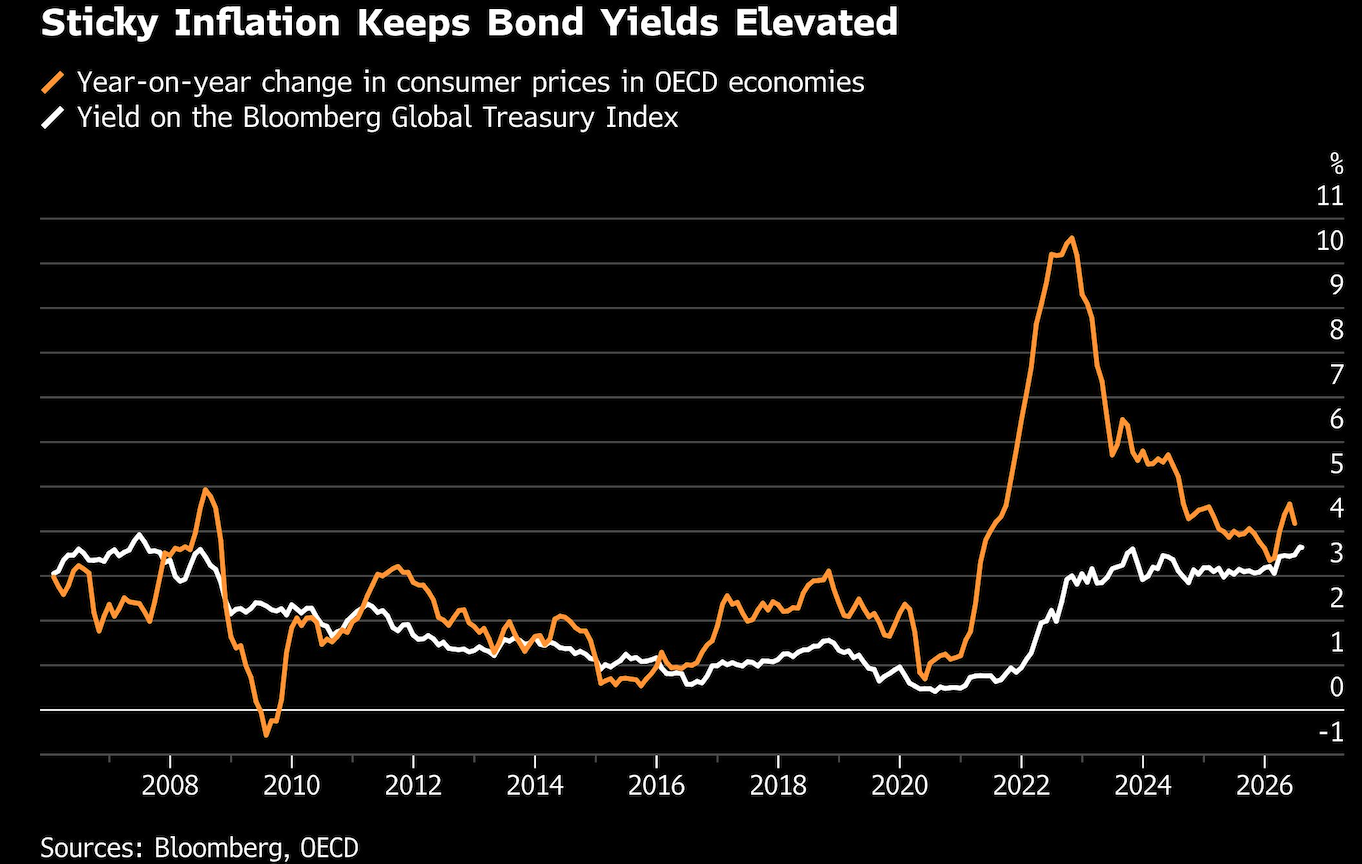
It marks a shift from the Fed-dominated rate cycle of recent years. This time, central banks are facing overlapping pressures from higher oil prices from the Iran war, heavy government spending and an AI investment boom that’s supercharging growth. Inflation across countries in the Organisation for Economic Co-operation and Development recently hit a two-year high.
That leaves investors with an uncomfortable prospect: bonds are supposed to cushion portfolios when things go wrong — for example, if the AI-driven stock rally reverses or another trade war hits growth. If central banks outside the US are forced to tighten more aggressively, those bonds could instead add to losses, undermining one of the foundations of traditional diversification.

“From a diversification perspective, it doesn’t do the job,” said George Efstathopoulos, portfolio manager at Fidelity International, which oversees over $1.1 trillion in assets. He has very little exposure to government debt, holding only some Treasury inflation-protected securities and Brazil paper.
See more: Is Your Bond Strategy Built for Change?
“In a world of just more geopolitics developments, more energy dependence, sticky inflation, big fiscal stimulus — you’re probably going to see more inflation resistance,” he added.
Traders are pricing in about 400 basis points of rate hikes across seven major markets over the next year, data compiled by Bloomberg show. If they’re right, the implications may ripple beyond bonds, weighing on richly-valued stocks by reducing the present value of future earnings, tightening financial conditions and disrupting currency trades.
Higher rates also raise the return investors can earn simply by holding cash, giving them more alternatives for their money, according to Ed Al-Hussainy, portfolio manager at Columbia Threadneedle. That means governments and companies have to offer higher yields to compete for capital, he said.
Seoul and Tokyo are expected to lead the next leg of global tightening as costlier energy collides with an AI-driven investment boom that is boosting demand for chips, power and labor.
Their bonds are feeling the strain. South Korean government debt has lost nearly 9% this year in local currency terms, the worst performance among 44 bond markets tracked by Bloomberg. Japanese bonds are also among the biggest decliners, down about 4%.
In Europe, higher energy costs and a wave of defense spending are weighing on the outlook. The benchmark 10-year yield in France climbed to its highest level since 2009 on Friday, while those in Germany and Italy have both risen more than 30 basis points this year.
Bonds clawed back some of those declines on Monday, with front-end yields slightly lower. 10-year US Treasury yields fell about 1 basis point to 4.69% while 10-year French yields continued to hover around Friday’s high.
Yet some investors are more upbeat on European bonds. The European Central Bank was among the first to raise rates after the global energy shock, signaling a more aggressive stance on inflation. Fund managers also see the region’s fiscal and monetary outlook as more predictable than in the US or Japan.
Iain Stealey, fixed-income international chief investment officer at JPMorgan Asset Management, prefers European debt over US peers, particularly gilts, where he says there’s too much tightening priced from the UK central bank.
“I am much more convinced around buying the front-end of the European curve, particularly the UK,” he said in a Bloomberg TV interview Thursday. “I don’t think the Bank of England is in any hurry to hike rates.”
US Outlook
In the US, bond traders have stopped fully pricing in a Fed rate hike this year as inflation concerns have cooled. Still, the 10-year Treasury yield is up about 50 basis points this year, while the recent 30-year auction drew the highest borrowing costs in decades amid concerns over the growing deficit.
What Bloomberg Strategists Say...
“Fiscal deficits and term premium haven’t disappeared simply because the latest inflation prints were tepid. The long end of the Treasury yield curve still looks structurally heavy, keeping the curve biased toward further steepening.”
— Brendan Fagan, macro strategist.
Bonds now occupy a “much smaller place in portfolios” than a decade ago, said Kenneth Goh, director of private wealth management at UOB Kay Hian Pte in Singapore. With major markets seen tightening at the same time, diversifying across bonds offers less protection than when policy cycles diverged.
“Many investors still assume bonds will cushion the portfolio — they just don’t work like that anymore,” he added.
A message from Advisor Perspectives and VettaFi: Discover something new! Click here to register for our upcoming webcasts.
Bloomberg News provided this article. For more articles like this please visit
bloomberg.com.
Read more articles by Ruth Carson, Masaki Kondo, Cameron Fozi