More than a decade ago, hundreds of US garage entrepreneurs were working on shoestring budgets to develop drones with dreams of scaling the new technology. Then China’s DJI introduced a small, inexpensive drone with a stable built-in camera.
The US drone industry was killed in the cradle. DJI, Autel and other Chinese drone makers went on to dominate the market in the US and around the world. The US is now using tariffs and Federal Communications Commission bans to block Chinese drones and encourage the rebirth of a domestic industry, though the fallout is painful for government agencies, companies and individuals who use the cheap machines.
See more: How To Build Your Very Own Humanoid Robot
The US is trying not to repeat this history with humanoid robots, which are of particular fascination in China — as illustrated by the buzz around the initial public offering of Yushu Technology Co., known as Unitree Robotics, whose shares will start trading in Shanghai on Wednesday. It will be important for the US to build out an efficient supply chain while these next-generation machines are still in their infancy.
Last month, the FCC added to its banned list most foreign-made power inverters and advanced robotics, which include humanoid and four-legged, canine-shaped robots. The move is timely because these humanoid robots aren’t very useful right now beyond demonstrations and pilot programs. But they have the potential in the next decade or two to be commonplace in factories, stores and even the home.
It’s unfortunate that the US needs to fall back on protectionism, but that’s the consequence of inviting China into the World Trade Organization and then allowing the country to flout the rules. It never opened its sectors fully to competition, made foreign companies enter partnerships with local ones, forced technology transfers and subsidized industries it targeted to dominate.
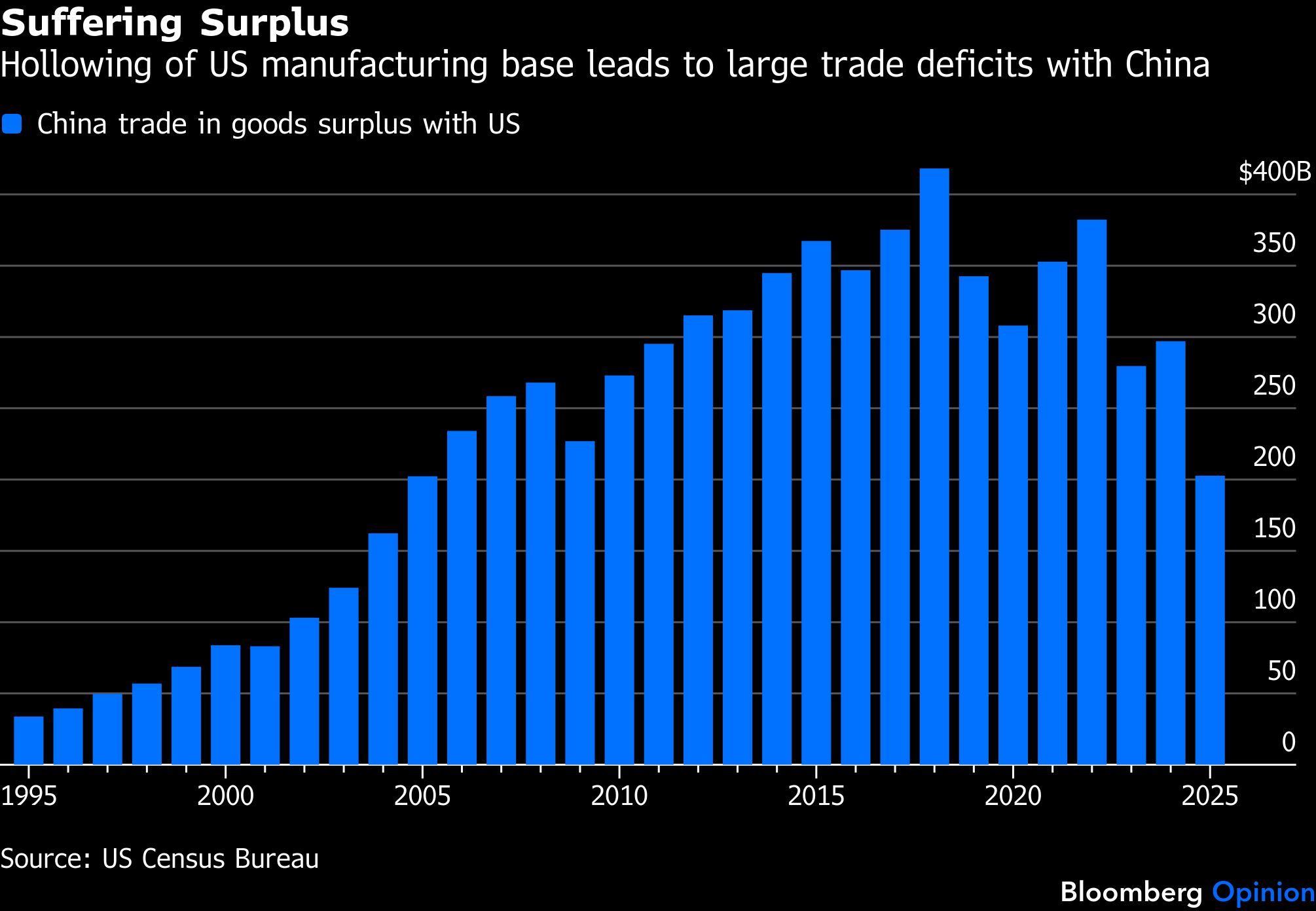
To make matters worse, US companies were complicit, moving factories to China to lower costs. Consumers fell into a cheap-goods consumption binge. The massive trade imbalance was mostly ignored until the pandemic issued a wake-up call that the US doesn’t manufacture much at home anymore and that its economic dependence on an adversary is a problem.

The US can start to remedy the problem with a domestic supply chain to produce these humanoid and caninoid robots. When married with an AI brain, these machines will be able to perform many more tasks with minimal programming. This is the physical AI or embodied AI revolution that is about to take the world by storm, or at least that’s what Nvidia Chief Executive Office Jensen Huang and others are telling anyone who will listen.
Advanced robotics will allow the US to reshore some manufacturing, and it even has an environmental benefit if fewer products are shipped from halfway around the world. The national security implications are even greater. Unfortunately, these machines can also be used as weapons — just like drones, which have both commercial and military purposes.
The US will be a leader in AI software, and it must also make sure it’s at the forefront of hardware. Production of key component parts and final assembly need to be situated in North America. This includes Mexico, a low-wage neighbor that can help keep the costs competitive, especially in early years.
The good news is that the development of these advanced robots is in its early stages — similar to the drone industry a decade and a half ago. US companies, including Agility Robotics and Apptronik, are already building and deploying humanoids in pilot programs. Also, China hasn’t been a robotics powerhouse — yet. Industrial robots have mostly been built by European and Japanese companies, including ABB Ltd., Fanuc Corp. and Yaskawa Electric Corp.
China is the leader by far for industrial robot installations and is gaining ground quickly on production of the machines. The nation’s enthusiasm for humanoid robots has produced events to display these machines dancing, running races or even doing flips. Many of these demonstrations are preprogrammed or manipulated by remote human operators, and there are unanswered questions about how long it will take before these robots can perform genuinely useful tasks.
To stay ahead, the US — in addition to building out a robotics supply chain — needs to foment excitement around mobile robots in schools with kits to assemble and experiment with this technology. This is a much lighter lift than trying to claw back the drone industry or achieving the nearly impossible task of reviving commercial shipbuilding.
Standard Bot, a Glen Cove, New York-based industrial robot startup, said it’s on track to install 10% of robots in the US and expects its supply chain will be completely sourced domestically by 2027. “We must build American robots and put them to work in American factories,” founder Evan Beard said in an announcement when his company raised $200 million to finance expansion. “It’s a national imperative.”
Jabil Inc. the Florida-based contract manufacturer, is producing humanoid robots in Mexico for Texas-based startup Apptronik and expects one day to use these mobile machines to help make other robots, Tom Brown, a senior director of engineering and technology, said in an interview.
It would be a mistake to impede the development of a robotics supply chain by insisting everything be built in the US immediately. For the more labor-intensive components, Mexico can play a role while keeping the supply chain close to home. There may come a day when automation makes wage differentials insignificant in the search for a manufacturing location. Until then, we need our neighbors.
At the moment, the supply chain is mostly in Asia. Suppliers will move to North America if production is located there. “I could definitely see more of the supply chain popping up where the production’s occurring, but it takes time,” Brown said.
If the US is serious about reviving manufacturing, it can’t make the same mistake with humanoid robotics that it made with drones. It needs to keep the advanced robotics revolution close to home.
A message from Advisor Perspectives and VettaFi: Discover something new! Click here to register for our upcoming webcasts.
Bloomberg News provided this article. For more articles like this please visit
bloomberg.com.
More Asian/European Markets Topics >