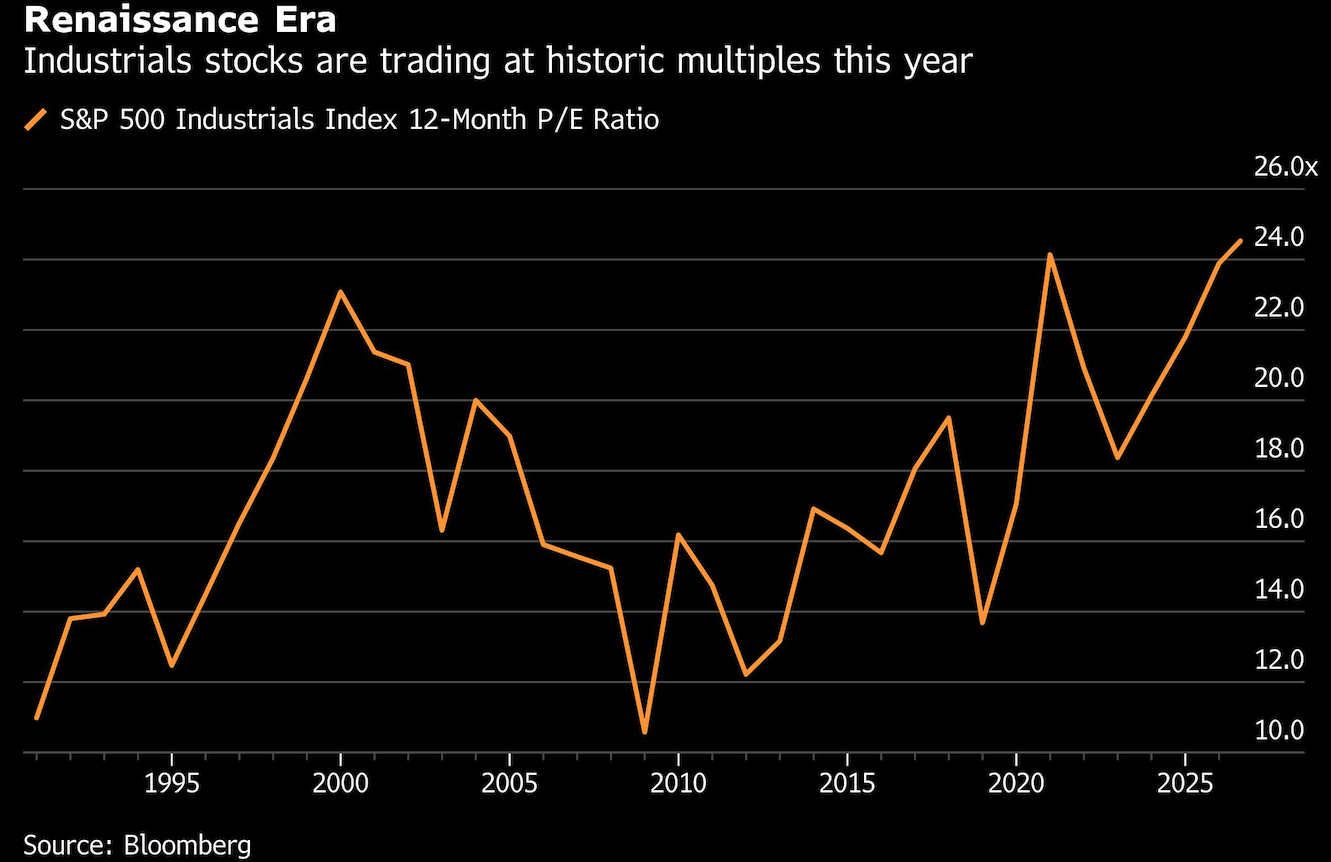
A brisk rally in industrial stocks this year has defied higher oil prices, rising bond yields and restrictive trade policies, as investors bet on big gains from the artificial intelligence boom. Now signs are emerging the optimism may have gone too far.
Shares of companies that make heavy machinery, move goods around and construct buildings and bridges are among the best performers in the S&P 500 Index alongside energy and information technology. A gauge of the group has gained 16% so far in 2026, a rally that has made it the most expensively valued sector in the S&P.
“Expectations for a cyclical recovery in 2027-28, coupled with secular tailwinds from AI and the data center buildout, reshoring and mega projects have further stretched already lofty industrial valuations,” said Chris Ciolino, industrials analyst at Bloomberg Intelligence. It “could potentially leave the group more vulnerable to sharper pullbacks if growth expectations disappoint.”
Out of the 11 sectors that comprise the 500-member benchmark, industrials currently have the highest valuation, beating out even information technology, which is at the frontline of the AI trade. The 12-month forward price-to-earnings ratio for the sector stands at 24.7, with information technology at 21.2 and S&P 500 at 19.7.
Industrials are also trading significantly above historic multiples. They have been at these levels only one other time since 1990 — during the post-Covid years when earnings were rebounding from extreme lows.
Meanwhile, the State Street Industrial ETF — one of the largest funds tracking the group — is on pace for the smallest monthly inflow since May. Another major fund — the Vanguard Industrials ETF — is set to see its biggest monthly outflow since April 2025, when traders were gripped by fears about President Donald Trump’s tariff policies.

See more: There’s More to Growth Than AI
There are “good reasons” behind the sector’s elevated valuation profile, said Matt Stucky, chief portfolio manager at Northwestern Mutual, noting increased confidence among investors that the sector’s growth was more durable and less volatile than the overall market’s.
It’s a “little bit easier” to forecast for stable manufacturing giants like Caterpillar Inc. and GE Veronva Inc. than for a company like Micron Technology Inc., Stucky said. “There’s just like an easier comfort in forecasting out the margin trajectory for these businesses relative to some of the cyclicality that you might see in the technology space.”
Large industrial companies, such as makers of electrical equipment, power generators and turbines, battery manufacturers and construction firms, are currently in a sweet spot as they combine two major investment themes: the physical expansion of AI data centers and defense spending.
Caterpillar, Eaton Corp. and Deere & Co. have benefited from the former, while the ongoing conflicts in Iran and Ukraine, as well as higher military spending globally in an increasingly uncertain world order, have given a boost to companies such as RTX Corp., General Electric Co. and Boeing Co.
“This AI buildout has been a renaissance for industrial companies,” said Michael O’Rourke, chief market strategist at Jonestrading.
Still, with risks swirling, investors wonder how much longer industrials can enjoy their day in the sun.
O’Rourke said the main risk lies in the nature of the AI buildout, noting that the current level of growth in building is “hard to sustain.”
“If we talked about the AI buildout being a little slower but steadier over the next five years, that would be really good for industrial companies,” said O’Rourke. “You don’t want to get it all at once, but I think there’s a massive pull forward in demand occurring in 2026 and into 2027.”
A message from Advisor Perspectives and VettaFi: Discover something new! Click here to register for our upcoming webcasts.
Bloomberg News provided this article. For more articles like this please visit
bloomberg.com.
Read more articles by Joel Leon