Sift through the filings of pension funds and insurers around the world and one thing stands out: some of the biggest holders of US assets have little protection against a weaker dollar, leaving the currency at risk of steeper declines if sentiment suddenly turns.
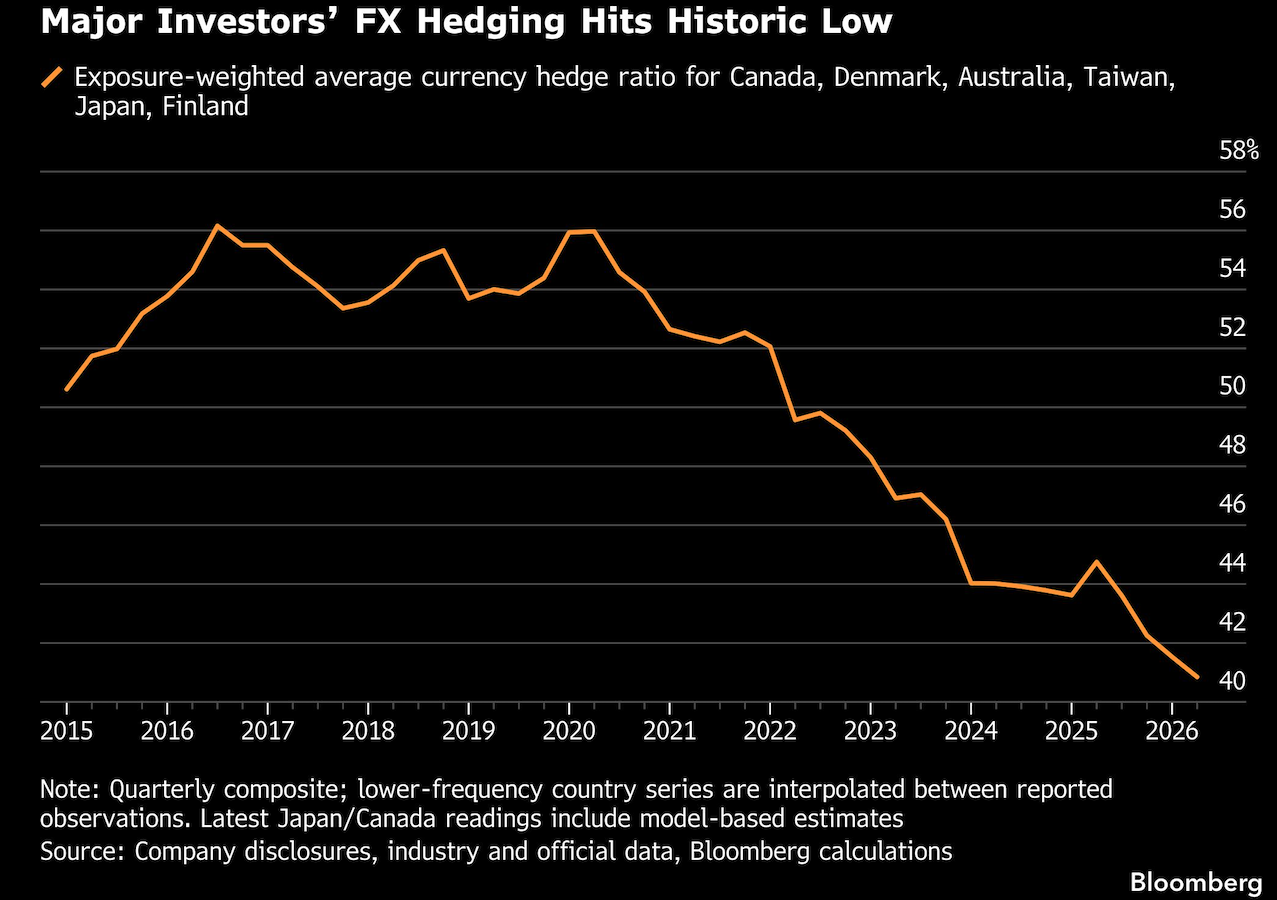
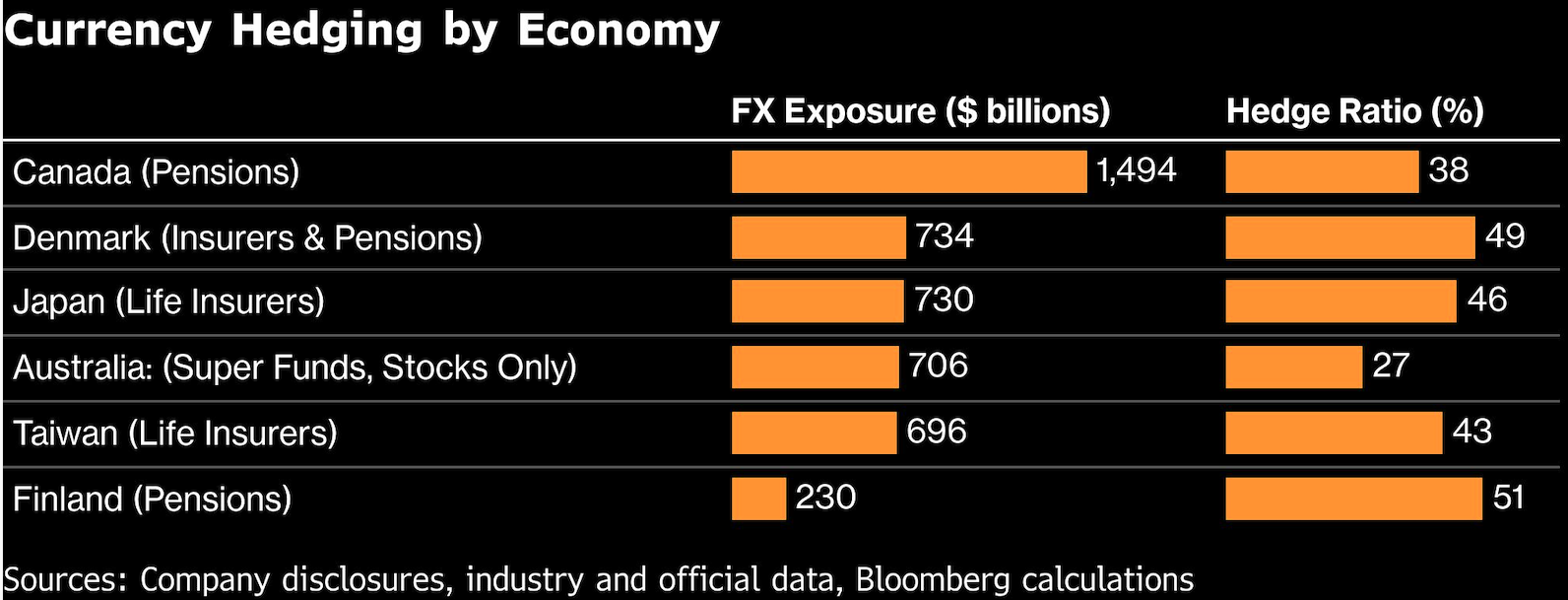
Across markets including Japan, Canada and Taiwan, these investors hedged just 41% of their foreign-currency exposure as of June 30 — the lowest since at least 2015 — according to Bloomberg calculations using data from six markets where such figures are available.
While not a complete picture, it offers a glimpse into how the sudden rush last year to hedge against dollar losses triggered by President Donald Trump’s global tariff rollout has faded as the US currency slowly stabilized.
Hedging protects investors from currency swings by using derivatives to sell the greenback for their home currency. Because US assets make up a large share of global portfolios, increased hedging effectively means more dollar selling.
In cutting back their hedges, investors are returning to an approach that had worked for much of the past decade. The dollar tended to rise, or at least hold up, when markets turned volatile, cushioning losses on US stocks and bonds when they’re converted back into investors’ home currencies. And with hedging expensive, there was little incentive to pay for protection.
The risk now is that two pillars underpinning that strategy — high hedging costs and the dollar’s haven status — are being challenged at the same time.
The greenback is down about 2.6% this quarter and has weakened against all G10 peers as investors revive the debasement trade, the view that US policies will erode the currency’s value. Treasury Secretary Scott Bessent’s moves to support the yen and contain rising US yields have fueled those concerns, as have doubts over whether Federal Reserve Chair Kevin Warsh will raise rates to curb inflation amid Trump’s push for lower borrowing costs.
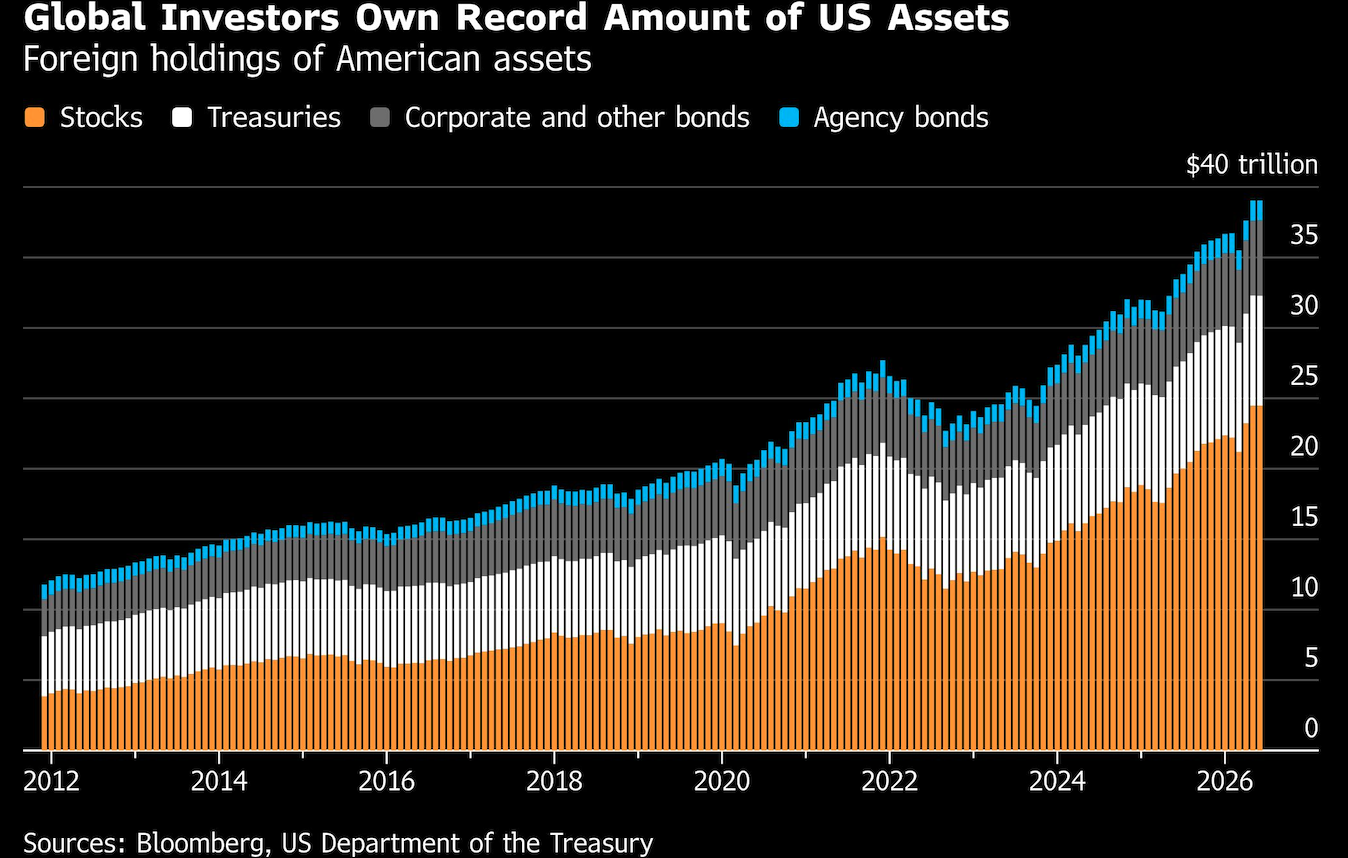
“Given the scale of foreign holdings of US assets, it doesn’t take a dramatic change in positioning to matter,” said Laura Cooper, the London-based head of macro credit at Nuveen, which oversees $1.4 trillion. “Foreign investors hold a sizeable stock of US assets, so even small shifts in hedge ratios can drive meaningful FX flows.”
A five-percentage-point increase in hedge ratios would translate into around $230 billion of transactions, according to Bloomberg estimates based on $4.6 trillion of foreign-currency holdings across the six markets, which also include Australia, Denmark and Finland.
The estimate excludes major markets such as the UK and euro area, but the countries covered still represent a significant slice of US asset holdings. Japan is the world’s largest foreign holder of US Treasuries, accounting for about 10% of overseas holdings, while Canada and Taiwan rank among the top 10.
The factors that drove hedging down from more than 50% over the past four years are starting to shift.
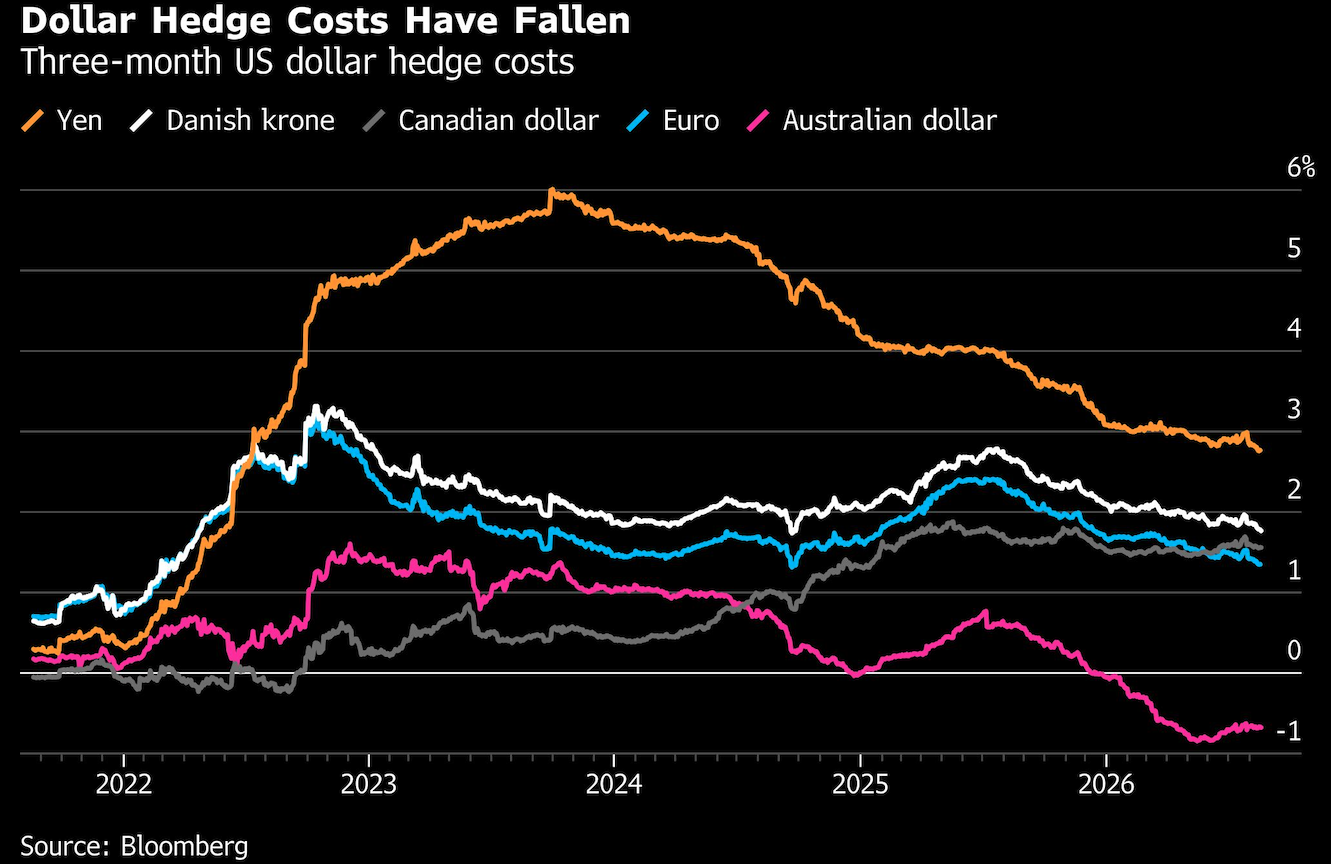
The rate gap that made hedging expensive is shrinking. Three-month dollar hedge costs for yen-based investors have slid to a four-year low of 2.75%, from a high of 6% in October 2023. For euro-based investors, they’ve dropped to a two-year low of 1.32%.
Hedging demand has swung before. A year ago, flows into dollar-hedged exchange-traded funds buying US assets outpaced unhedged funds for the first time this decade, data from Deutsche Bank AG showed. Now, the Iran war and surge in energy prices are adding to inflation pressures, pushing central banks globally toward higher rates and shrinking the gap with the US.
The path for US rates is less clear, with Warsh’s communication leaving investors guessing about how aggressively he will tackle inflation. His vow at Jackson Hole on Friday to tame price pressures boosted expectations for hikes, but they have faded since then. On Thursday, Federal Reserve Governor Christopher Waller commented on inflation progress, pushing traders to pare back those hike bets.
“If markets continue to price out Fed hikes and interest-rate differentials narrow, investors may start rebuilding those hedges,” said Nathan Thooft, chief investment officer of the multi-asset solutions team at Manulife Investment Management. “That creates a steady source of US dollar selling pressure.”
What Bloomberg Strategists Say...
The dollar has increasingly decoupled from both nominal and real yields as policy credibility has displaced rate differentials as the dominant driver.
— Tatiana Darie, Markets Live Strategist
Stuart Simmons, head of multi-asset solutions at QIC Ltd., one of Australia’s biggest government-owned money managers, said relying on a foreign-currency basket that’s 70% exposed to the dollar as a defensive tool may no longer work.
“In an era of increased geopolitical uncertainty, are you really that confident going forward that the US dollar is going to be the main expression of defensiveness?” Simmons said. “What we are recommending is just have a look at some of the alternatives out there, and just ensure that you’ve got a bit more diversification within that foreign-currency basket.”
The dollar’s strength is also being questioned. The Treasury’s plan to ramp up purchases of long-dated debt to contain borrowing costs and coordinated US-Japan yen intervention have raised concerns about authorities’ willingness to support markets and other currencies at the dollar’s expense.
“If investors become less confident that the dollar will reliably appreciate during periods of market stress, they may see less reason to tolerate large unhedged currency exposure,” said Noureldeen AlHammoury, chief market strategist at Equiti Group in Dubai.
Investors wouldn’t need to sell their US assets. They can keep their stocks or Treasuries while increasing currency hedges by selling dollars forward. “That distinction is very important because it means US asset demand can remain relatively strong even while the dollar comes under pressure,” he added.
Japan
The potential for a shift toward more hedging may be greatest in Japan, home to some of the largest foreign holders of US assets. Deutsche Bank’s estimates for Japanese investors show a similar trend, with them hedging 41% of new foreign bond purchases in the first half of this year, down from 62% in 2024.
“The last time it was this thin, in 2013, the dollar was entering a 10-year bull market,” said Shoki Omori, the bank’s chief fixed income strategist for Japan. “Today’s macro looks closer to the mirror image.”
Omori sees three potential catalysts: further Bank of Japan rate hikes, which would narrow the rate gap; a sharp dollar decline, which could deepen losses and prompt risk committees to add protection; and a new solvency regime that leaves insurers with less tolerance for currency swings.
Erik Nelson, a strategist at Wells Fargo, cautioned against treating hedging as a fundamental driver of the dollar, saying monetary policy is likely to dominate over the longer term. Still, he sees scope for investors to add dollar hedges as the cost of shorting the currency eases.
Nelson expects the euro to be a main beneficiary, given European funds’ large unhedged purchases of US equities. “Any signs that the USD is underperforming on risk-off can see a quick shift in FX hedging behavior that can accelerate a down-move in USD,” he said.