A sudden reversal in momentum for previously high-flying shares of industrial companies over the past three weeks has some investors bracing for more pain ahead.
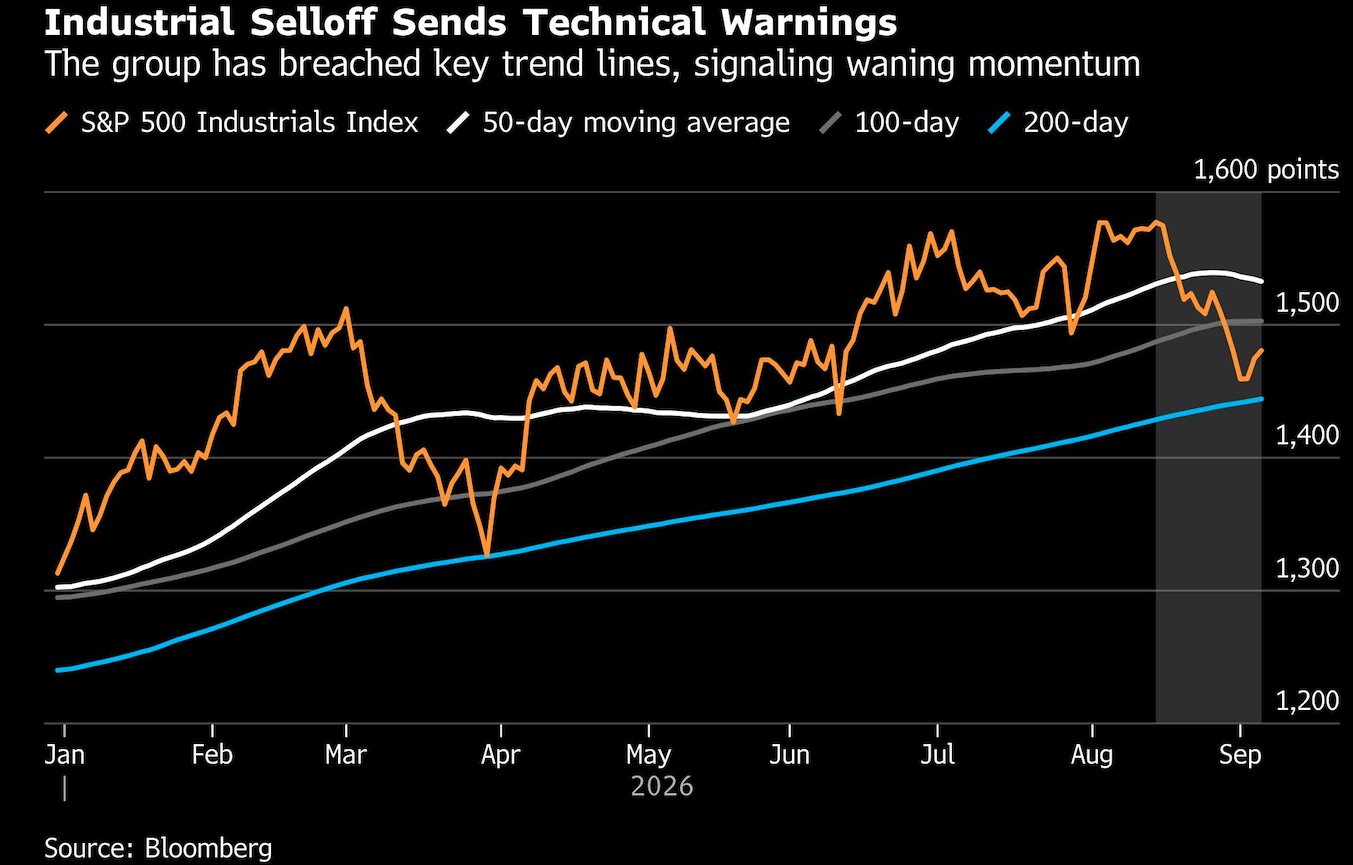
The S&P 500 Industrials Index has tumbled 6.1% since reaching its last record on Aug. 14 as the Iran war once again pushed up oil prices and the artificial intelligence trade went into reverse.
Technical alarm bells have started to ring. The selloff has dragged the index below its 50-day and 100-day moving averages, measures of its short-term and medium-term price trends.
“It is likely that breaking below these moving averages steepens the decline in the short term,” said Brian Mulberry, chief market strategist at Zacks Investment Management. The index is now likely to test its 200-day average, a “key level of support” that is about 2.5% below where it’s trading now, Mulberry said.
Mulberry blames the selloff on a breakdown in the momentum trade that had powered the sector to its recent highs, while others on Wall Street point a finger at economic forces.
Oil prices have resumed their march higher as shipping through the Strait of Hormuz remains disrupted, keeping inflation expectations and long-term bond yields elevated. That’s a toxic cocktail that threatens to increase production prices and the costs that capital-intensive manufacturers pay to borrow money, while dealing a blow to the broader economy that drives their sales.
And these headwinds are swirling as the industrials group trades at some 23.7 times estimated earnings for the next 12 months, a premium to the broader S&P 500 Index’s multiple of 19.4.
“It’s a recipe for a pullback,” said Brian Sponheimer, a portfolio manager at Gabelli Funds. “If you’re a trader, it makes the path of least resistance pressing the sell button.”
Still, there are signs that so many investors have already hit the sell button that the worst of the declines could be over. In a note last week, Bank of America Corp. flagged “capitulation” among its clients, who have dumped shares in the sector to a degree never before seen in data going back to 2008.
And the fundamentals look like they’re holding up for now, meaning it’s possible the retreat over the last three weeks may end being a short-lived correction rather than the start of a serious downturn. The gauge of large-cap industrials is still up 13% in 2026, building on last year’s 18% gain.
US manufacturing activity grew for an eighth consecutive month in August, although the pace of expansion slowed somewhat.
Yet like so much of the stock market, the ultimate fate of industrial stocks may come down to the state of the the artificial-intelligence trade that was previously an engine for the sector. Technology companies are pouring hundreds of billions of dollars into the data-center buildout, creating demand for power generators, electrical equipment and construction machinery.
Recently, though, the AI infrastructure trade has stumbled. Concerned that capital spending on data centers may not meet sky-high hopes, traders have dumped chipmakers and power equipment names alike since early July. Public backlash to data center construction has added to the selling pressure, Nationwide’s Mark Hackett said.
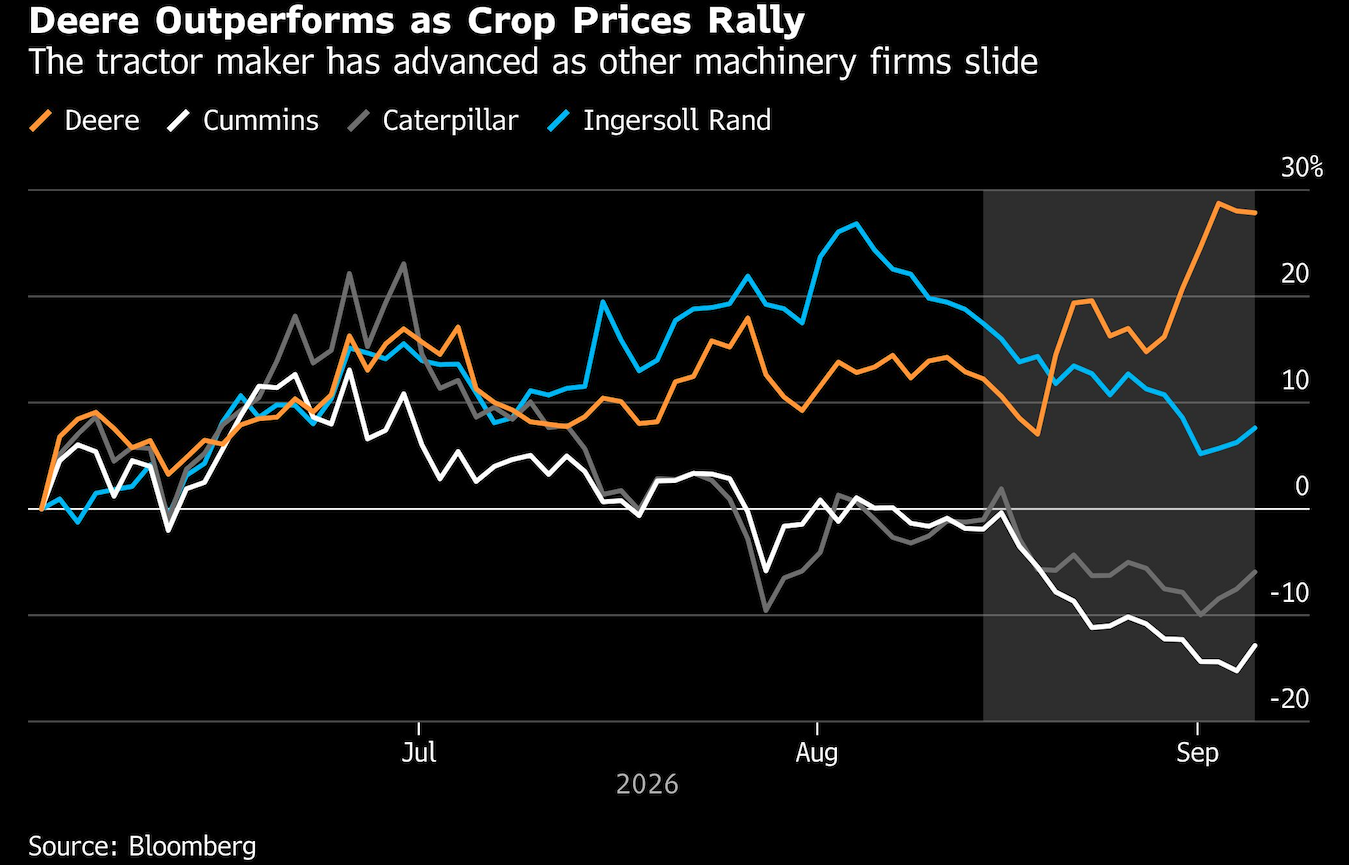
Gas turbine giant GE Vernova Inc. and electrical equipment maker Eaton Corp. are down at least 9% since Aug. 14, making them among the biggest drags on the industrials index. Caterpillar Inc. is down 5%.
Industrial names like Caterpillar have long been considered bellwethers for the broader market, and that importance has only grown due to their connection to AI, said Matt Maley, chief market strategist at Miller Tabak.
“If the weakness in this sector continues, it should send up some general warning flags for investors,” Maley said.
Transport Woes, Farming Hopes
GE Aerospace and RTX Corp. have also been some of the biggest weights on the index since its last record. Oil prices are up more than 10% since mid-August, contributing to a slide in the jet-engine makers alongside fuel-hungry airlines.
Freight transportation stocks have also been weak amid elevated oil prices and interest rates. Meanwhile, investors in truckers such as Knight-Swift Transportation Holdings Inc. are concerned about a drop in the prices they’re able to charge customers, a worrying sign that comes just after trucking rates rebounded from a yearslong slump.
“We’re basically trying to figure out, is this reversal temporary?” Citi analyst Ari Rosa said. If trucking rates end up disappointing, he said, “the implications are pretty profound for corporate earnings.”
Agricultural equipment makers have been one of the few bright spots. The prices of crops such as wheat and soy are surging, which tends to put more money in farmers’ pockets that they can use to buy tractors and other equipment. That’s lifted shares of Deere & Co. and its peers and drawn upgrades from analysts.
For now, other industrial stocks remain at the mercy of less-rosy economic forces. Yet company-specific metrics such as margins and orders are strong, said CFRA’s Jonathan Sakraida, who thinks investors will catch a break when the next earnings season arrives.
Earnings growth for the group is forecast to accelerate to almost 19% for the current period, from 13% in the second quarter, and top 17% for all of 2027, according to analyst estimates compiled by Bloomberg Intelligence.
“In the near term, there certainly is potential for more volatility on a sentiment basis,” Sakraida said. “Once we come to Q3 and really Q4 and we start getting those outlooks for 2027, we think that’s going to be superseded.”