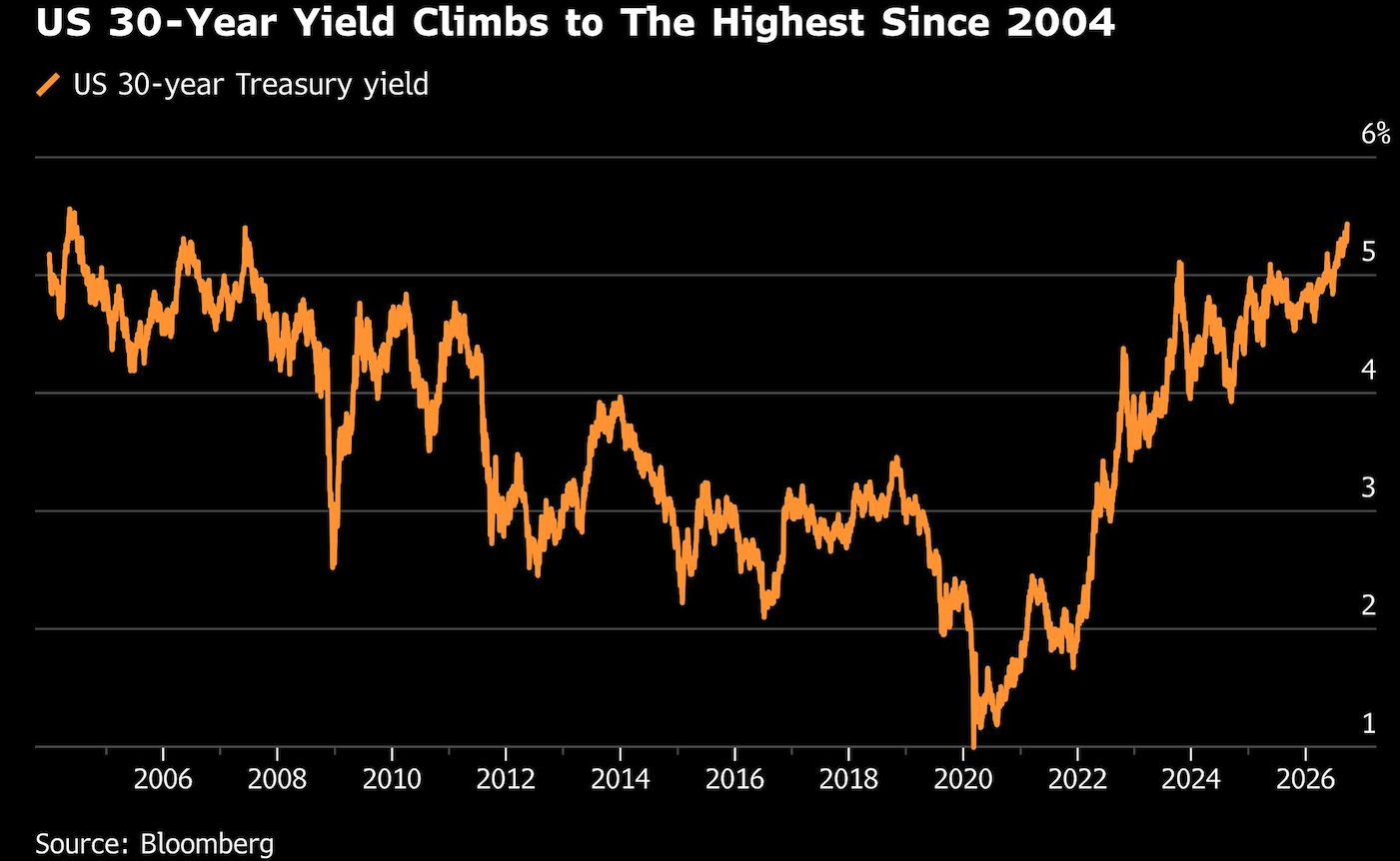
Yields on the US’s longest-dated bonds climbed to the highest level in more than two decades, the latest milestone in a global selloff driven by inflation fears and concern about government debt burdens.
A fresh jump in oil prices on Thursday lifted the rate on 30-year Treasuries by as much as four basis points to 5.44%, its highest since 2004. European yields were also on the rise, while those on Japan’s government debt hit levels last seen in 1996 as the market reopened after a three-day break.
The average yield on government debt worldwide now stands within a whisker of 4%, the highest since 2007, Bloomberg’s Global Aggregate Treasuries index shows. It’s another reminder of the end of the low-yield era as markets contend with the inflationary impact of the war in Iran, a robust US economy and a torrent of bond sales from governments and tech companies.
“It’s rare you get a move like this in bonds,” said Dave Aspell, co-chief investment officer at Mount Lucas Management LP, who is short 10-year bonds in the UK, Germany, Canada, Japan and the US. “The Fed has hiked again, inflation is clearly not at target. The economy is doing okay and there’s a large amount of government spending.”

The rise in borrowing costs is pressuring US President Donald Trump ahead of the November midterm elections, as dissatisfaction over lofty mortgage rates and the cost of living mounts. He’s called for US interest rates to be “1%, or less” and criticized what he called a “hostile” Fed board for the decision to raise rates earlier this month.
Treasury two-year yields have climbed over 150 basis points since the start of the US-Iran war, while those on the 30-year are up over 80 basis points.
The continued yield rise undercuts the Treasury Department’s efforts to bring down long-term borrowing costs: Treasury Secretary Scott Bessent expanded the government’s bond buyback program in mid-August in an effort to ease pressure — though it’s had little sustained impact in the market.
See more: Higher Yields May Be More Structural Than Cyclical
A five-year US debt auction this week ranked as the second-worst by one measure in data recorded since 2018, drawing the highest yield since 2006 and showing the pressure on Washington as it faces the rising cost of servicing around $40 trillion of debt.
A seven-year note auction is ahead Thursday at 1 p.m. New York time, followed an hour later by the second expanded buyback operation. The $44 billion auction is indicated to draw a yield near 5.05%, exceeding all previous results for sales of the tenor since its 2009 reintroduction.
The buyback operation targets as much as $6 billion of debt maturing in 20 to 30 years, three times as much as originally planned. The first expanded buyback on Sept. 10, targeting $6 billion maturing in 10 to 20 years, netted only $5.2 billion, and deepened a selloff as it reinforced doubt that buybacks can contain rising yields.
Given the forces at play, “bonds are actually behaving rationally,” said Amy Xie Patrick, a money manager at Pendal Group.
US five-year yields topped 5% on Wednesday for the first time since 2007, while those on 10-year jumped the most since the Liberation Day tariff shock in April 2025. Strong economic data and surging oil prices prompted traders to ramp up bets on further Federal Reserve tightening.
Strategists at JPMorgan Chase & Co. and KKR & Co. see scope for US yields to climb further as energy-driven inflation, heavy government borrowing and the risk of additional central-bank tightening continue to percolate.
What Bloomberg Strategists Say...
Investors aren’t rejecting Treasuries because inflation credibility is collapsing, but because the real policy and term-premium outlook still demands a larger concession.
— Alyce Andres, Markets Live strategist
Swaps now fully reflect three quarter-point hikes over the next year from the Fed, with significant hedging for a fourth.
Global Moves
The selloff hoisted yields on German 10-year bonds to 3.59%, the highest since 2009, while Japanese 10-year yields climbed about 10 basis points to 3.09%.
Global government bonds have lost around 2.4% this year, compared with a 6.8% gain last year, according to the Bloomberg index. The gauge posted its biggest one-day loss since May on Wednesday, rising eight basis points to 3.99%, the latest data available shows.
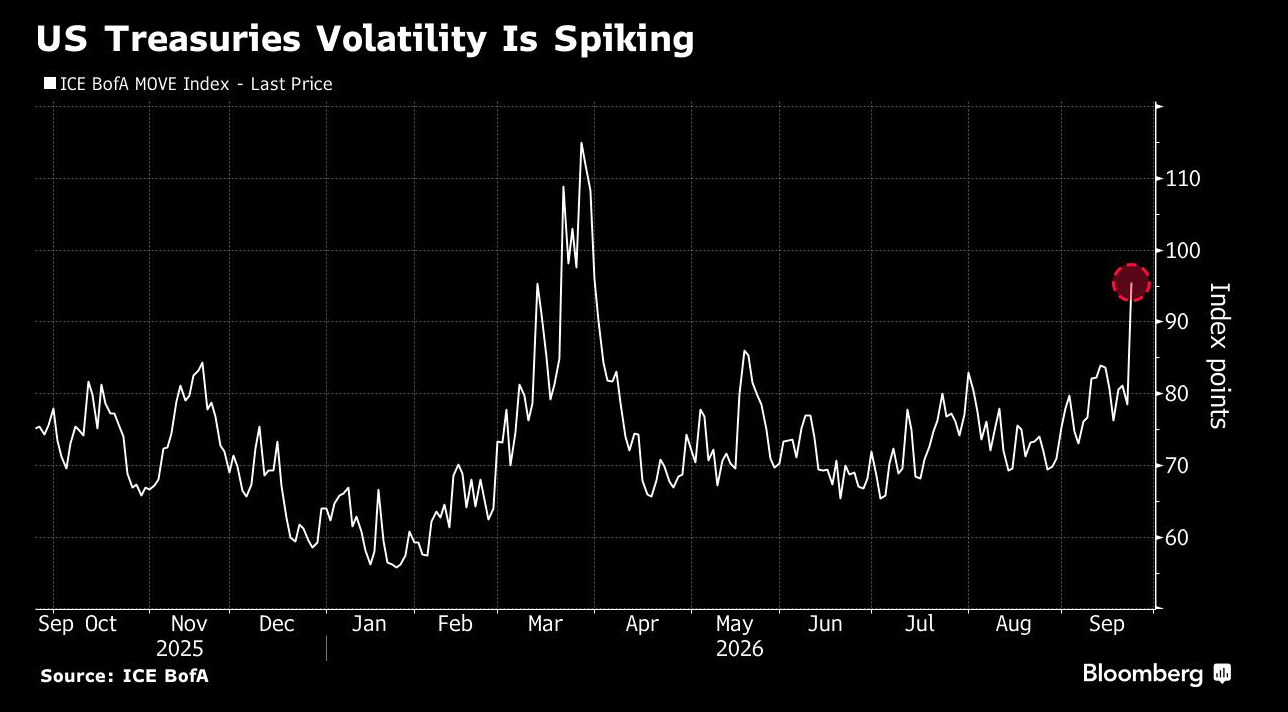
Rising volatility is adding to the gloom, making investors more hesitant to step in even as higher yields make bonds more attractive. The ICE BofA MOVE Index, which measures US bond market swings, climbed Wednesday to the highest level since March.
“Most fixed income will like higher yields, but want them to be stable there,” said Hans Mikkelsen, strategist at TD Securities.
Investors are “afraid of catching a falling knife,” he said.
A message from Advisor Perspectives and VettaFi: Discover something new! Click here to register for our upcoming webcasts.
Bloomberg News provided this article. For more articles like this please visit
bloomberg.com.
Read more articles by Alice Atkins, Ruth Carson