Signs of resilient economic momentum are reinforcing the bull case for US small caps, which have been under pressure lately in the face of soaring borrowing costs.
For these stocks, whose fortunes are most tied to the domestic economy, manufacturing is the macro indicator with the biggest impact on relative performance, according to Bank of America Corp. And there, things appear to be moving in the right direction, with data in October showing factory activity expanded for a ninth consecutive month, the longest stretch since 2022.
That’s good news for companies in the Russell 2000 Index that derive more than two-thirds of their sales at home. Couple that with signs the group is sitting at the lowest valuations in four months, and small caps may be ripe for a rebound.
“Small and mid caps are very historically cheap versus large and mega caps,” Jill Carey Hall, a strategist at Bank of America, said in an interview. Valuation is not necessarily a good short-term timing tool, she said, “but over the long term, it tends to be more predictive.”

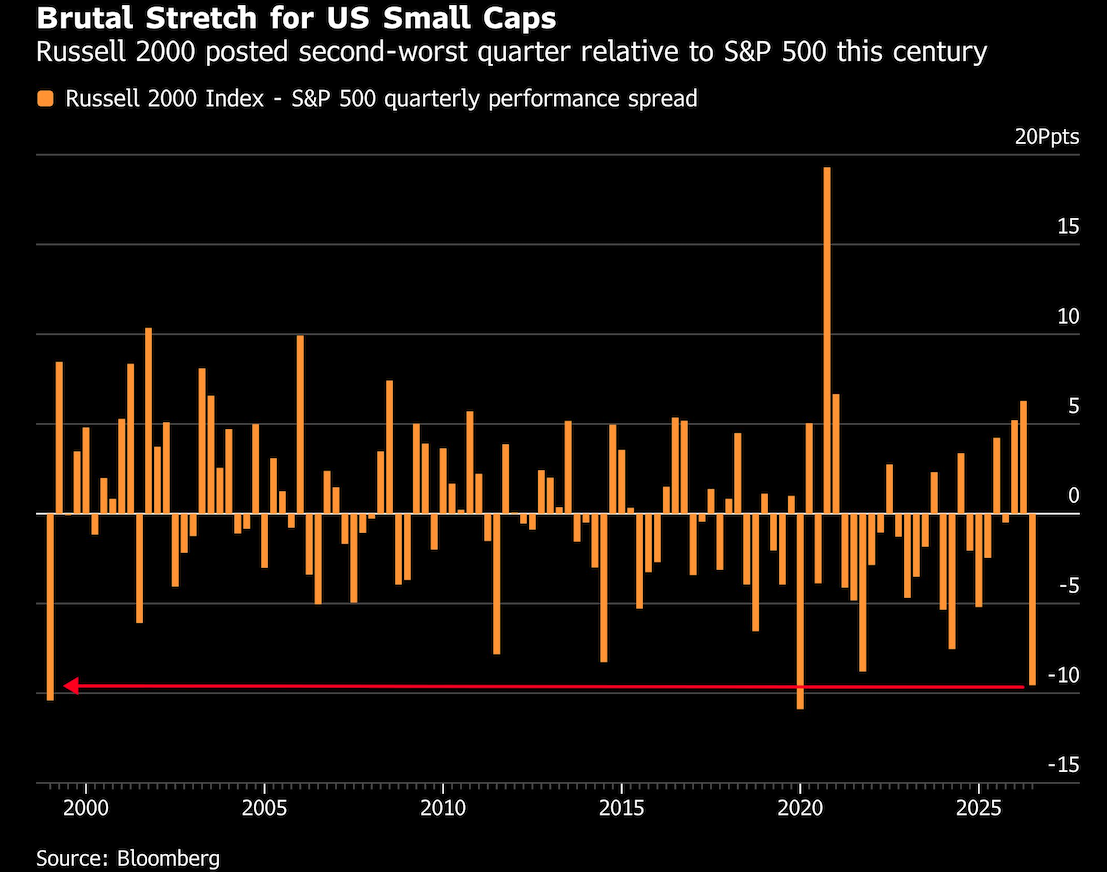
The view is a welcome respite for investors who just witnessed the Russell 2000 plunge 7.5% in the three months through September, its second-worst quarter this century relative to the S&P 500. The gauge dropped amid a combination of factors, including persistent inflationary pressures, an interest-rate hike and a breakout in Treasury yields that makes the cost of servicing debt more expensive.
The upcoming earnings season may provide another upside catalyst. A gauge measuring upgrades to revenue estimates in Russell 2000 companies relative to downgrades is sitting near the highest level since 2022, Nathaniel Welnhofer, a strategist at Bloomberg Intelligence, wrote in a note.
See more: From TINA To TIGA: Diversification Pays Again
Beyond the third quarter, small-cap sales are projected to outpace those of the S&P 500 by an average of 11.2 percentage points in the next four quarters, with earnings growth also expected to exceed large-cap peers, Welnhofer added.
Couple that with signs that the group’s balance sheets are in a much stronger position than in the past, and it may create additional momentum for the group, Steven Desanctis, a strategist at Jefferies, said in an interview. The debt-to-capital ratio of Russell 2000 companies is sitting near 33.9%, the lowest level since 2021, his data show.
The Russell 2000 fell 0.6% on Tuesday, widening its decline from an all-time high in August to 7.8%. The S&P 500 and Nasdaq 100 rose 0.6% and 0.5% each, closing at records.
This century, September has been the worst month of the year for the Russell 2000, with an average decline of 1.3%. The index fell 5.4% last month in the worst September since 2023.
For those expecting the momentum in small caps to pick up in the next few weeks, Christopher Jacobson, a strategist at Susquehanna, suggests traders buy $290/$300 call spreads on the iShares Russell 2000 ETF (ticker IWM) expiring at the end of October.
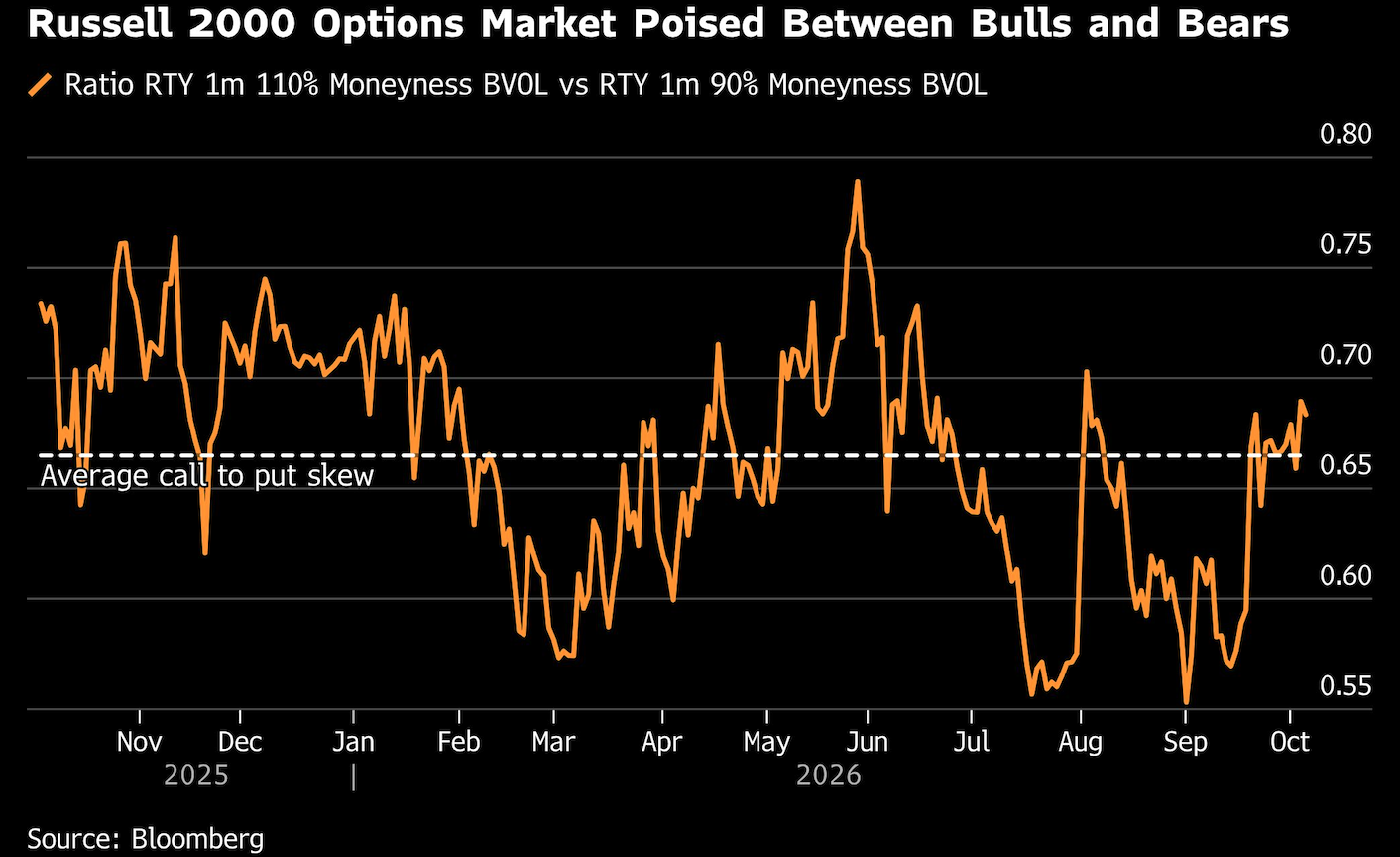
By one common measure of options sentiment — demand for calls that pay out on a 10% rise in the Russell 2000 relative to puts that protect against a similar decline — traders are largely ambivalent about what will come next for the index.
The so-called call-to-put skew is sitting just above average, indicating that sentiment remains well balanced between bulls and bears.
One of the biggest question marks for small caps is where interest rates are heading. While the S&P 500 has been able to withstand the pressure from the 10-year Treasury yield sitting near the highest level since 2002, small caps have been less fortunate. If the 10-year yield keeps advancing for the right reason — like a pick-up in economic growth — small caps can still outperform, DeSanctis said.
Small-cap investors will be laser-focused on the Fed’s next interest-rate meeting in late October. And minutes of the Fed’s September meeting, when policymakers raised rates for the first time in three years, are due on Wednesday.
“Small caps are plagued with the same reasons that are holding back the S&P 500 ex-mega cap,” Welnhofer said. “This earnings season could help the broader market, assuming it goes well, but without that, they’ll look for a less hawkish Fed.”
A message from Advisor Perspectives and VettaFi: Discover something new! Click here to register for our upcoming webcasts.
Bloomberg News provided this article. For more articles like this please visit
bloomberg.com.
More ETF Topics >