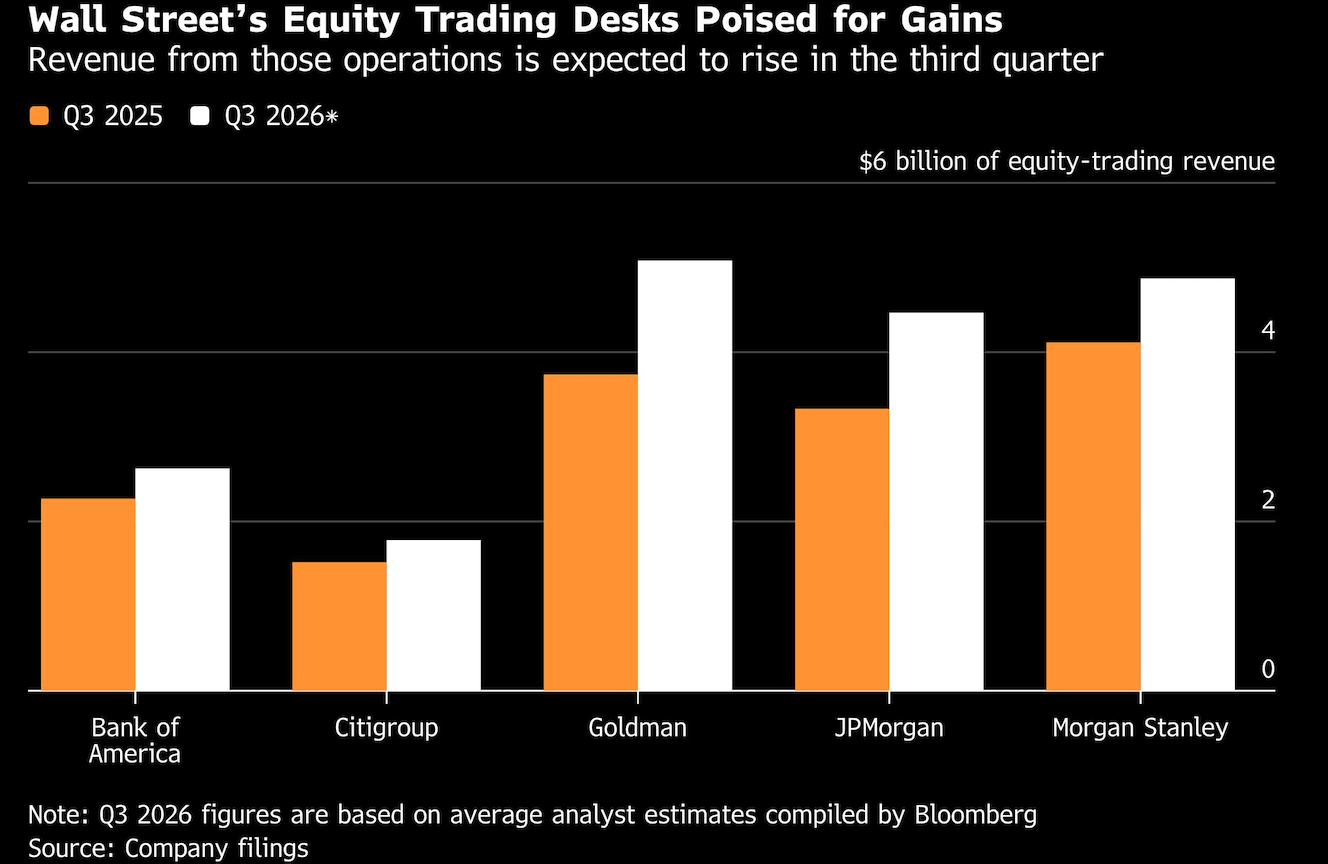
Wall Street’s biggest banks are expected to unveil a quarterly stock-trading haul of nearly $19 billion when the firms report earnings next week.
But a cooling in the capital markets is starting to draw a clear line: Some banks are starting to fare better than others. It’s a marked change from the first half of the year, when almost all of the five biggest US banks rode a wave of trading that kept both equity and fixed-income trading desks busy.
“For the first half of the year it’s almost like everybody won, and now that might not be the case,” Wells Fargo & Co. analyst Mike Mayo said. “There’s likely a wider dispersion this quarter between the winners and losers.”
Goldman Sachs Group Inc., which reports Tuesday, is expected to lead the pack with stock-trading revenue of $5.1 billion, followed by Morgan Stanley with $4.9 billion, according to analyst estimates compiled by Bloomberg as of the close of New York markets Thursday. Analysts are forecasting a $4.5 billion haul from JPMorgan Chase & Co. and $2.6 billion of revenue from Bank of America Corp.’s equity traders.

Other operations are facing pressure. Higher rates are weighing on fixed-income trading, which is expected to generate the lowest amount of revenue so far this year at five of the biggest banks. Rising rates also threaten to add more volatility to banks’ balance sheets.
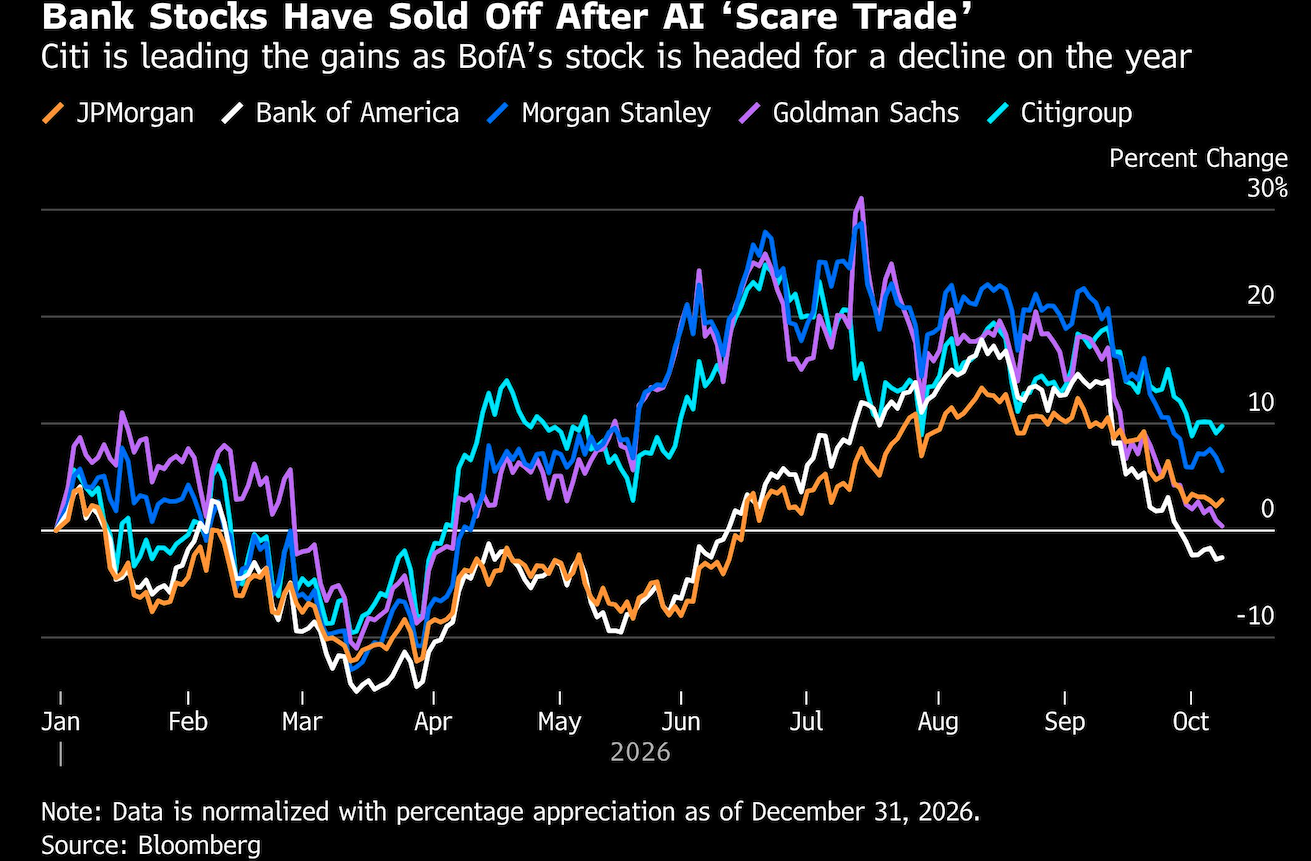
On top of all that, swirling fears about artificial intelligence — and how agents might direct deposits away from banks — has pushed some stocks down. The third quarter was the worst period for the KBW Bank Index since the first three months of 2023, when a regional bank crisis started sweeping through the US.
“The stocks have clearly sold off given concerns around capital markets revenue growth that’s slowed this quarter, concerns around higher funding costs, concerns around the AI-driven cash optimization tools,” Morgan Stanley analyst Manan Gosalia said.
See more: What a Less Dominant America Might Mean for Your Money
Fixed Income
Higher rates can be a boon to lenders if they translate into more interest payments from customers. But they’re making things harder for trading desks.
Fixed-income markets businesses at five of the biggest US banks are expected to generate more than $19 billion in revenue in the period, down from the more than $21 billion posted in the second quarter.
Bank of America’s stock ended up dropping sharply in mid-September when Chief Executive Officer Brian Moynihan warned that fixed-income trading was expected to be down in the third quarter.
At that time, Goldman’s David Solomon acknowledged that fixed income was softer than equity trading, which had remained “very strong.”
Bank of America analyst Ebrahim Poonawala forecasts that capital-markets activity for the second half of 2026 “will be markedly weaker” than in the first half, leading to questions on the “sustainability of the current capital-markets cycle,” according to a note.
With higher rates, banks are also confronting swings in the value of certain assets they hold. That impact, which filters through earnings via the firm’s so-called accumulated other comprehensive income, can create paper losses that lead to bumpy earnings reports.
Debt underwriting — another part of banks’ businesses that’s impacted by rising rates — has one silver lining with the flow of companies needing to refinance.
“When it comes to debt underwriting, there is a wall of refinancing over the next three years that’s to some degree baked in,” Mayo said. “But if rates continue to increase, that could hurt demand for bonds.”
Deal Pipeline
The pipeline of deals — and whether that can be sustained — has also emerged as a concern in recent weeks. Dealmakers are seeing signs of a slower third quarter with the value of announced mergers and acquisitions in the three months through September dipping roughly 10% from a year earlier, according to data compiled by Bloomberg.
Initial public offerings had been a particularly bright spot this year. In June, SpaceX went public in a record-breaking listing. Anthropic PBC is scheduled to meet prospective investors next week in preparation for its IPO, Bloomberg News has reported.
But some listings have faced hiccups. In September, Oura Inc. postponed an IPO. CVC Capital Partners-backed Bamboo Insurance Services Inc. also delayed its IPO.
When asked about the strength of the dealmaking pipeline, JPMorgan CEO Jamie Dimon hinted at a slowdown in the US compared with the first half of the year.
“If you talk about Europe’s IPOs, M&As activity pipe — it is pretty good,” Dimon said Tuesday in an interview on Bloomberg Television. “If you talk about the United States, there’s probably a little bit of a slowdown in September.”
For now, analysts expect JPMorgan to post a 15% gain in investment-banking fees from the same period a year earlier, while those revenues are expecting to climb 8.1% at Goldman and 1.9% at Morgan Stanley.
In September, Jefferies Financial Group Inc. offered the first glimpse of Wall Street’s earnings season with its investment bank and equity-trading desk pulling off a record quarter. But its fixed-income trading business saw a 26% decline in net revenue during the period.
Entry Point
Even as AI concerns swirl and batter stocks, the banks are still seeing the benefits of financing the industry’s expansion.
“This whole AI investment cycle is a multiyear investment cycle and it spans more than just the hyperscalers,” said Morgan Stanley’s Gosalia. “That’s going to help capital markets over multiple years.”
Analysts including Mayo and Gosalia said the AI “scare trade” with banks appears overdone, and with Wall Street poised to deliver another strong quarter, the stocks’ cheapness could be a win for investors.
“We see this selloff as an attractive entry point,” Gosalia said.
A message from Advisor Perspectives and VettaFi: Discover something new! Click here to register for our upcoming webcasts.
Bloomberg News provided this article. For more articles like this please visit
bloomberg.com.
Read more articles by Denitsa Tsekova