US stocks were higher after the market opened as Americans headed to the polls on Election Day, with control of both chambers of Congress at stake and investors weighing mounting risks to the artificial intelligence trade.
The S&P 500 Index gained 0.2% while the Nasdaq 100 advanced 0.6% as of 9:33 a.m. in New York, clawing back earlier losses. Technology shares attempted a rebound a day after entering a correction.
The election adds another layer of uncertainty to an already fragile market backdrop. Polymarket is pricing roughly a 95% probability of Democrats taking the House of Representatives and about a 77% chance of a Senate victory, pointing to a potential sweep of both chambers. The divergence between opinion polls and prediction-market expectations has drawn fresh attention as investors position for the outcome.
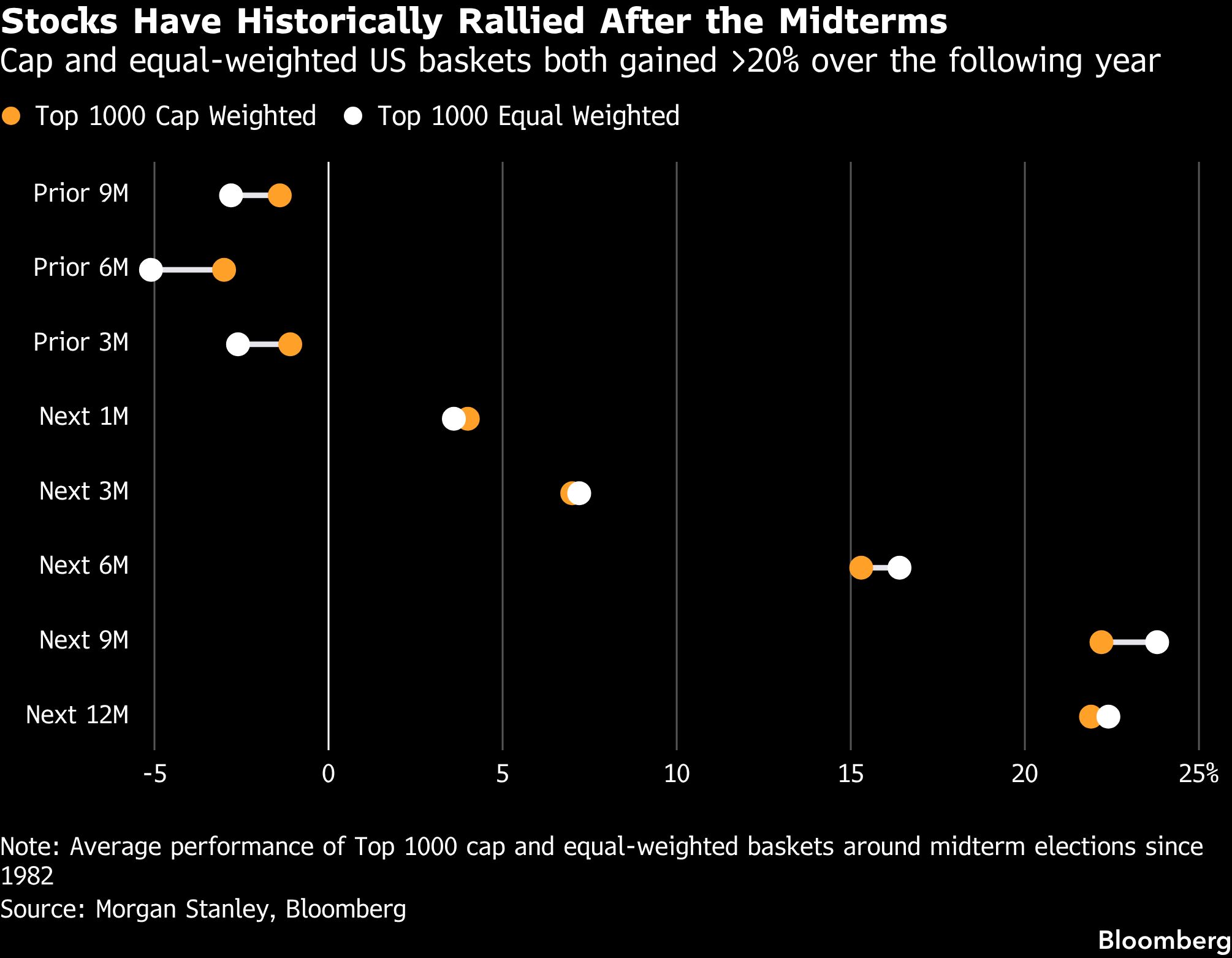
History, however, has generally favored stocks following midterm elections. Large-cap equities have gained about 15% on a market-cap-weighted basis and 16% on an equal-weighted basis in the six months after midterms since 1982, according to Morgan Stanley. Both measures have advanced roughly 22% over the subsequent year.
“For all the prognostications and reactions to tonight’s results, here’s the key stat to remember: While past performance doesn’t guarantee future results, since 1950, so 76 years, the S&P 500 has never been lower 12 months after a midterm election, and that is the most notable point of all for clients,” said Tom Essaye, founder of The Sevens Report.
To UBS Securities, US stocks may be poised for a year-end rebound as favorable seasonality and low hedge fund positioning set the stage for a potential rally after the midterm elections.
“Hyperscaler earnings clearly did not provide the all-clear investors were hoping for, but getting through the election could be the catalyst that unlocks a year-end squeeze,” Davide Montoni, Americas head of institutional equity derivatives and QIS sales at UBS Securities, wrote in a note to clients.
Still, investor positioning suggests caution is building. Investors added a further $9.6 billion in net new short positions in S&P 500 futures last week, bringing overall positioning close to neutral, according to Citigroup strategists. Nasdaq futures saw a similar trend. Positioning in Russell 2000 futures improved, driven by short-covering and suggesting investors have become less bearish on US small-cap stocks, Citi strategists led by David Chew said.
Concerns about the sustainability of AI spending are adding to the unease. As tech heavyweights increasingly turn to bond markets to finance their AI investments, some of the world’s largest asset managers are warning that the boom risks is developing into a bubble. Pacific Investment Management Co. Chief Executive Officer Emmanuel Roman and Bain Capital Chair John Connaughton are among investors flagging the possibility of an eventual downturn following the sector’s rapid expansion, even as Wall Street executives continue to tout its long-term potential.
In single stocks, Apple Inc. added to the pressure after its latest quarterly results disappointed on several key metrics, including revenue in China. Yum! Brands Inc. shares rose as RBC says Taco Bell’s third quarter comparable sales drop of 4% is better than the buyside feared. Palantir Technologies Inc. share tumbled after the software company issued a quarterly outlook that pointed to a potential slowdown in sales growth.
The earnings backdrop has remained relatively resilient. Companies representing about 70% of the S&P 500’s market capitalization have reported third-quarter results, with 84% beating earnings estimates and 13% missing expectations.