Democrats’ midterm sweep gives them a good chance of keeping control of the Senate until at least 2032, about the time when Social Security is due to exhaust its trust fund. Barring new legislation, the government will then be forced to slash benefits by 22%.
Social Security is known as the third rail in politics because it’s the primary source of income for many retirees. Neither party wants to admit that restoring solvency in an equitable way involves cutting benefits and raising taxes. Vermont’s Bernie Sanders, who is in line to chair the Senate’s Social Security subcommittee come January, recently tweeted his preferred solution: Increasing benefits another $2,400 and scrapping the cap on the payroll tax so “the wealthy pay their fair share.”
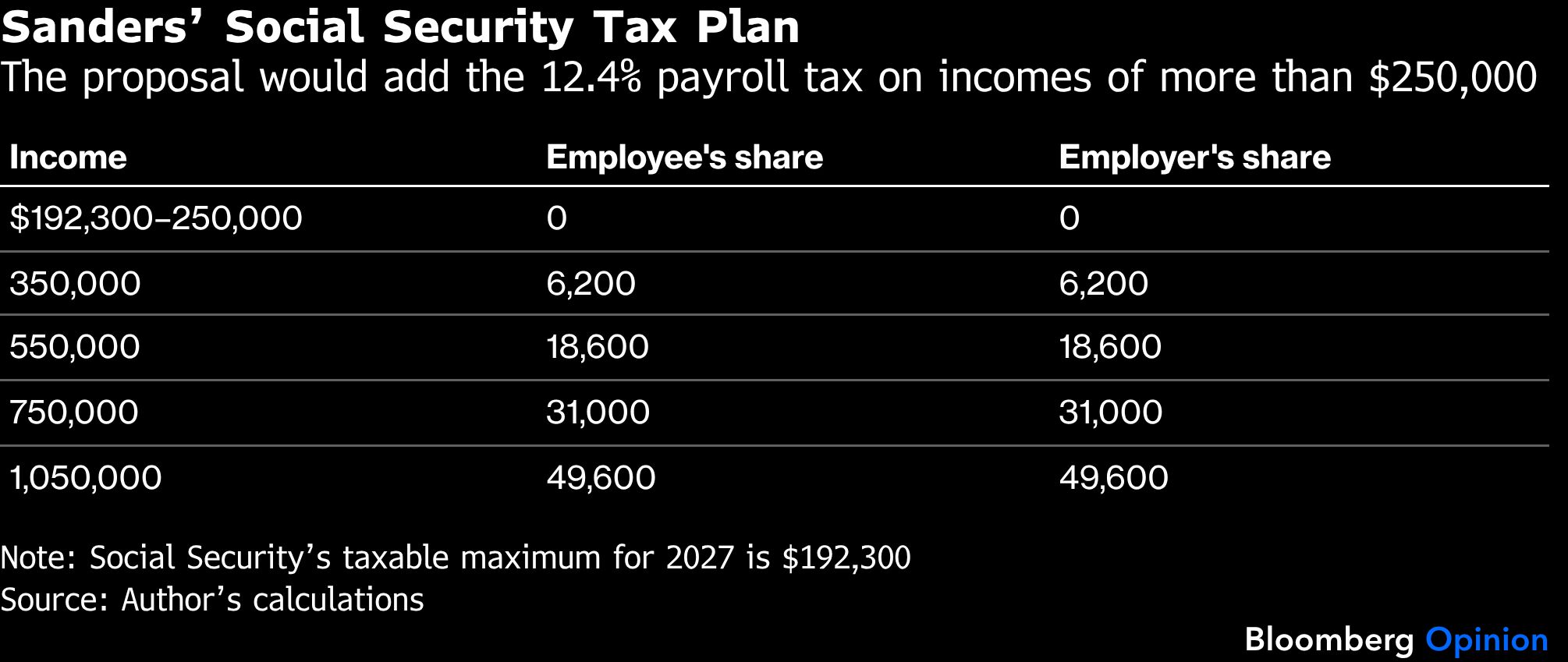
Sanders’ Social Security Expansion Act, introduced last year, would apply the 12.4% payroll tax to incomes of more than $250,000 (versus the existing approach, which caps social security payments in 2027 on incomes of $192,300 or more). Under both the Sanders plan and the existing approach, employees and employers each pay 6.2% of the payroll tax (self-employed taxpayers pay the full amount).
See more: Age Isn't Just a Number
Here’s my calculation of what the impact of a Sanders increase would be on a series of high-income taxpayers. I handled this in a straightforward way: I multiplied the difference between $250,000 and each higher income bracket by 6.2%. Voila:

Sanders’ full proposal would tax some investment and business income as well and amount to one of the largest marginal-tax-rate increases in American history. It’s true that someone earning $350,000 a year can probably afford to pay more in taxes. And if financing Social Security was our only budget priority, this could be a defensible idea. But Sanders’ proposed increase is so large that it would not leave much room to raise taxes for other priorities such as healthcare, childcare or infrastructure.
An additional 6.2% is not nothing, but economists argue that what matters for a worker’s well-being is their take-home pay, not just the deduction they see on a pay stub. Studies (here and here) have shown that eventually a worker pays the employer’s share of taxes, too.
For a company, an increase in the payroll tax makes labor more expensive, and that money must come from somewhere. Maybe higher-paid workers see only 6.2% taken out of their check the first year, but as time goes on, either wages will grow more slowly, 401(k) matches will shrink, or there will be fewer jobs. However it plays out, workers will bear the costs of most of the 12.4% tax, which is why the Congressional Budget Office assumes payroll taxes are paid by workers one way or another.
If there is a ceiling on how much we can tax the rich before it changes behavior and weighs on economic growth, then the US needs to have a debate about how to deploy this limited capacity. Many young people already feel short-changed as they struggle to find good work, raise a family and afford housing.
Sanders argues that the levy would be borne by just 9% of American households. But those who feel the full incidence would pay 53.2% in federal taxes alone; if they live in a high-tax state such as New York or California, that would rise to more than 60% of earnings.
At lower levels, you can increase taxes without changing behavior and economic growth too much. But at more than 70%, taxes start to reduce the incentives to work and invest, or people just go to great lengths to avoid paying.
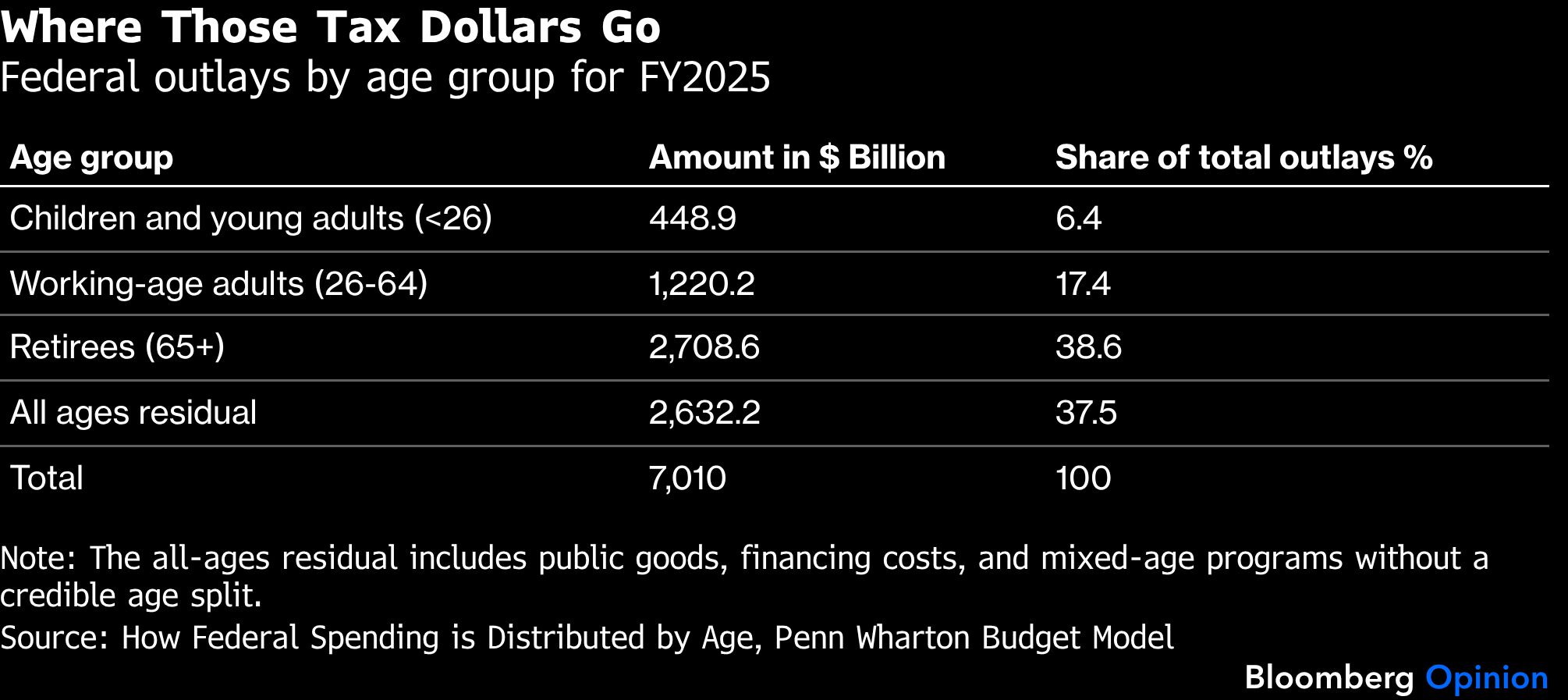
Spending on retirees already takes a substantial share of gross domestic product. Meanwhile, 14.3% of American children live in poverty compared with 9.9% of people over 65, since the latter group gets full health coverage under Medicare and many have substantial savings from their 401(k). Close to $5.6 trillion in social security and Medicare benefits, for example, will be paid over the next decade to seniors with pre-benefit incomes of more than $100,000, according to the Brookings Institution.
Perhaps some of that money is better spent on investing in infrastructure and education, or expanding the child tax credit, or restoring subsidies on health insurance for working people. The US also already has an enormous amount of debt that needs to be paid off, while rising interest rates make those borrowings more expensive to service.
Social Security remains a problem to be solved, but a more equitable approach involves raising taxes on higher earners (more like 2% on incomes above a certain threshold, not 12.4%) and increasing the base tax on everyone by a percentage point to 13.4%. Other ideas include changing the formula used to calculate Social Security benefits when people retire, so they grow with inflation rather than wages. There will also need to be benefit cuts for higher earners and an increase in the retirement age. Ideally, these changes would be phased in so people have time to adjust.
The hard truth is that to sustain the state we have, let alone the one many voters want, everyone will end up paying more — not just higher earners. An aging population is putting a bigger burden on young workers already, it would be reckless and irresponsible to burn what taxing capacity we have left to extend even more money to retirees.
A message from Advisor Perspectives and VettaFi: Discover something new! Click here to register for our upcoming webcasts.
Bloomberg News provided this article. For more articles like this please visit
bloomberg.com.
More ETF Topics >