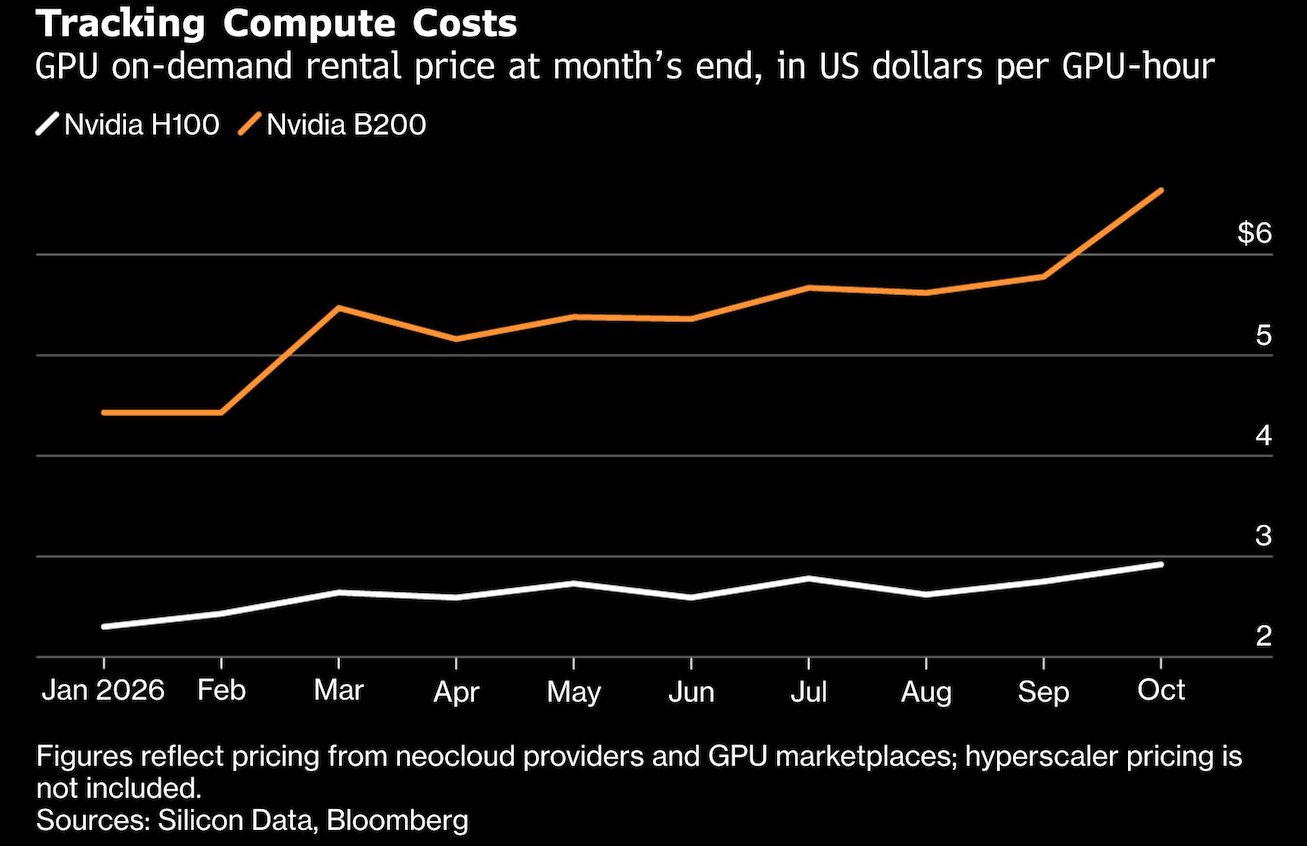
Fund managers are racing to launch products for trading a market that doesn’t exist yet.
Earlier this year CME Group Inc. and Intercontinental Exchange Inc. each unveiled plans to build a futures market for compute: the processing power in data centers used to train and run artificial intelligence models. It’s a business dominated by closed-door deals involving the world’s most valuable tech giants. But as companies anticipate ever-greater capacity needs and make business plans around the price and availability of compute, the case for treating it like a commodity has grown.
A futures market would allow businesses buying processing power to fix their future costs, and sellers to lock in future cash flows. In theory, it could lower costs in the long run by making markets more efficient.
But building a financial market around compute has another appeal. It could give investors eager to get in on the AI trade a new way to play it. When the plans for compute futures were announced, phones at CME started ringing almost immediately, and one type of client kept turning up on the other end: exchange-traded fund issuers. ETFs, because they trade like stocks, are easy for retail investors to access compared with futures. “As soon as we announced that we were developing this contract, I had calls from 10 different ETF providers,” Peter Keavey, the global head of energy and environmental products at CME, said at the Dow Jones Energy Forum in October. “ ‘Hey, I want my ETF out there first. What’s your date?’ ”
Roundhill Financial, Grayscale Investments, GraniteShares ETFs and ProShares are among the firms that have filed prospectuses for products tied to yet-to-be-approved compute futures. It’s unclear how long they’ll have to wait: In November the US Commodity Futures Trading Commission extended its review by two months, Bloomberg reported.
The ETF managers are jockeying for a foothold in a market where being first is a matter of make or break. Compute would be rare new territory in an ETF arena congested with funds that focus on every asset class, industry and investing fad imaginable. Laggards will need to try harder to carve out a niche. “And if you can’t, you have to figure out over time if it’s worthwhile to stay in the market,” says Steve Vanourny, the head of index at Grayscale.
See more: A New King of Dividend ETFs
But winning over investors will require a product fitting a market still shrouded in regulatory and pricing uncertainty, just as massive Democratic wins in the US Congress and questions surrounding Jensen Huang’s departure as chief executive officer of chipmaker Nvidia Corp. add to doubts about the durability of the AI boom.
TODAY, THE COMPUTE market works like this: A provider operates a data center packed with graphics processing units, the computer chips that drive AI technology. The chips vary by age and bandwidth. CME has planned contracts to track rental costs for Nvidia’s H100 and newer B200 GPUs. Rather than purchase the actual hardware, compute buyers—typically AI companies or labs—rent processing capacity priced for a specified period of time.
Demand for that capacity has been ballooning. But while compute shares some traits with mature commodity markets—most obviously power trading’s use-it-or-lose-it quality—the connective tissue linking physical transactions to financial flows isn’t as developed yet.
Existing indexes don’t capture the private deals that analysts say make up an overwhelming majority of the market. That means in theory a mammoth agreement between Anthropic PBC and Amazon.com Inc. could reshape the economics of compute without ever registering in the spot prices that futures are meant to track. “Those are big chunks of compute, and those are quite intransparent deals,” says Antti Belt, who leads Boston Consulting Group’s technology and AI topics in commodity trading.
Steve Hou, the head of research at Silicon Data, which provides indexes on compute prices and is working with CME, says that situation isn’t so unusual. Natural gas and corporate loans are often traded between two parties, but the markets are still tracked by well-known indexes. Hou says that his company’s indexes also incorporate transaction data beyond posted prices.
ETF buyers will also have to navigate the complexities of the funds themselves. Grayscale’s Vanourny says that his firm is refining features like tenor, or the time remaining until a contract expires. “There’s only so much you can do until you get visibility into both timing and exactly how the futures will be constructed,” he says. Rival GraniteShares has filed for three ETFs: one linked to H100 GPUs, another to B200s and a third tracking a blend of the two, according to founder and CEO Will Rhind. The instinct to differentiate is survivalist, because when two nearly identical products launch side by side, it all but guarantees that one will eventually disappear.

The cycle of obsolescence is familiar in the ETF world. More than 1,100 new products entered the market this year through early November, the most ever for a comparable period. Trading volume also hit a new yearly high, yet those flows were overwhelmingly dominated by the ETF giants. “Everybody else is fighting over the scraps—I mean, the scraps are huge,” says Bloomberg Intelligence analyst James Seyffart, alluding to the US ETF market’s more than $16 trillion value. The average ETF that liquidated this year had a life of only one year and nine months, down from three years and six months in 2025, according to a BI analysis.
INVESTORS IN compute ETFs will be wading into an entirely untested futures market. They may have to ride price moves on the order of several-cent ripples or multidollar waves—no one yet knows. If it’s any indication, 30-day average volatility for Silicon Data’s B200 Rental Price Index was hovering just above 25%, about half that of the Brent crude oil contract and roughly the level of the S&P 500 as of early November.
What’s more, ETF holders could lose money each time contracts roll over if the forward curve of contracts has an upward-sloping shape. That dynamic, called negative roll yield, happens when contracts further out on the curve are more expensive than the expiring ones so that funds have to pay up to roll over their exposure.
A cautionary tale for new tech asset classes is the broadband venture of energy giant Enron Corp., which collapsed in 2001 after its accounting fraud surfaced. During the dot-com boom, it sought to turn fiber-optic bandwidth into a tradable commodity. After the bubble burst and trading dried up, Enron adopted a new way of measuring volume that vastly overstated the market’s size. One difference then: Enron was developing both the product and the market for it.
For all the risks and complexity, though, optimism is running high. “This is obviously the beginning and by no means the last thing that will be created,” says Silicon Data’s Hou. “We’ll have more evolution toward actual physically linked compute futures as this market evolves.” The hope is that a rapid ETF rollout draws in speculators, seeding the liquidity needed to lure commercial hedgers and establishing the bona fides of compute futures. And if anyone is accustomed to adapting on the fly, it’s the ETF providers whose businesses depend on it.
A message from Advisor Perspectives and VettaFi: Discover something new! Click here to register for our upcoming webcasts.
Bloomberg News provided this article. For more articles like this please visit
bloomberg.com.
More Volatility/Downside Protection Topics >