US Treasuries fell as investors hit the brakes on haven-buying as the return of Jensen Huang at the helm of Nvidia Corp. buoyed the stock market.
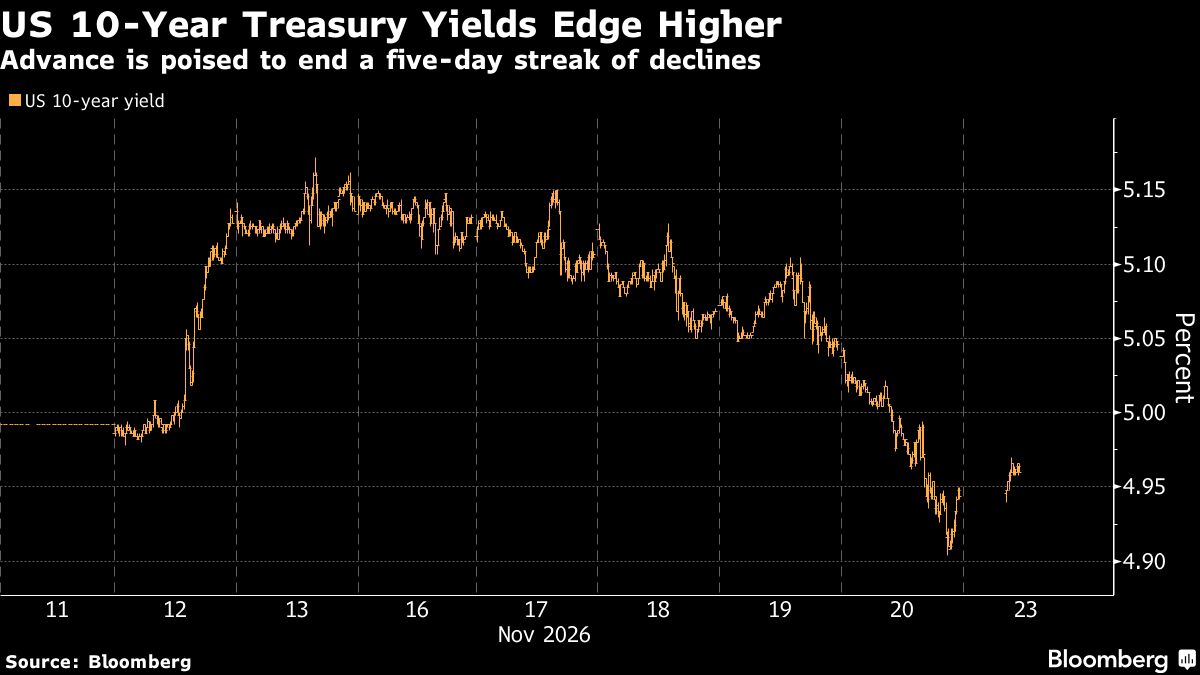
The declines on Monday pushed yields higher across maturities, with those on two-year notes up some six basis points to 4.71%. Benchmark 10-year yields were poised to snap a five-day streak of declines, rising two basis points to 4.96% after dropping 10 basis points on Friday.
Stock dip buyers had emerged in early trading, boosting US equity futures and drawing some investors away from the safety of Treasuries. After Huang was reinstated as Nvidia’s chief executive officer, shares of the giant chipmaker soared 30% in early trading. Futures on the S&P 500 climbed 4.7%. Nasdaq 100 contracts were halted for volatility after a 7% jump.
“Last week’s AI selloff pushed investors into Treasuries,” said Anna Wu, an investment strategist and founder of Floodlines Research. Now, “some of that safety bid is coming out.”
Huang’s reappointment at Nvidia was based on input from “senior levels of the US government,” showing how important the company has become to officials seeking to maintain a strong outlook for US economic growth.
European equity markets were mostly higher. Asian stock indexes closed broadly lower even after authorities across the region raced to put a floor under falling share prices, with measures including widening curbs on short selling and an easing of margin requirements.
Meanwhile, European bonds were mixed, with French bonds rallying after President Emmanuel Macron told Le Figaro newspaper he would consider trying to adopt a “golden rule” to help rein in budget deficits.
Price Reversal
Treasuries had rallied on Friday as a slump in stocks prompted traders to pare wagers for Federal Reserve interest-rate hikes. Two-year yields fell 20 basis points last week, the biggest decline since August 2025, as markets ceased to fully price in a quarter-point rate increase at next month’s FOMC outcome.
On Monday, traders added back some of those wagers on monetary tightening. Futures again reflect traders fully pricing a Fed quarter-point rate hike in December, though the chances of a larger half-point hike are seen as low.
“We don’t see how the Fed can deliver a 50bp hike in December, or Warsh delivering a hawkish press conference,” said Mohit Kumar, chief economist and strategist at Jefferies. “In our view the December FOMC should mark the peak in Fed’s hawkishness and that should clear another hurdle for risky assets.”
US Treasuries returned 1.3% last week, their biggest five-day gain since April 2025, according to a Bloomberg total return index.
Despite the bounce in US equity futures, some analysts remain wary about the durability of the AI trade and warn that a renewed decline may have far-reaching implications.
“If the selloff across global assets persists into this week, it could shift the calculus of central bank policy at the margin, whereby the Fed and the European Central Bank may have to tone down their hawkish rhetoric,” said Cedric Chehab, chief economist at BMI, a Fitch Solutions company. “Emerging-market central banks may have to adopt a slightly more hawkish stance.”
Strategists at Bank of America Corp. and BMO Capital Markets have been steadfast in their backing of so-called curve-flattening trades, wagering that short-maturity Treasuries will underperform their longer-dated peers. The idea is that continued Fed rate hikes will push up short-dated yields, while the resulting drag on growth and inflation eventually pulls down longer-term borrowing costs.