Avoiding down days in the stock market often means missing out on the biggest single-day gains. Those who cashed out after US equities reeled last week just learned that lesson the hard way.
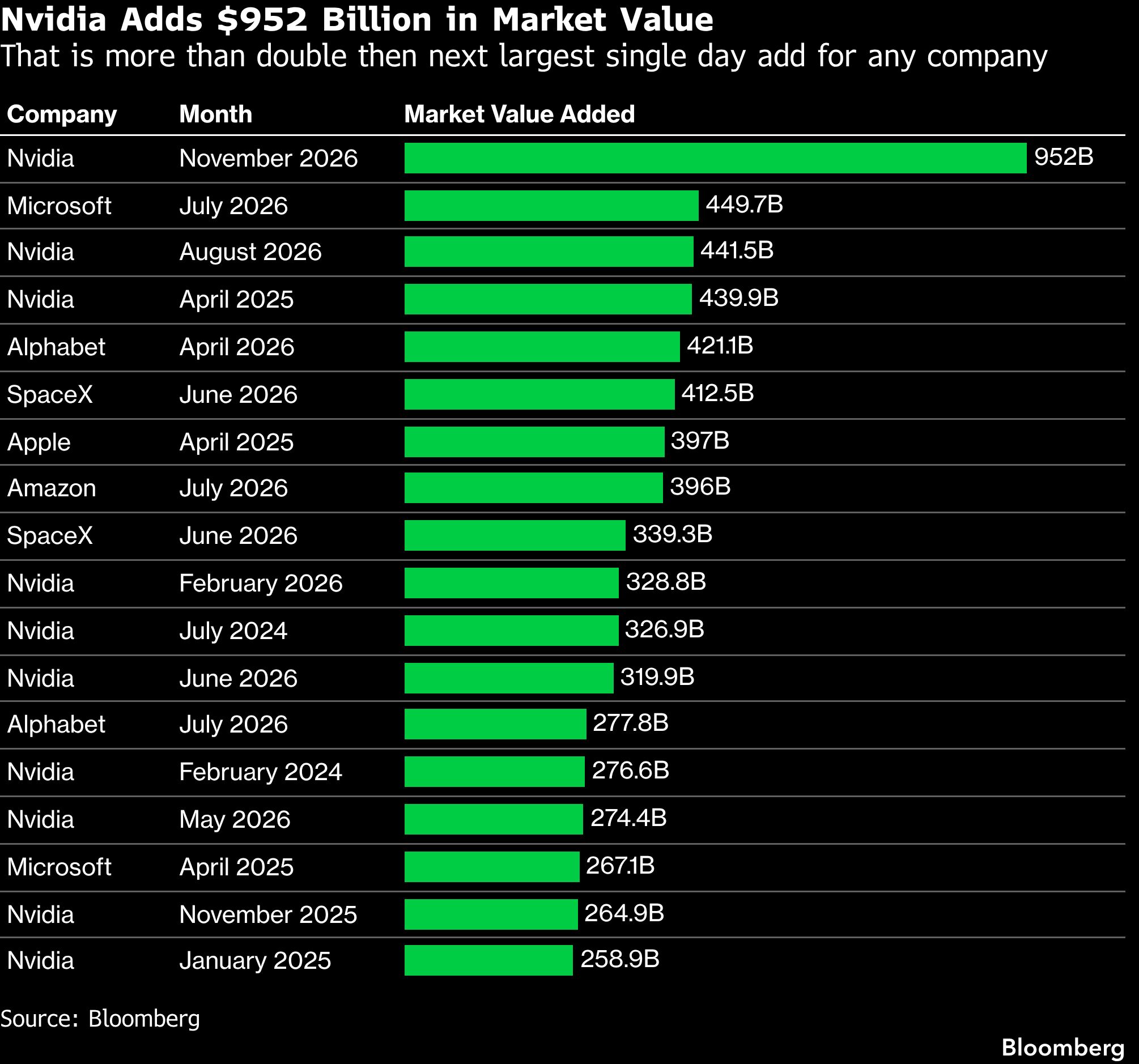
Timing the market is hard enough on normal days, let alone in sessions when trillions of dollars get wiped out, then restored by headlines that have little to do with the fundamental backdrop. After dropping 5.6% on Friday, the Nasdaq 100 jumped 6.7% on Monday as Nvidia Corp.’s board reinstated Jensen Huang as the company’s chief executive officer, in what was among the sharpest reversals going back 40 years ago. Futures on the gauge lost 2.4% on Tuesday as the Wall Street Journal said the US is preparing to raise tariffs on China.
See more: The Free Money Bubble
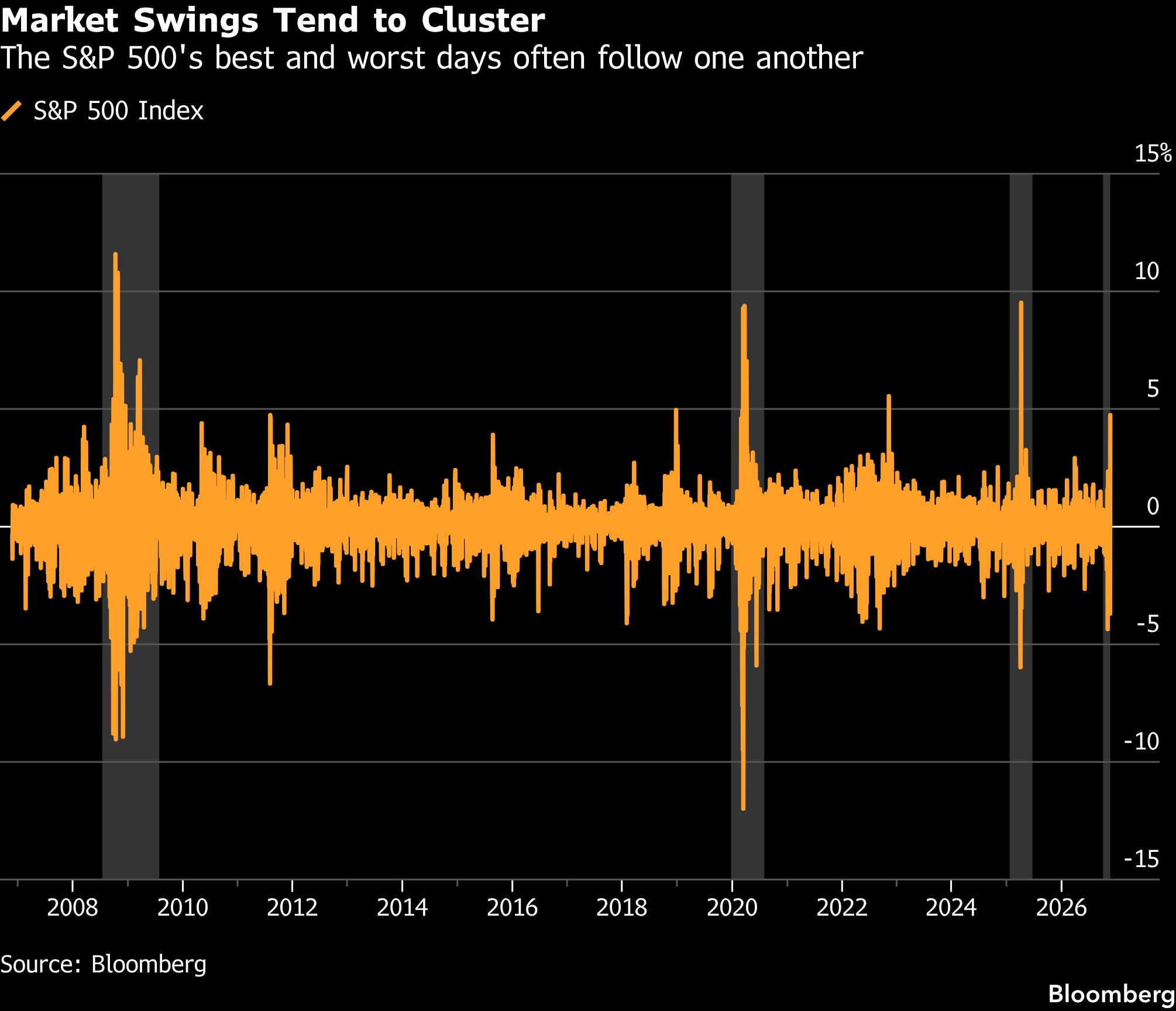
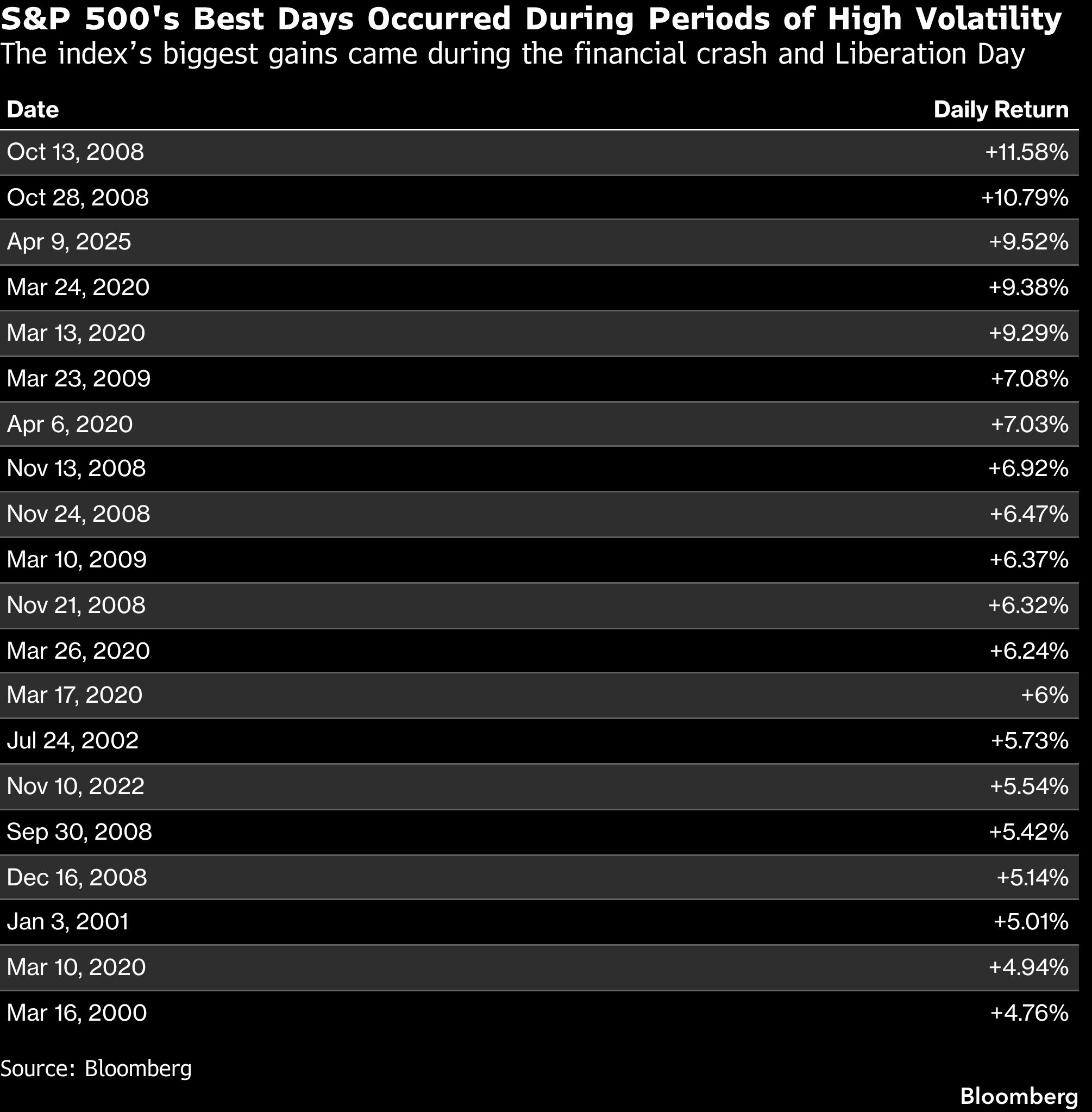
Big single-day drawdowns and rebounds are often clustered together, and the best way to capture the market’s strongest bounces could be by suffering through its biggest drops. Skipping just the 10 biggest up sessions in the S&P 500 Index this century would have reduced the gauge’s annualized return by half, data compiled by Bloomberg show, a penalty that could put an investor’s career at risk.
“Time in the market is more important than timing the market,” said Chris Galipeau, head market strategist at Franklin Templeton Institute. “You don’t have to make one right decision, you have to make two: you have to make the exit and the entry.”

Clusters of sharp swings in either direction have been a consistent phenomenon for decades. Data compiled by Hightower Signature Wealth in May showed that $10,000 invested on the last day of 1999, before the dot-com crash, the financial crisis and the Covid-19 pandemic, would be worth more than $75,000. But those who wanted to sell during those drops, and therefore miss some of the biggest upswings, would have their principal grow to just $33,000.
Some on Wall Street think volatile drops and bounces have become more common in recent years, making the advice of staying invested both more important but also harder to follow.
“I’ve been doing this a long time, and in the last five to 10 years, the markets have been way less accommodative in letting people back in,” Michael Wilson, chief US equity strategist and chief investment officer at Morgan Stanley, said in an interview. “When you make these lows, they really are like the bottom, and they just go straight up, they let nobody in.”
Those who sold their holdings when the war in Iran broke out in March 2026, or when President Donald Trump rolled out tariffs in the spring of 2025, or when China’s DeepSeek app sparked a rout in US tech giants in January that year, or when markets got pummeled during the darkest days of the Covid-19 pandemic, know this all too well.
The challenge for investors is that major swings like the one US equities posted in the last two sessions are more common in bear markets than they are in rising markets, said Jonathan Krinsky, chief market technician at BTIG LLC. And in the short-term, investors are often left worse off.
Historically, days when the S&P 500 jumped more than 4% while trading below its 200-day moving average have preceded a decline of another 2.1% in the next five days, on average, his data show.
“I’m not calling it a bear market but I don’t think we’ve seen the final bottom,” he said by phone.
Longer-term, the data is fairly compelling. Stockholders that remained invested in the market from 1995 to 2025 enjoyed an average annual return of roughly 8.4%, according to a report from the Wells Fargo Investment Institute in 2025. But those who sold during periods of weakness and missed 30 biggest single-day gains saw their average annual return drop to 2.1%. Missing out on 40 of the best trading days cuts those returns to just 0.7%.
Morgan Stanley’s Wilson sees the huge pop in equity indexes Monday as a “classic reflexive move after a washout.” Although Wilson said he’s “a buyer of any kind of pullback” at this point, investors still need to be cautious, he said.
“These are fast moving markets, you’ve got to be careful,” Wilson said. “Just like selling out everything on Friday was a bad idea, buying everything on day one is probably not a great idea, so pick your spots.”
A message from Advisor Perspectives and VettaFi: Discover something new! Click here to register for our upcoming webcasts.
Bloomberg News provided this article. For more articles like this please visit
bloomberg.com.
More Fixed Income Topics >