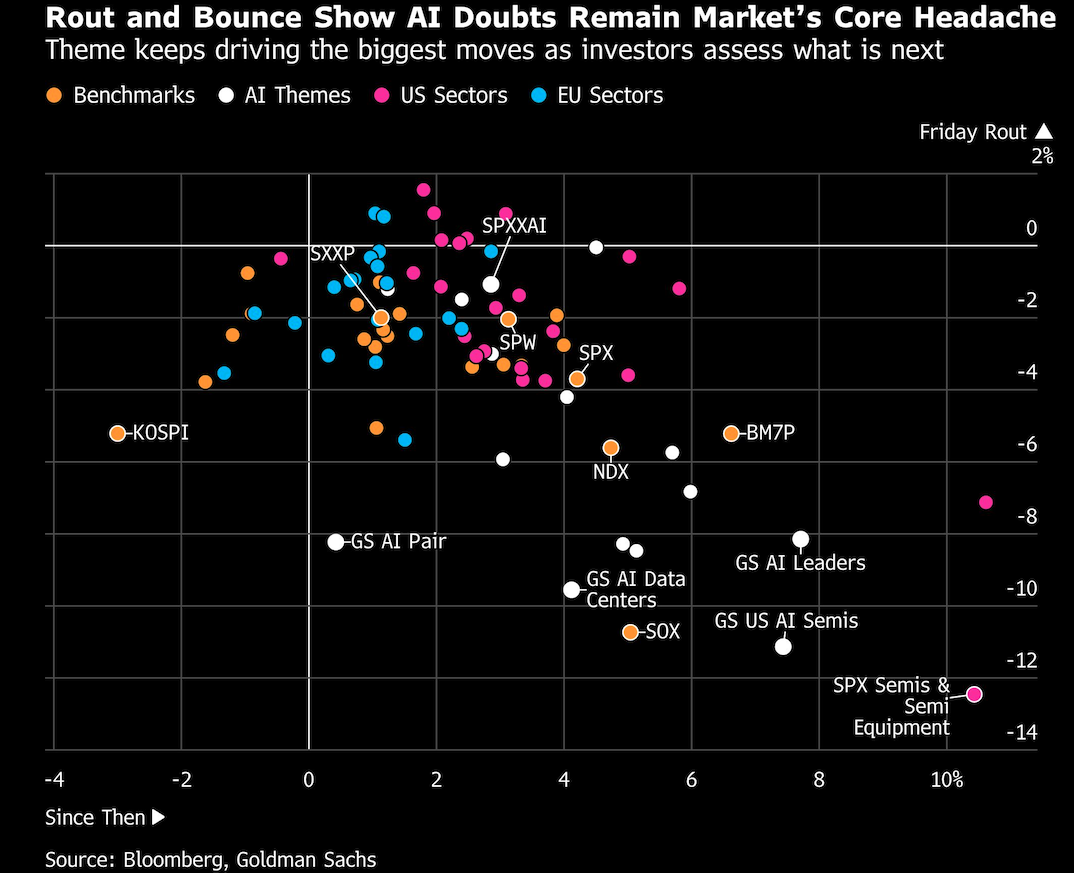
US equity futures fell for a second day, extending losses on a wave of heavy selling as traders dumped technology shares, with worries around AI dominating sentiment on Wall Street.
Futures contracts tied to the Nasdaq 100 Index slid 3.3%, as of 8:42 a.m. in New York, while contracts on the S&P 500 Index fell 2%. A key gauge of market turbulence — the Cboe Volatility Index, or VIX — topped 30, a level that signals growing market stress. An exchange-traded fund tracking chipmakers fell 4.4%.
Adding to selling pressure was data showing inflation continues to run hot, which reinforced expectations for a Federal Reserve interest-rate hike next month.
Enthusiasm over Monday’s return of Jensen Huang to the helm of Nvidia Corp. has quickly evaporated as investors focus on bigger questions about the risks, costs and profit prospects of artifical intelligence. After a short-lived rally to start the week, stocks tied to the AI industry have dragged the market lower.
On Wednesday, ahead of the Thanksgiving holiday, Nvidia shares dropped 5.1% premarket. The S&P 500 is now heading for its worst November since the height of the 2008 financial crisis.
“Markets remain mired in concerns about the sustainability of the AI boom,” said Panmure Liberum strategist Joachim Klement. “We expect that the US market and AI-related stocks will continue to remain under pressure as traders pare positions before the Thanksgiving weekend.”
Thinner-than-normal liquidity into a holiday-shortened week in the US may amplify volatility, making investors reluctant to rebuild significant equity exposure in the short term. Markets are closed on Thursday for Thanksgiving and will end early at 1 p.m. in New York on Friday.
Investor appetite for AI-related shares remains fragile given lingering concerns over funding for the buildout and the impact of high capital spending on major companies’ earnings. US-listed shares of Nvidia’s key foundry Taiwan Semiconductor Manufacturing Co. sank 4.7% premarket while shares of memory chipmaker SK Hynix Inc. dropped 5.2%.
See more: Jensen Huang Back at Nvidia: 2 Sector Tilts to Consider

Anthropic PBC, the company behind the Claude AI chatbot, sank another 4.3% premarket after trading below its $83 initial public offering price for the first time a day earlier. The stock had briefly jumped as high as $115 in its first day of trading last week amid a frenzy of AI hype.
Traders are also assessing that the US plans to impose new import taxes on goods from China, the European Union and a dozen other economies, in a move to rebuild President Donald Trump’s sweeping global tariff agenda that the Supreme Court found unconstitutional.
“Reports of new US tariff plans add further pressure on markets,” wrote Tom Essaye, a former Merrill Lynch trader who founded The Sevens Report newsletter. “The Trump administration is preparing new tariffs on imports from more than a dozen major trading partners following a probe into excess industrial capacity, reigniting trade tensions.”
Inflation Read
As Federal Reserve officials enter a blackout period this weekend before the US central bank’s Dec. 9 policy meeting, money managers are wrestling with what could stop the selloff after the S&P 500 dropped about 8% from its Oct. 6 record, nearing a correction, while the Nasdaq 100 is 16% below its closing peak — teetering on the brink of a bear market.
The Fed’s preferred measure of underlying inflation, the personal consumption expenditures price index excluding food and energy, rose 0.3%. From a year earlier, core PCE was up 3.3% — keeping Fed policymakers on track for a rate hike next month. Overall inflation was 3.8%, well above the central bank’s 2% target.
Gross domestic product rose 4.3% annualized in the third quarter, the most in three years, as business investment rose by the most since 2020. BUt a separate report showed US consumer spending stalled in October, with persistent inflation squeezing household budgets.
The stock market narrative is shifting so quickly even so-called fast money can’t keep up.
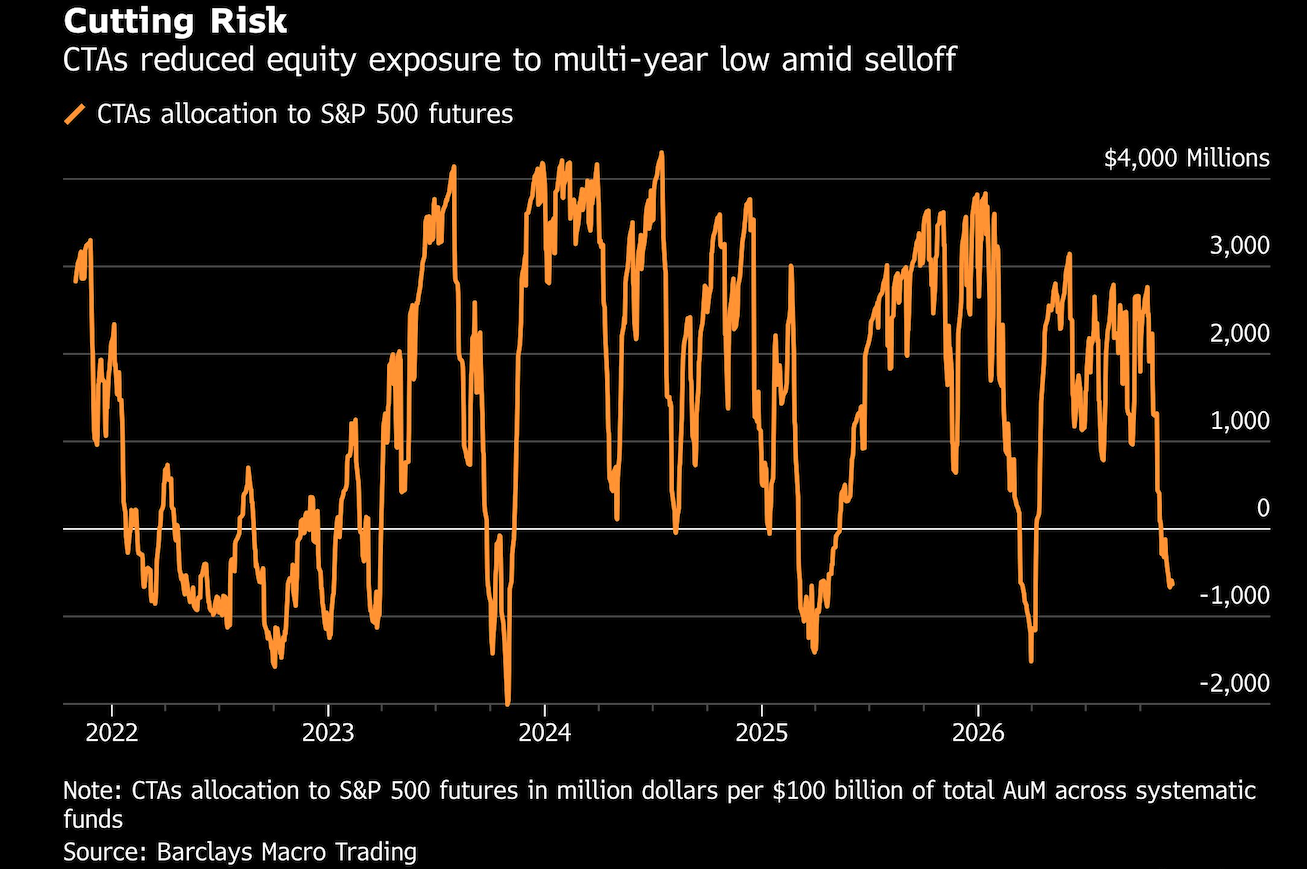
The models these systematic funds track have yet to signal that it’s time to ease up on selling. Commodity-trading advisors, or CTAs, are expected to unload $68 billion worth of global equities in the next five days, estimates compiled by Goldman Sachs Group Inc.’s trading desk show, on par with the five days through Friday when stocks clocked their worst week since the Covid-19 pandemic.
Elsewhere, Deere & Co. fell 2.4% premarket after the world’s biggest farm machinery maker in its first outlook for the new year estimated net income between $4.5 billion and $5.25 billion. That’s below the average Bloomberg estimate for $6.1 billion.
Meantime, Dell Technologies Inc. boosted its fiscal year revenue sales outlook for the third time as the rapid build-out of AI data centers fuels surging server sales. Dell, the third-best performing S&P 500 stock this year after soaring 135% in 2026, fell 5.9% premarket.
HP Inc. gave a profit forecast for the current year that will likely exceed analysts’ estimates, signaling the computer and printer maker is improving its ability to manage rising costs associated with memory chips. HP shares were flat premarket.
A message from Advisor Perspectives and VettaFi: Discover something new! Click here to register for our upcoming webcasts.
Bloomberg News provided this article. For more articles like this please visit
bloomberg.com.
Read more articles by Jessica Menton