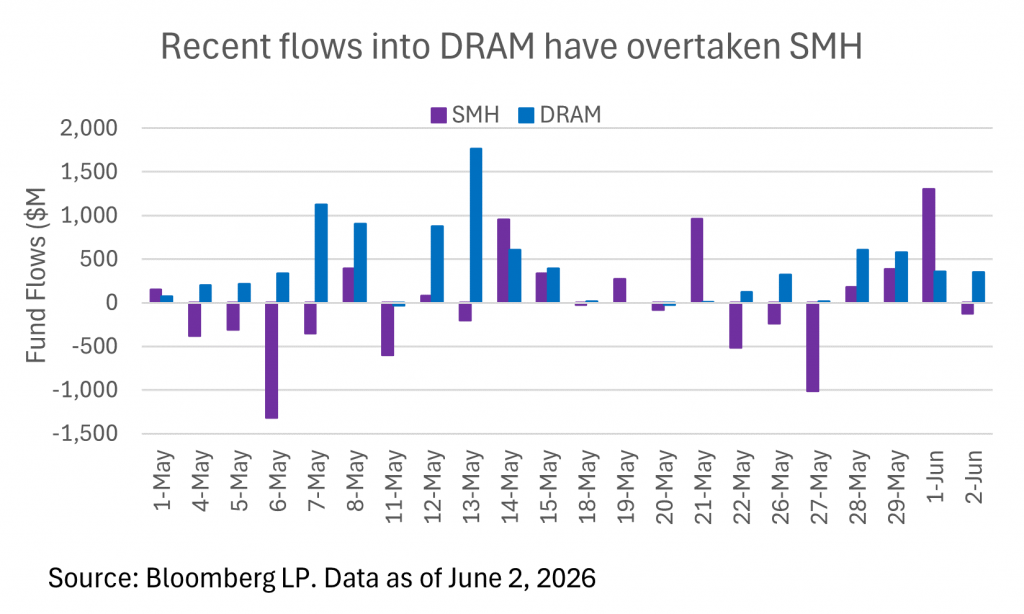
The first phase of the artificial intelligence investment trade was relatively straightforward: if you wanted to capture the AI boom using familiar names, you bought semiconductors. The VanEck Semiconductor ETF (SMH) became the default for this theme, with over $9 billion in net inflows over the past one year. But as AI becomes a larger and more embedded investment theme, ETF exposure is becoming more granular. Instead of simply buying broad semiconductor or AI funds, investors are increasingly looking at the specific infrastructure layers supporting AI growth.
One of the clearest examples has been the Roundhill Memory ETF (DRAM). The fund has gathered almost $11 billion in net inflows since its early April launch, which is notable for any ETF (especially a niche ETF with only around 15 holdings). This reflects a broader shift in how investors are thinking about memory chips within the AI supply chain. High-bandwidth memory has become a critical component of AI computing, and companies like SK Hynix (000660 KS), Samsung Electronics (005930 KS), and Micron Technology (MU) have become more central to the AI infrastructure story. Both SK Hynix and Samsung are South Korean semiconductor leaders, which can be harder for U.S. investors to access directly, likely adding to the fund’s appeal.

Now, several new ETF launches and filings are following a similar path by breaking the AI theme into even more specific segments. Recent filings tied to photonics, neocloud infrastructure, and compute futures show that the AI ETF universe is moving beyond the obvious winners and into the more specialized technologies that make AI possible.
See more: AI News You Need to Know — June Edition: Capex, Inference, & Beyond
Photonics: Light-Based Technology
Photonics is a light-based technology that is crucial to AI infrastructure. It can support faster data transmission in contrast to copper, advanced semiconductor manufacturing, optical networking, sensing, and next-generation computing. A popular stock in the space has been Poet Technologies (POET), which is a leader in chip-scale photonic solutions. As of June 2, the stock has been up 118% YTD.
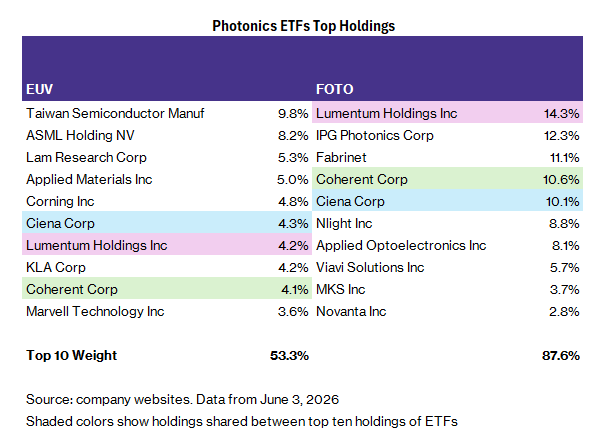
Recently, Corgi Funds launched the Corgi Lithography & Semiconductor Photonics ETF (EUV), an actively managed ETF which has just over $200 million in assets. This ETF is the largest out of its initial launch of 34 thematic and buffer funds all launched in early May. EUV invests in companies involved in photonics and light-based technologies, including extreme ultraviolet lithography, semiconductor manufacturing and inspection tools, lasers, optical components, photonic integrated circuits, fiber-optic networking, imaging, sensing, and lidar. Its top holdings include Taiwan Semiconductor Manufacturing (TSM) at 10%, ASML Holding (ASML) at 8%, and Lam Research Corp (LRCX) at 5%.
Tuttle Capital also launched the Tuttle Capital Pure Play Photonics ETF (FOTO) on May 29. Like EUV, FOTO is actively managed, and is tied to the AI data center bottleneck, offering targeted exposure to optical technologies replacing copper-based connections inside AI infrastructure. According to Tuttle, the fund invests across areas like lasers, optical transceivers, silicon photonics, specialty wafers, and foundry capacity. Top holdings include: Lumentum Holdings (LITE) at 14%, IPG Photonics Corp (IPGP) at12%, and Fabrinet (FN) at 11%. FOTO takes a more pure-play approach and has only around 16 holdings vs. 40 for EUV.
Some other photonics ETFs have been filed by REX, Roundhill, KraneShares, Tema, Defiance, and others. The proposed Aura AI Photonics ETF is an example of an indexed ETF, which would track the VettaFi AI Photonics Index. Unlike EUV’s and FOTO’s actively managed approach, Aura’s potential fund would use a rules-based index designed to capture global companies engaged in generating, transmitting, and processing data using light-based signaling for AI computing. The index breaks the photonics value chain into layers, including raw materials, lasers and micro-optics, optical chips and digital signal processors, module integration, fiber-optic networks, and testing/quality-control platforms.
The New Neocloud
Roundhill has filed for the Roundhill Neocloud ETF (proposed ticker: NCLD), an actively managed ETF designed to provide exposure to companies building the next layer of AI infrastructure. According to the filing, “Neocloud Companies” include businesses tied to GPU-as-a-Service platforms, high-density colocation data centers built or retrofitted for AI and high-performance computing workloads, AI platforms, data center development and operations, cooling and thermal management, power infrastructure, and high-speed networking. In simple terms, GPU-as-a-Service allows enterprises to access GPU clusters and AI compute capacity through the cloud instead of buying, deploying, and maintaining the hardware themselves.
Financializing Power: Compute Futures
Compute futures are part of a new evolution to turn AI computing power into a tradable, hedgeable commodity. Recently, ICE and CME Group both announced that they will launch compute futures contracts later this year, which will be tied to the cost of renting AI computing power.
While still very early ahead of the futures launches, several ETF issuers have already filed products tied to this concept. ProShares filed for the ProShares AI Computing Power ETF, along with leveraged and inverse versions, which would seek exposure primarily through GPU compute futures contracts. Roundhill filed for the Roundhill Compute ETF, which may use compute futures, swaps, and other instruments tied to computational power. Leverage Shares filed for both an unlevered Computing Power ETF and a 2x version, while Volatility Shares filed unlevered, 2x, -1x, and -2x AI Computing Power ETFs. The filings show how ETF issuers are already trying to package AI compute as a new investable asset class, even though the underlying futures market is still developing.
Bottom Line:
The AI ETF story is becoming more specialized as investors move beyond the broad semiconductor trade and look deeper into the infrastructure layers powering AI growth. Memory, photonics, neocloud, and compute futures all represent more granular ways to access the AI theme, but they also require more attention to what investors actually own. As ETFs become more focused, equity holdings may become more concentrated and holding multiple ETFs across AI themes may result in some overlap.
Originally published on ETF Trends
For more news, information, and analysis visit the Thematic Investing Content Hub.
A message from Advisor Perspectives and VettaFi: Discover something new! Click here to register for our upcoming webcasts.
Read more commentaries by VettaFi