The third quarter of 2026 emphasized an increasingly divided macro regime for financial advisors and institutional allocators alike. On one end, broad market hopefulness drove steady capital deployment into broad-market beta, while on the other end, raised rate volatility and geopolitical tension forced strategic pivots across fixed income, real assets, and systematic strategies, according to BlackRock’s Q3 earnings call, released October 14.
Matthew Bielski, founder and CEO of Defiance ETFs, recently joined Scarlet Fu and Eric Balchunas on Bloomberg’s ETF IQ to discuss the Defiance Autism Impact ETF (ASD) and the personal family experience that helped inspire its development.
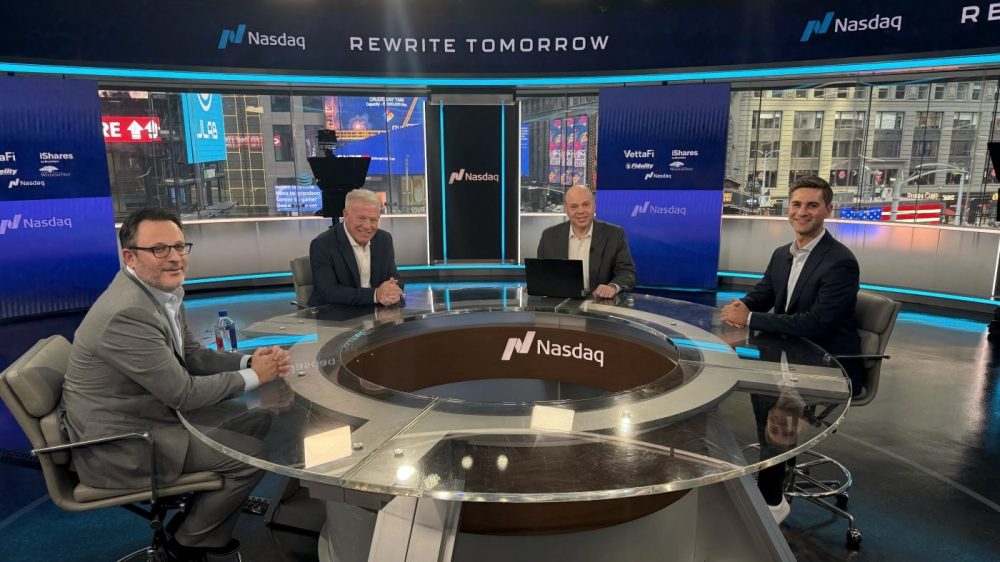
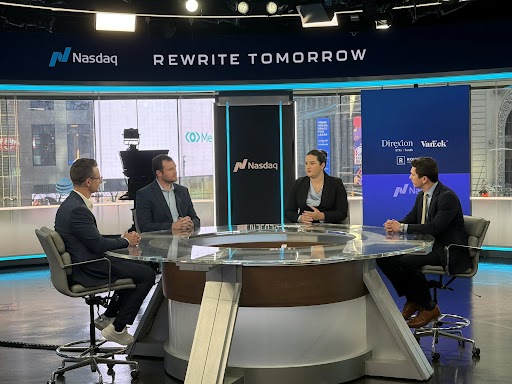
BlackRock, WisdomTree, and Fidelity Investments had representation at the recent Nasdaq VettaFi Asset Allocation summit.
In a recent webcast, Ari Polychronopoulos, TMX VettaFi’s head of RAFI Indices™, and Brent Leadbetter, TMX VettaFi’s head of RAFI Distribution, discussed growing market concentration risk.
Last week, the NEOS Nasdaq-100 High Income ETF (QQQI) crossed $15 billion in assets under management. This major milestone was the result of investor demand. In the first nine months of 2026, the tax-efficient options-based ETF had $7.0 billion in net inflows. With the help of the $13 billion NEOS S&P 500 High Income ETF (SPYI), NEOS has firmly established itself as a premier manager for enhanced income ETFs.
A new peptide ETF launched today, holding the drugmakers behind GLP-1 weight-loss treatments along with the companies that make and deliver them.
The Northern ETF SKOR crossed the $1 billion AUM threshold following $247 million in recent inflows amid surging corporate bond yields.
The recent Nasdaq Vettafi summit on asset allocation saw issuer leaders talk thematic ETFs, AI, and leveraged ETFs.
CLOs simply offer strong yield potential that often outpaces corporate bonds with similar credit ratings. Given that the ‘income’ portion of fixed income is often a key priority for investors, attaining high yield on a consistent basis gives CLOs a compelling use case.
Tokenization has taken hold in money market funds, leaving ETFs room to grow, while Cerulli eyes private markets as the long-term prize.
Broadly speaking, when advisors and investors consider adding focused industry exposure to a portfolio, there needs to be a strong justification for doing so. Take the AI industry, for example, where sustained buildout has driven many to target key tech players for exposure.
September ETF launches highlighted active strategies and an AI hardware ETF as year-to-date inflows reached a record $1.54 trillion.
Advisors choosing between two similar ETFs often let the lower expense ratio decide, but that fee says little about a fund’s liquidity. It may not even point to the cheaper fund to own, according to State Street Investment Management research.
Sometimes, there’s safety in size. Semiconductor Goliath Nvidia (NVDA) is proving as much. Already one of the world’s largest companies by market capitalization, Nvidia is up 29.5% year-to-date. That extends a five-year run in which the stock surged 1,066%.
Interest rates are on the rise, and, according to market expectations, the ascension may not be over quite yet.
On the surface, the municipal bond market may not check the “dynamic” box. After all, individual muni bonds and ETFs such as the ALPS BBH Intermediate Municipal Bond ETF (MNBD) are positioned, rightly so, as conservative, income-bearing investments.
International stock funds outpaced U.S. large caps in September, as ETF inflows cooled and investors leaned toward defensive sectors.
In a world defined by rampant energy demand and electrification, battery tech is one of the more intriguing places to invest. While attention has turned to the big AI narratives and debates in the market, tech categories like battery innovation have plenty of opportunities.
Bond yields still look attractive, but investors are earning little extra for taking on corporate credit risk, according to Thornburg Investment Management.
Long viewed as an emergency brake for macroeconomic panic, gold is starting to prove itself as much more than a crisis asset.
September’s fixed income sell-off marked a watershed moment for muni bond markets, delivering the steepest drawdown since the 2008 Great Financial Crisis. As benchmark yields spiked, prices across muni ETFs fell in tandem, and the volatility has not let up. This week, both 10-year and 30-year Treasury yields climbed to their highest levels since 2002.
VettaFi has experienced strong growth as a differentiated index provider in 2026. This momentum continues with today’s acquisition of The SPADE® Defense Index. The deal adds a popular, high-conviction thematic sector strategy to a global platform. More than $260 billion in index-based assets is tied to VettaFi.
T. Rowe Price has announced the launch of the T. Rowe Price Dynamic Emerging Markets Bond ETF (TDEM) on the Nasdaq today, the company said.
In September, Vanguard ETFs overall recorded a mix of steady market performance, some volatility, and significant dividend distributions, with investors pouring substantial capital into its funds.
Midterm elections are increasingly taking over the headlines, and that includes coverage of markets. While inflation, rates, and geopolitics probably have more outright impact on portfolios, investors and market watchers still look to midterm elections as a major event.
Yesterday’s cooler-than-expected PCE print finally gave the bond market a breather, pulling Treasury yields down from their brief 5.3% peak. For financial advisors, this recent whiplash brings fixed income duration conversations back to center stage — specifically, balancing the hunt for long-term yield with the safety of ultra-short cash alternatives.
Explore how muni bond ETFs and targeted state funds can provide tax-efficient yields and strategic flexibility heading into 2027.
It’s a complicated economic environment to retire in, with high costs and significant geopolitical and policy uncertainty. Still, people want and often may need to retire. However, thanks to innovation in the asset management world, investors have an increasing array of options.
Given that the Federal Reserve raised interest rates earlier in September, inflation data that was already crucial has taken on a new meaning. These reports could now serve as a barometer for what is to come from the central bank.
On September 23, Invesco launched the Invesco Nasdaq International Innovators 100 ETF (QQI), a fund that seeks to track the performance of the Nasdaq International Innovators 100 Index.
Retail investors buy corporate bond ETFs expecting steady coupons and ballast against stock market volatility. Traditionally, fixed-income portfolios were anchored by defensive issuers like banks, industrials and utilities.
The BlackRock Model Portfolio Solutions team made significant allocation shifts during the week ended September 24, 2026. The team recently managed over $300 billion and often causes shockwaves in the ETF industry.
The yield on the 30-year hit a multi-decade high this week, spiking amid continued fiscal and monetary concerns. The 30-year hitting 5.45%, its highest mark since 2004, comes amid an already busy year for bonds.
We know from recent history why this question feels so timely. Fixed income remains a foundational portfolio building block, offering low-correlated or uncorrelated diversification and downside risk mitigation. However, holding long-dated bonds in recent years has been notoriously painful.
The Texas Stock Exchange (TXSE) is more than a regional milestone — it is a shift in competition among U.S. capital markets. After months of anticipation, the TXSE reached a major landmark last week as Texas Capital’s TXS and OILT ETFs became its first primary listings, followed a day later by PWRX as the first new ETF to launch on the exchange.
Markets have dealt with serious whiplash from the Federal Reserve’s dramatic policy pivot this year. In just six months, the Fed funds futures market went from pricing in two rate cuts totaling 50 basis points to now pricing in two rate hikes in 2026.
Share buybacks are when a company purchases its own shares, reducing the total number of shares on the market. Oftentimes, these buybacks occur on the open market, but companies may also look to buy shares from existing shareholders as well.
Goldman Sachs Asset Management launched two new ETFs Monday, expanding exposure to emerging and international equities. The ETF duo includes the Goldman Sachs Data Enhanced Emerging Markets Equity ETF (GEMQ) and the Goldman Sachs Data Enhanced International Equity ETF (GIEQ). That pair joins an ETF landscape in which those segments are seeing growing interest.
In August, a flurry of ETF-related deals were announced and expected to close by early 2027. Goldman Sachs is buying NEOS Investments. T. Rowe Price plans to add F/M Investments. Victory Capital is acquiring First Eagle.
Throughout this Indexing Redefined series, we explored how traditional market-capitalization indexing ties portfolio weights directly to stock prices, creating hidden concentration risks. Furthermore, we discussed how fundamental indexing offers a disciplined alternative by weighting companies according to their real-world economic footprint. In this final installment, we address the dilemma investors face in highly concentrated equity markets.
According to the latest SPIVA U.S. Scorecard report, broader isn’t always better for active managers. Following a volatile start to the year, the S&P 500 rebounded sharply in the second quarter to gain 10% through June 30 thanks to robust corporate earnings.
In an environment marked by the Fed’s first rate hike in three years and ongoing market uncertainty, income-focused investors face a unique dilemma. While cash alternatives offer attractive yields in the short-term horizon, they leave portfolios vulnerable to reinvestment risk should the
As ETF strategies continue to expand into new asset classes and structures, the SEC has been taking a closer look at how some of these products fit within existing regulations.
ETFs are increasingly breaking down the wall between public and private markets. Asset managers are finding ways to “ETF-ize” private equity and pre-IPO holdings — giving retail investors liquid, fractional access to growth opportunities historically restricted to institutional and accredited buyers. As companies stay private longer, the most explosive growth phases of high-profile startups often occur off public exchanges.
Janus Henderson launched a new international equity ETF on Wednesday, according to a Janus Henderson press release. The Janus Henderson International Core Alpha ETF (JINT) seeks long-term growth of capital across developed markets outside the U.S.
Single-stock leveraged ETFs were unusual when they first arrived in the U.S. market just four years ago. Today, it might be hard to find a stock without one. Issuers are aggressively pushing beyond megacap tech into niche equities, pre-IPO registrations, and even experimenting with leverage levels and frequency.
Discover how autocallables provide steady income and downside risk protection in volatile markets, and how autocallable ETFs can help.
On September 2, TMX VettaFi Head of Research Todd Rosenbluth appeared on the Schwab Network to discuss ETF inflows nearing record highs in 2026 and the 50th anniversary of the first-ever index fund, the Vanguard 500 Index Fund. The fund’s ETF share class, which trades under the ticker VOO, is a bit newer, having launched in 2010.
Demand for fixed income ETFs hit a historic high-water mark in September. Investors and advisors turned to fixed income ETFs at a record-breaking pace, driving 2026 net inflows of $446 billion past all-time levels with months to spare. The massive tide of capital arrives at a critical juncture.