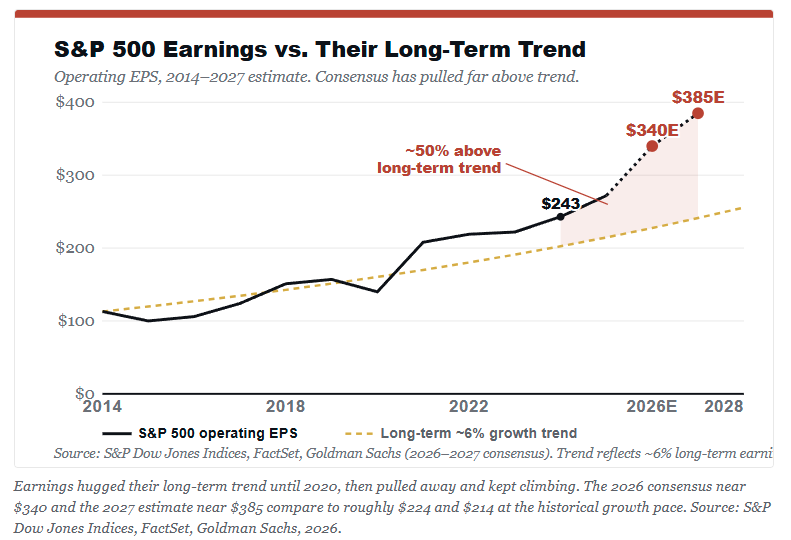
Consensus earnings estimates now sit close to 50% above trend, and that gap is exactly where an earnings mean reversion tends to begin.
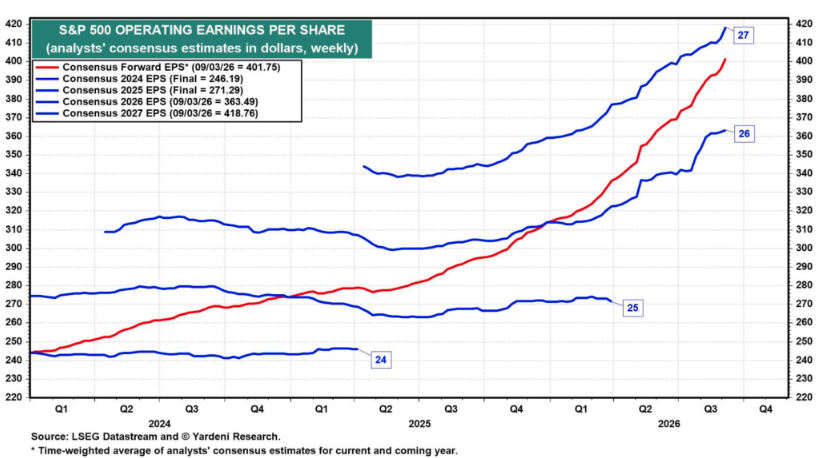
This has been an incredible year in that Wall Street has spent all of it raising its earnings estimates, and the second-quarter season only accelerated the trend. Analysts began the year expecting S&P 500 earnings to grow about 15%. By the close of Q2, that number had been ratcheted up to roughly 24%, with 2027 and 2028 estimates drifting higher right behind it.1 Rising profits are good news. The question I keep coming back to is whether the slope of these revisions can hold, or whether we’re setting up for an earnings mean reversion that catches a lot of people leaning the wrong way.
Here’s why it matters. Based on the current consensus, forward earnings are close to 50% above their long-term growth trend. Make no mistake, a gap that wide does not appear at random points in a cycle. It shows up near the top of one.
The Earnings Mean Reversion Setup Is Building
Notice in the chart above how tightly actual earnings tracked their long-term trend right up until 2020. Since then, the line has separated and refused to come back. That separation is the deviation Wall Street is now extrapolating into 2027 and 2028, and the Q2 print poured fuel on it.
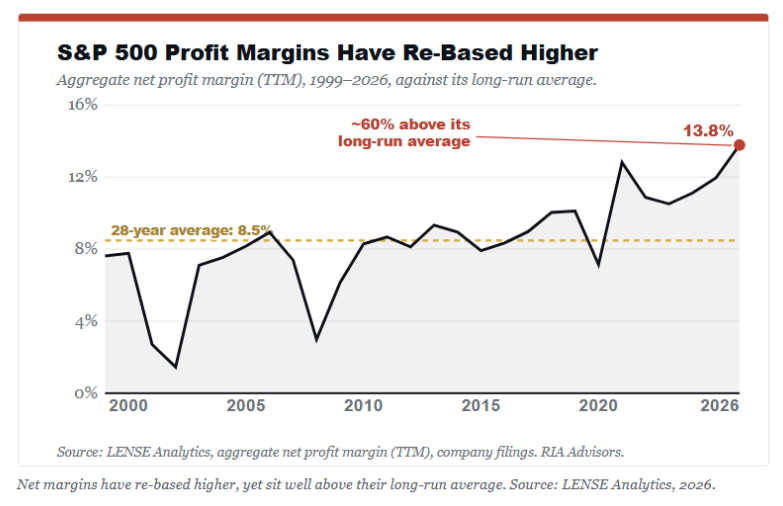
Q2 delivered blended earnings growth near 38%, the second straight quarter above 20%. That headline flatters reality, though. Strip out a single one-time gain at Alphabet, and growth falls to about 26%.2 The same distortion runs through margins, which hit a record on non-recurring “gains” at a few mega-caps rather than the underlying business.3
The estimates aren’t merely high. They are being raised while companies keep clearing them, helped along by one-time boosts. Such is the tension at every late-cycle earnings peak. It feels wonderful on the way up, and it is the exact setup that precedes the sharpest disappointments.
Is “This Time Different”? Partly Yes
While the earnings mean-reversion story is crucial to understand, the more bearish argument ignores something very real. The S&P 500 index isn’t what it used to be, which means some of the views on cycles are partially stale. Technology and communication services now generate close to half of S&P 500 profits, which is up sharply from a sliver two decades ago. Those businesses also carry structurally fatter margins than the industrials and retailers they replaced. When you add a lower corporate tax rate since 2018 and years of cheap financing, the margin base is higher than in history.4
However, the question that keeps landing in my inbox goes like this:
“What if the index has really changed enough that the old trend no longer applies?”
That is the right question, and part of the answer is yes. The margin level has re-based, and that piece is probably permanent. But where the bulls overreach is in assuming the rate of change rebases, too.
Why the Slope Still Reverts
With that said, there are three things that keep pulling me back to the earnings mean-reversion case.
“Profit margins are probably the most mean-reverting series in finance. And if profit margins do not mean-revert, then something has gone badly wrong with capitalism.” – Jeremy Grantham
The reason is that if capitalism is functioning properly, the basic supply/demand equation will eventually correct itself. When the economy eventually slows or enters recession, profit margins will decline as prices fall due to decelerating demand.
Over the next few years, the environment will look markedly different from the past.
The economy is returning to a slower-growth environment, with a risk of recession.
Inflation is slowly returning toward 2%, meaning less pricing power for corporations.
No artificial stimulus to support demand.
Over the last four years, the pull-forward of consumption has now begun to drag on future demand.
Interest rates are substantially higher, impacting consumption, and elevated corporate borrowing costs will impact margins.
Consumers have sharply reduced savings and increased debt.
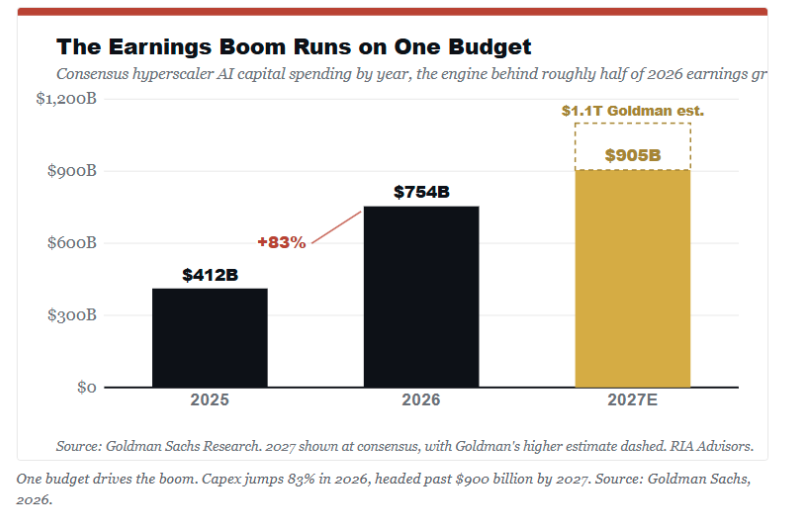
Secondly, economic growth has become increasingly narrow. By Goldman’s math, roughly half of this year’s earnings growth ties to AI infrastructure spending, and a small group of mega-caps drives most of the upward revisions.5 A lot of that is a “closed loop.” Hyperscaler capital spending, running near $754 billion this year, an 83% jump from 2025, lands as revenue on the income statements of the chip and infrastructure companies selling into it.6 The buyers’ budgets are the sellers’ earnings, and Wall Street sees that budget climbing past $900 billion in 2027.
Third, analysts are reliably too optimistic about the years they can’t yet see. Over the past 25 years, the bottom-up estimate at the start of a year has overshot the final number by an average of 6.2%. Strip out the recessions, and that shrinks to under 1%.7
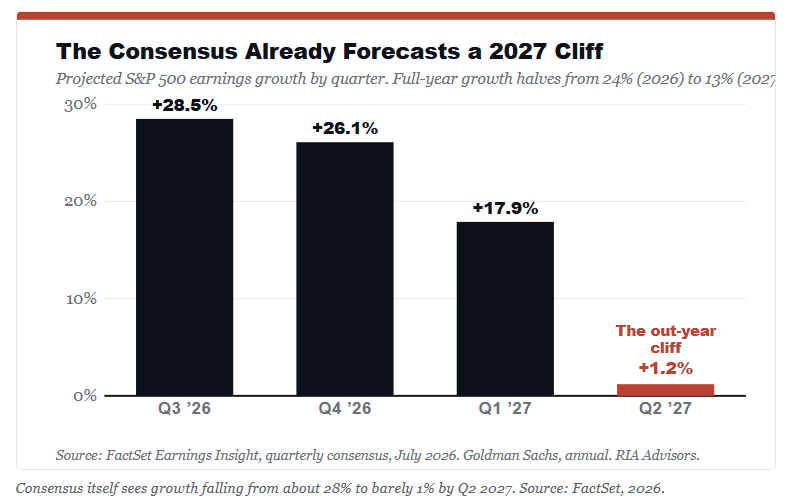
The estimates are usually fine, right up until the moment they’re catastrophically not. Notice that the consensus already forecasts its own deceleration. Goldman’s 2027 growth estimate drops to 13% from 24% this year, and FactSet’s analysts pencil in a second quarter of 2027 that barely grows at all.8 The out-years are the softest part of the stack, and the sell side knows it.
Earnings Mean Reversion Won’t Start Where You Expect
That brings us to the most interesting part of the question. What actually forces the reversion? The consensus answer is a recession or a hawkish Fed. But that’s the door everyone is watching, and reversions rarely come through the door everyone is watching.
The issue is NOT whether AI is real. It’s what the narrow leadership carrying these estimates has “priced in.” Because the growth is this concentrated, you don’t need a broad recession to break the aggregate number. You need the leaders to crack, and the early cracks are visible. Since June, correlation across the large AI hyperscalers has fallen from about 80% to 20%, as investors began rewarding names that tie spending to revenue and punishing those funding the buildout with debt.9
Goldman doesn’t expect AI supply and demand to balance until at least the second half of 2027. The moment one or two hyperscalers signal that the return on a trillion dollars of spending isn’t arriving fast enough, the revision engine throws into reverse, first in the names whose out-year estimates are stretched the furthest. A concentration unwind, not a “soft landing” or a classic recession, is the mechanism that fits this cycle.
The bottom line is this. The level of corporate margins is structural and probably durable. The slope of these earnings revisions is cyclical and probably not. I’m reasonably confident that the out-year estimates are marked down before they’re marked up again. I’m less sure about the timing because momentum like this tends to run longer than it should.
When the adjustment comes, watch AI capex, not the unemployment rate. That’s where the earnings mean reversion begins.
Sources & Notes
FactSet Earnings Insight, S&P 500 Q2 2026 season updates, July 2026; Goldman Sachs, U.S. equity outlook, May 2026.
Join RIA Advisors and elevate your career within a deeply experienced team focused on innovation. Our collaborative environment is built on a foundation of advanced technology and effective investment models, designed to enhance your ability to serve clients and grow your practice. Benefit from a supportive culture that encourages professional development and fosters a forward-thinking approach. By joining our team, you’ll be part of a group dedicated to excellence and continuous improvement, empowering you to focus on building meaningful client relationships and pursuing your business ambitions. Discover the advantages of working with our accomplished advisory team by starting your conversation today.