Municipal Bonds and AI Data Center Financing
Membership required
Membership is now required to use this feature. To learn more:
View Membership Benefits
Key takeaways

- Munis can fund local power, grid, water and wastewater infrastructure; most AI campus capital will be financed in non-municipal markets.
- Muni AI issuance may reach up to $11 billion in 2026; less than 2% of expected annual muni issuance.1
- Alphabet's prepaid utility bond shows munis can be a capital source, not the primary source.
- Credit outcomes hinge on who pays, contract protections and execution discipline.
The role of munis in the AI buildout
The AI data center buildout is reshaping U.S. infrastructure, but its impact on the municipal market is likely to be targeted. Municipal issuers may finance the power, grid, water, and wastewater systems needed to support a data center, while hyperscalers and developers fund the privately owned campuses, GPUs, servers, cooling equipment and dedicated generation.
See more: How Finance Teams Use Agentic AI to Plan Smarter, Forecast Accurately, and Operate Proactively
Municipal bonds represent one link in a much broader financing chain. For investors, the central question is not whether AI-related demand is growing, but whether an issuer is adequately compensated for the infrastructure it builds and the risks it assumes.
Selective impacts in the muni market
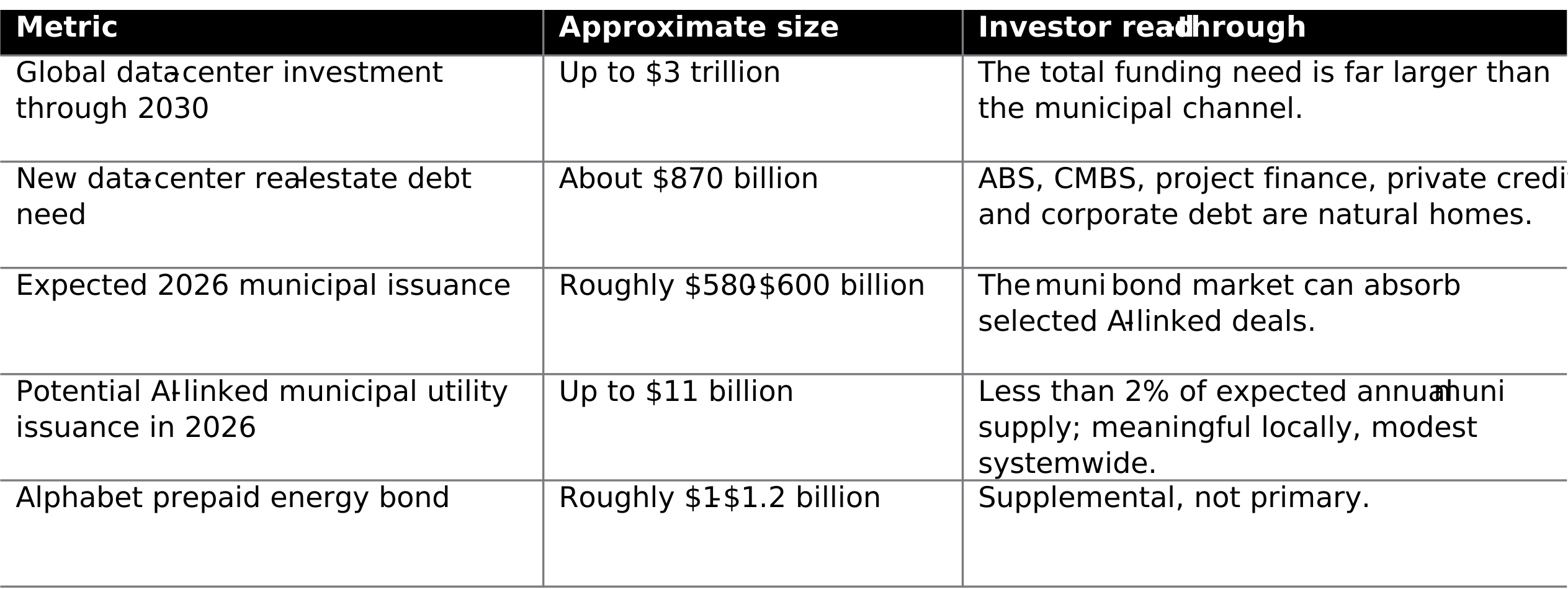
The scale of required capital extends well beyond the municipal market. JLL estimates that nearly 100 GW of global data center capacity could be added from 2026 to 2030, requiring up to $3 trillion of investment. This includes roughly $1.2 trillion of real-estate value creation, $1–$2 trillion of tenant technology fit-out, and approximately $870 billion of new debt financing for the real-estate component alone.
Within the municipal market, data-center-related borrowing could be meaningful for select issuers while remaining modest relative to overall supply. We estimate issuance could reach $11 billion in 2026, concentrated in public power, water and wastewater, and related infrastructure. Relative to projected market-wide issuance of roughly $580–$600 billion, however, the opportunity remains targeted rather than broad-based.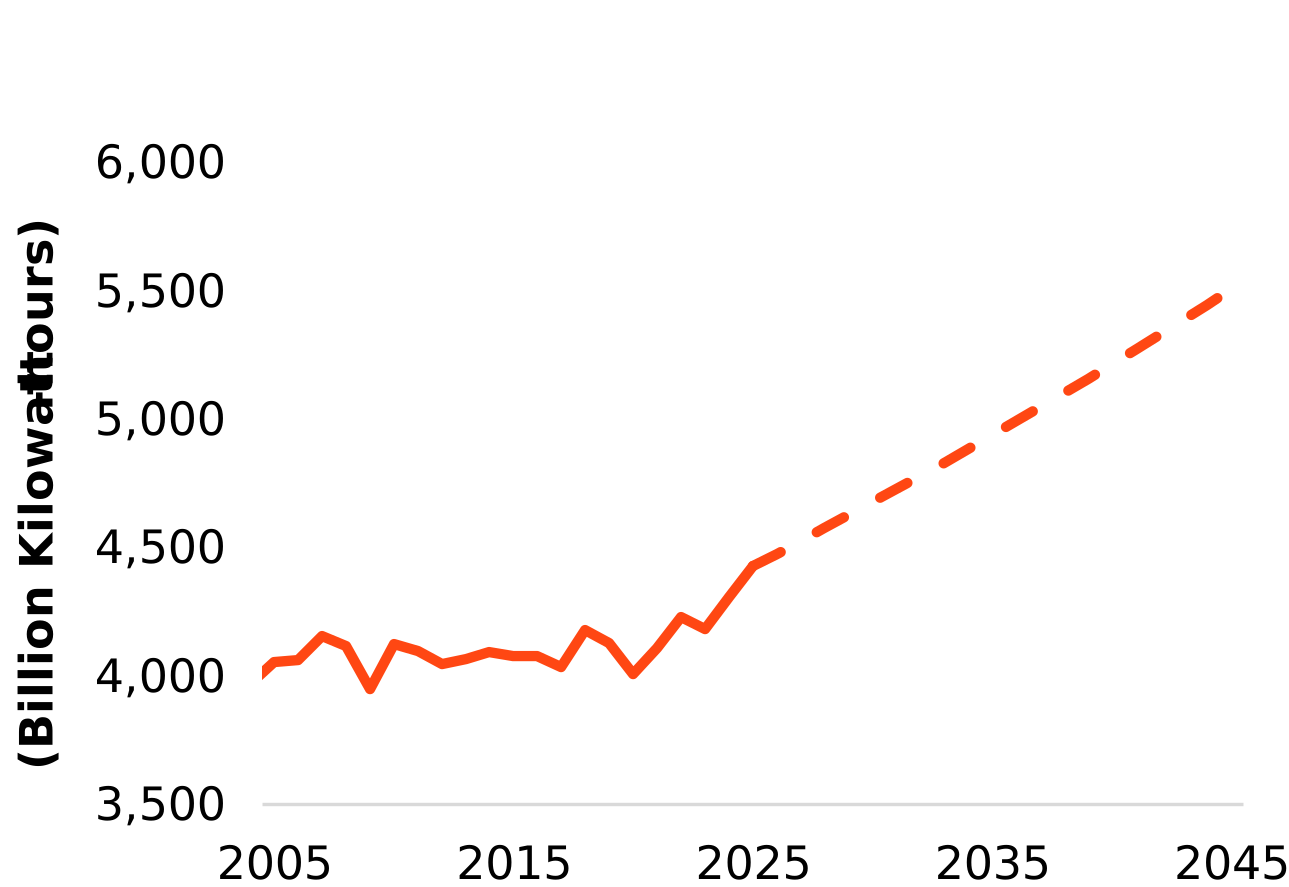

Infrastructure requirements & bottlenecks
Data centers require reliable, uninterrupted power at significant scale. Near-term solutions are pragmatic and market-specific, including purchased power, extending the lives of existing generating assets, and incremental natural gas capacity. In regions where supply is more constrained, utilities and developers are also revisiting nuclear generation, including small modular reactors. Nuclear may become part of the longer-term solution, but development remains constrained by regulatory timelines, construction delays and cost-overruns, and the need for meaningful federal or sponsor support.
Transmission and interconnection are often the gating assets. Developers may approach several utilities for the same prospective campus, creating duplicate requests across public pipelines. That risk is already becoming visible, as transmission constraints and lengthy interconnection timelines have contributed to delays and cancellations. Investors should distinguish preliminary inquiries from projects supported by executed contracts, deposits, interconnection agreements and minimum-bill commitments. Once contracted, however, utilities increasingly treat large data centers as long-duration load from credit-screened counterparties.
Water presents a different challenge. Cooling systems involve a trade-off between water and power use: air-cooled systems require less water but consume more electricity, while evaporative systems reduce power needs but place greater demands on local water supplies. In water-stressed regions, the key municipal need may be in wells, storage, treatment or discharge capacity rather than power generation alone. For bondholders, the central questions are the same as those facing electric utilities: who bears the cost, when and under what contract?
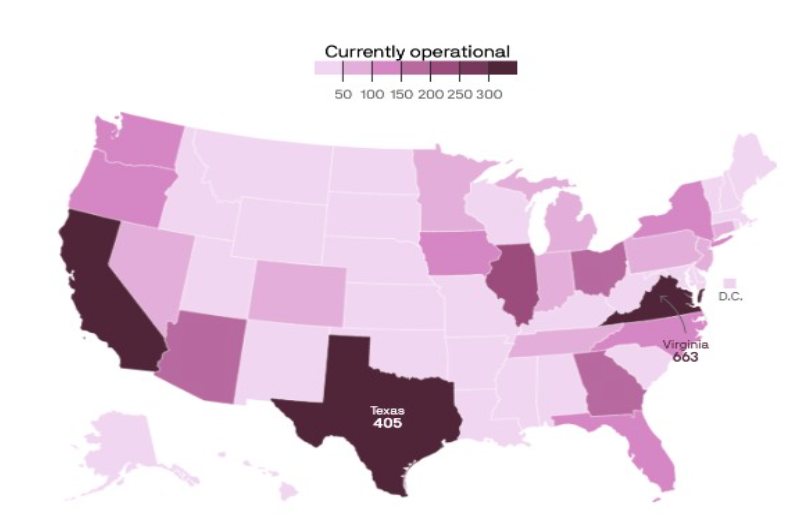
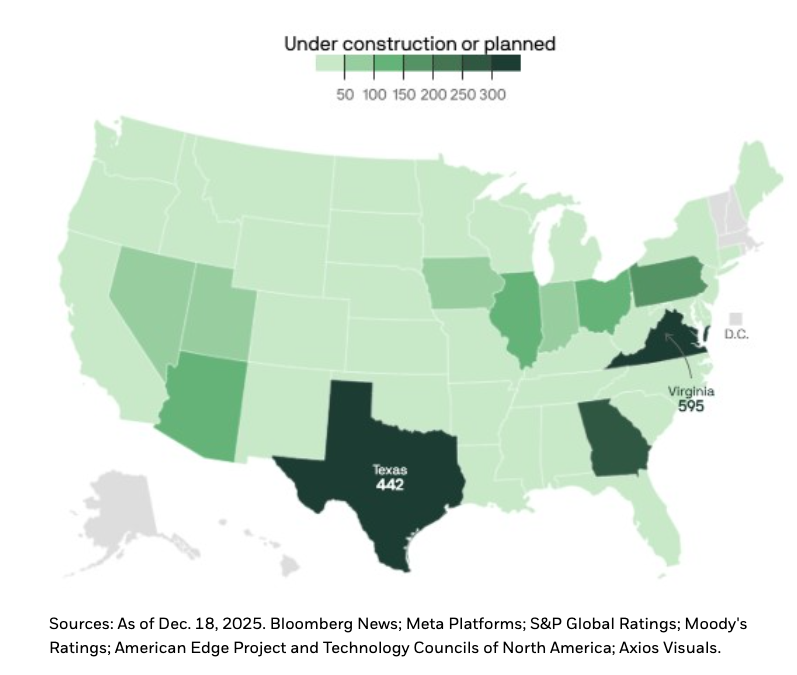
Current and Planned Data Centers
Financing implications for the muni market
The municipal market is likely to play a targeted role in financing data center growth. Municipal bonds are best suited to long-lived, essential assets that serve a broader system, including substations, public power upgrades, transmission and distribution networks, water and wastewater capacity, and grid resilience projects. They are less suited to tenant-specific technology that can become obsolete quickly. Compute hardware, for example, may turn over in three to five years, while municipal debt often amortizes over 20 to 30 years. That mismatch makes private capital structures with meaningful equity support a more natural fit.
Tax treatment may further narrow the opportunity set. Long-term agreements that reserve capacity for a single private user can raise private-use concerns, potentially shifting the financing into taxable municipal debt or private markets.
Prepaid power and capacity-style structures may still become more common where a public power provider can lock in lower long-term energy costs and a strong corporate counterparty supports repayment. Alphabet’s transaction is a useful example, but these deals are complex, tax-sensitive and limited in scale.
Beyond the municipal market, AI data center infrastructure is already financed through ABS, CMBS, project finance, private credit, taxable corporate debt and equity. Moody’s has noted that developers and landlords will need to raise substantial capital across these channels. In our view, municipal bonds can address selected infrastructure needs, but most of the capital required for AI-related development will come from outside the tax-exempt market.
Prepaid energy bonds are a limited option
Alphabet’s 2026 municipal market debut brought the topic into sharper focus. The California Community Choice Financing Authority issued a $1.2 billion prepaid-energy transaction for Pioneer Community Energy, with Alphabet identified as the recipient of a senior unsecured loan funded from the bond proceeds. The deal supported a long-term clean-power prepayment and marked the first known prepaid-energy transaction involving a major U.S. technology company.
Given its unique structure, the transaction was well received by municipal investors. Bloomberg reported a surge in demand, tighter secondary-market spreads, and heavy trading in the 2035 maturity following pricing. The response reinforces that municipal bonds can finance select power-procurement transactions, but the largest AI data center financings will continue to rely on non-municipal capital markets.
Private capital provides scale
At roughly $27 billion, the 2-gigawatt Hyperion data center project in Louisiana illustrates the practical limits of the municipal market. Meta and funds managed by Blue Owl formed a joint venture to develop and own the campus in Richland Parish, with Blue Owl holding an 80% interest and Meta retaining 20%. Meta contributed the land and construction-in-progress, while Blue Owl provided approximately $7 billion in cash, financed in part through private debt placed with PIMCO and other institutional investors.
Projects of this magnitude are too large to be absorbed entirely by the municipal market and will instead rely on hyperscaler cash flow, taxable debt, securitizations, project finance, private credit and equity to fund the core development. Municipal bonds are more likely to play a complementary role, financing power, water and other shared local infrastructure.
Credit considerations for the muni market
Credit risk is best assessed at the issuer level and will heavily depend on how each project is structured. Data centers can stress local credit profiles through electricity demand, water usage, land-use conflict, tax-incentive leakage and affordability concerns. The risk is greatest when governments or utilities commit capital before firm contracts are in place or allow data center costs to be absorbed by existing taxpayers or ratepayers. Most states offer tax incentives to attract data centers. Virginia alone offered over $1 billion in tax incentives between 2023 and 2025.
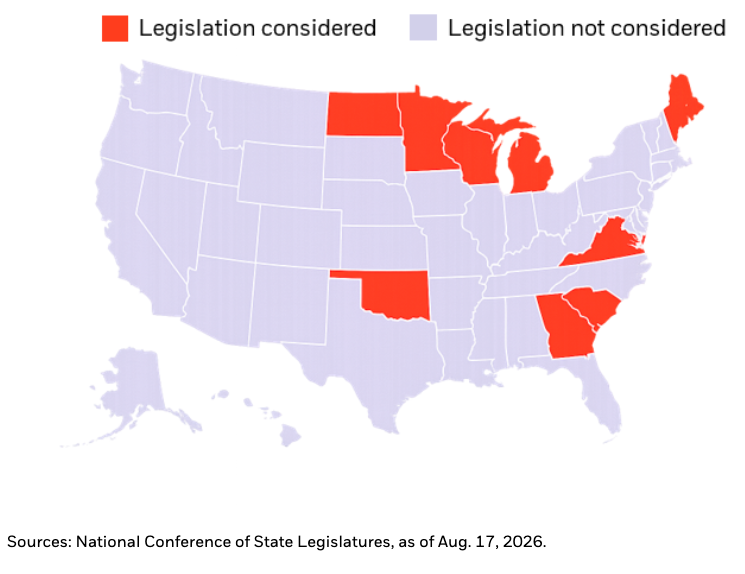
These risks can be mitigated through dedicated data center tariffs, minimum payment requirements, upfront capital contributions, termination fees, parent guarantees, and project-specific cost sharing. Moratoria and tighter development review may also give governments time to evaluate infrastructure needs, incentive packages, and rate structures before committing public resources.
Who pays? The key muni credit variable
The strongest municipal structures make the hyperscaler responsible for incremental costs through upfront contributions, dedicated tariffs, take-or-pay or minimum-charge contracts, termination payments and parent guarantees. These provisions reduce the risk that data-center-specific assets become stranded or that legacy customers subsidize private load.
Federal policy is also beginning to reflect these concerns. The 2026 Ratepayer Protection Pledge calls on major hyperscalers and AI companies to secure the power needed for their data centers and fund the related transmission and distribution upgrades. It also contemplates separate rate structures and minimum-payment obligations, even when contracted power is not fully used. The pledge is a policy signal, not a bond covenant. Investors should focus on the enforceable protections contained in service agreements and financing documents.
Data Center Pushback
Retail investor checklist
- Follow the contract, not the headline: identify minimum bills, take-or-pay charges, special tariffs and termination payments.
- Ask who pays for incremental generation, transmission, interconnection, water and wastewater capacity.
- Watch concentration: a strong utility can still face headline risk if one hyperscaler becomes a dominant customer.
- Do not overvalue tax incentives as a credit positive; incentives can dilute recurring revenue and may be revised as local opposition rises.
- Prefer amortization aligned with contracted cash flows and asset durability; avoid long debt backed mainly by short-lived technology economics.
- Expect more taxable muni and hybrid structures, but treat them as selective opportunities rather than a new core sector.
Sizing Snapshot2
1 Source: BlackRock estimate, as of Aug 31, 2026.
2 Source: BlackRock estimate, as of August 31, 2026.
A message from Advisor Perspectives and VettaFi: Discover something new! Click here to register for our upcoming webcasts.
Investing involves risks, including possible loss of principal. Past performance is no guarantee of future results. Index performance is shown for illustrative purposes only. It is not possible to invest directly in an index.
Performance data quoted represents past performance and is no guarantee of future results. Investment returns and principal values may fluctuate so that an investor’s shares, when redeemed, may be worth more or less than their original cost. All returns assume reinvestment of dividends and capital gains. Current performance may be lower or higher than that shown. Refer to blackrock.com for most recent month-end performance.
To obtain more information on the funds, including the Morningstar time period ratings and standardized average annual total returns as of the most recent calendar quarter and current month-end, please visit High Yield Municipal Fund, Short Maturity Municipal Fund and Intermediate Municipal Income Fund.
The Morningstar RatingTM for funds, or "star rating," is calculated for managed products (including mutual funds, variable annuity and variable life subaccounts, exchange-traded funds, closed-end funds, and separate accounts) with at least a three-year history. Exchange-traded funds and open-ended mutual funds are considered a single population for comparative purposes. It is calculated based on a Morningstar Risk-Adjusted Return measure that accounts for variation in a managed product's monthly excess performance, placing more emphasis on downward variations and rewarding consistent performance. The top 10% of products in each product category receive 5 stars, the next 22.5% receive 4 stars, the next 35% receive 3 stars, the next 22.5% receive 2 stars, and the bottom 10% receive 1 star. The Overall Morningstar Rating for a managed product is derived from a weighted average of the performance figures associated with its three-, five-, and 10-year (if applicable) Morningstar Rating metrics. The weights are: 100% three-year rating for 36-59 months of total returns, 60% five-year rating/40% three-year rating for 60-119 months of total returns, and 50% 10-year rating/30% five-year rating/20% three-year rating for 120 or more months of total returns. While the 10-year overall star rating formula seems to give the most weight to the 10-year period, the most recent three-year period actually has the greatest impact because it is included in all three rating periods.
Carefully consider the Funds' investment objectives, risk factors, and charges and expenses before investing. This and other information can be found in the Funds' prospectuses or, if available, the summary prospectuses which may be obtained by visiting www.iShares.com or www.blackrock.com. Read the prospectus carefully before investing.
Fixed income risks include interest-rate and credit risk. Typically, when interest rates rise, there is a corresponding decline in bond values. Credit risk refers to the possibility that the bond issuer will not be able to make principal and interest payments. International investing involves risks, including risks related to foreign currency, limited liquidity, less government regulation, and the possibility of substantial volatility due to adverse political, economic, or other developments. These risks may be heightened for investments in emerging markets. International investing involves risks, including risks related to foreign currency, limited liquidity, less government regulation and the possibility of substantial volatility due to adverse political, economic or other developments. These risks may be heightened for investments in emerging markets.
Stock and bond values fluctuate in price so the value of your investment can go down depending on market conditions. Non-investment-grade debt securities (high-yield/junk bonds) may be subject to greater market fluctuations, risk of default or loss of income and principal than higher rated securities. Asset allocation strategies do not assure profit and do not protect against loss.
Actively managed funds do not seek to replicate the performance of a specified index, may have higher portfolio turnover, and may charge higher fees than index funds due to increased trading and research expenses. There is no guarantee that an active fund will meet its investment objective.
This material is not intended to be relied upon as a forecast, research, or investment advice, and is not a recommendation, offer or solicitation to buy or sell any securities or to adopt any investment strategy. The opinions expressed are as of August 31, 2026, and may change as subsequent conditions vary.
The information and opinions contained in this commentary are derived from proprietary and non-proprietary sources deemed by BlackRock to be reliable, are not necessarily all-inclusive and are not guaranteed as to accuracy. As such, no warranty of accuracy or reliability is given and no responsibility arising in any other way for errors and omissions (including responsibility to any person by reason of negligence) is accepted by BlackRock, its officers, employees, or agents.
This commentary may contain “forward-looking” information that is not purely historical in nature. Such information may include, among other things, projections, and forecasts. There is no guarantee that any forecasts made will come to pass. Reliance upon information in this post is at the sole discretion of the reader.
Any opinions or forecasts represent an assessment of the market environment at a specific time and is not a guarantee of future results. This information should not be relied upon by the reader as research, investment advice or a recommendation. This material does not constitute investment advice and is not intended as an endorsement of any specific investment.
Prepared by BlackRock Investments, LLC, member FINRA.
©2026 BlackRock, Inc. or its affiliates. All rights reserved. BLACKROCK is a trademark of BlackRock, Inc., or its affiliates. All other marks are the property of their respective owners.
Muni0926-MH-5881669-EXP0927
Membership required
Membership is now required to use this feature. To learn more:
View Membership Benefits