Gold has traditionally been one of the most popular ways for investors to gain commodity exposure, but its recent weakness highlights the differences across various commodities. While precious metals have struggled, energy and certain agricultural commodities have seen stronger returns. Existing diversified strategies are also giving investors more ways to access commodities beyond traditional gold funds.
Key Takeaways:
- Commodity performance has diverged in 2026, with energy and certain agricultural commodities outperforming gold amid shifting supply and demand.
- Diversified commodity ETFs offer broader exposure, but differences in sector allocations, futures strategies, and fees can significantly impact returns.
- Investors should consider how commodity ETF structures, tax treatment, and underlying exposures align with their broader portfolio objectives.
Gold Is Struggling Relative to Other Traditional Commodities
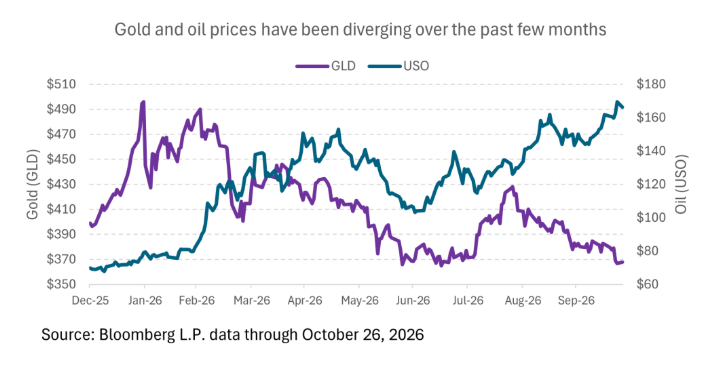
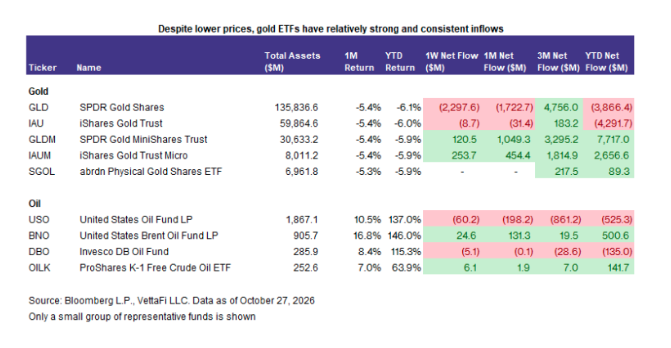
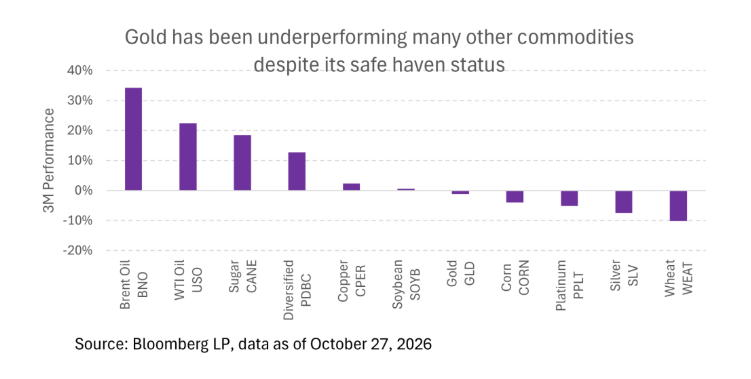
Commodity performance has varied significantly in 2026. Gold’s recent decline contrasts with strong gains across energy and certain agricultural commodities. The SPDR Gold Shares (GLD) has declined 1% over the past three months, with most of that weakness occurring over the past month, when it fell nearly 6%. Higher Treasury yields and a stronger U.S. dollar have weighed on precious metals. Expectations for tighter Federal Reserve policy have reduced the appeal of non-yielding assets like gold. Although gold’s recent price performance has shown that it hasn’t necessarily been a safe haven, flows are still relatively consistent. Especially when compared to flows into oil ETFs, which have seen less inflows.
Gold’s recent weakness also illustrates that its traditional safe-haven characteristics do not guarantee positive returns during periods of uncertainty. However, investor demand has not disappeared entirely, even as prices have fallen. While ETFs like GLD and the iShares Gold Trust (IAU) have seen recent outflows, their lower-cost versions, the SPDR Gold MiniShares Trust (GLDM) and the iShares Gold Trust Micro (IAUM), have both seen higher inflows — potentially due to their use as longer-term holdings rather than shorter-term trades.
Energy and Agriculture Take the Lead
Oil ETFs, on the other hand, have been among the year’s strongest performers. The United States Oil Fund (USO) gained 22% over the past three months and 12% over the past month. The United States Brent Oil Fund (BNO) rose 34% and 18%, respectively, over the same time periods. Brent crude oil has gained almost 90% year to date, supported by geopolitical tensions and supply disruptions in the Middle East. However, stronger oil prices have not necessarily translated into greater investor demand for oil ETFs. USO experienced net outflows in October despite its strong performance, illustrating how fund flows and price can move in different directions.
Outside of energy, certain agricultural commodities have also performed well, although recent price movements have been influenced by harvest conditions and supply/demand dynamics. The Teucrium Sugar Fund (CANE) has risen 18% over the past three months and 2% over the past month. Sugar prices have benefited from supply concerns, including heavy rainfall that disrupted harvesting and reduced cane availability in Brazil, one of the world’s largest sugar producers.
These differences demonstrate why commodity performance cannot be explained by inflation or geopolitical uncertainty alone. Supply constraints may support oil prices, while weather conditions influence agricultural commodities and interest rates affect precious metals. For investors, the challenge is determining which commodities to hold without becoming overly dependent on a particular market.
Diversified Commodity ETFs Offer Broader Exposure
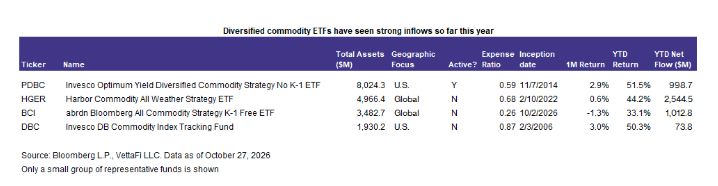
Diversified commodity ETFs can help reduce dependence on a single commodity by spreading exposure across energy, metals, and agriculture. These ETFs have seen a significant amount of inflows this year. But diversification does not eliminate risk completely, particularly when certain sectors dominate a fund or multiple commodities respond to the same macroeconomic trends.
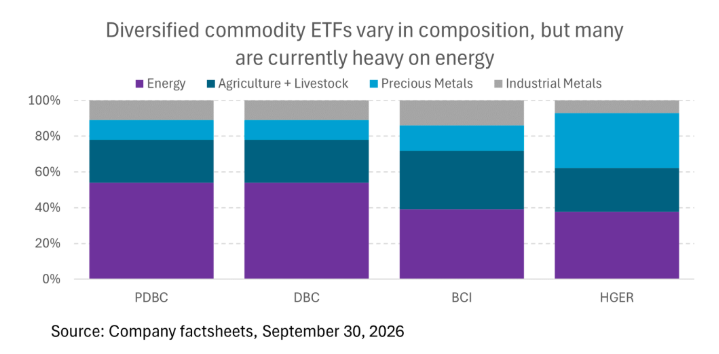
One option is the Invesco Optimum Yield Diversified Commodity Strategy No K-1 ETF (PDBC), an actively managed portfolio of commodity-linked futures and other financial instruments. Its strategy seeks to outperform a benchmark that uses an optimum-yield approach to futures contract selection, generally favoring contracts with more attractive roll characteristics. As of September 30, the fund has weights of: 54% energy, 24% agriculture, 11% precious metals, and 11% industrial metals. Invesco also offers the Invesco DB Commodity Index Tracking Fund (DBC), which is has similar allocations but is structured as a commodity pool and issues a K-1.
The abrdn Bloomberg All Commodity Strategy K-1 Free ETF (BCI), which tracks the Bloomberg Commodity Index Total Return, provides another alternative. The index uses production and liquidity measures to determine commodity weights, with limits designed to reduce concentration in individual commodities and sectors. As of September 30, energy represented approximately 39% of the fund’s futures exposure, followed by agriculture at 29%, precious metals at 14%, industrial metals at 14%, and livestock at 4%.
The Harbor Commodity All-Weather Strategy ETF (HGER) tracks the Quantix Commodity Index, which adjusts commodity weights based on their sensitivity to inflation and the cost of rolling futures contracts. The index also adjusts its gold allocation based on whether inflationary pressures appear to be driven by commodity shortages or currency debasement. As of September 30, energy was 38% of the ETF’s weight, precious metals 31%, industrial metals 7%, agriculture 23%, and livestock 2%.
Bottom Line:
Gold’s recent weakness and the strong performance of other commodities highlight the importance of looking beyond a single asset when evaluating commodity investments. Diversified commodity ETFs offer a way to participate across multiple markets, but their sector allocations, methodologies, fees, and tax structures can produce significantly different outcomes. Investors should focus on the role commodities are intended to play in their portfolios and select funds based on their underlying exposure rather than chasing the strongest performing commodity.
For more news, information, and strategy, visit the Commodities Content Hub.
Originally posted on ETF Trends
A message from Advisor Perspectives and VettaFi: Discover something new! Click here to register for our upcoming webcasts.
Read more commentaries by VettaFi