In today’s modern financial landscape, market-capitalization-weighted indices dominate the investment ecosystem with trillions of dollars tracking broad market indices such as the S&P 500 and the Russell 1000. However, a research article by RAFI Indices™, adapted from the CFA Institute Research Foundation series The Active Side of Indexing, exposes flaws within cap-weighted benchmarks.
Noted in this article is a phenomenon known as index “flip-flops.” This is where companies enter indices after strong price momentum and subsequently exit after extended price declines. This, in effect, causes investors to buy high and sell low. Fundamental indexing allows investors to do the opposite, creating opportunities for alpha.
Key Takeaways:
- RAFI Indices research reveals that market-capitalization-weighted benchmarks suffer from “flip-flops.” Index additions enter after extensive price run-ups and deletions exit after prolonged price declines.
- Historical index data from 1989 through 2025 documented 816 flip-flop events. Added constituents lagged the market by nearly 70% post-inclusion while deleted names generated almost three times the benchmark’s return prior to being readmitted.
- By weighting holdings according to tangible economic measures, fundamental indexing breaks the link to share price momentum. Instead, it enforces a disciplined, countercyclical rebalancing process that eliminates flip-flop performance drag.
See More: Flip-Flops: When Index Membership Doesn’t Last (CFA Institute Research Foundation Series)
Understanding Index “Flip-Flops”
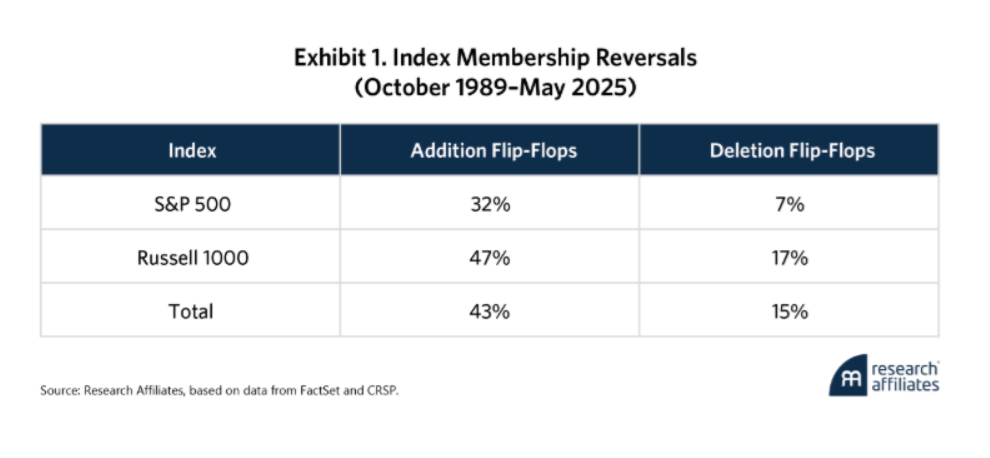
An index “flip-flop” occurs when a stock experiences a rapid membership reversal within an index. An addition flip-flop occurs when holdings are added after a period of intense market enthusiasm only to be deleted within 10 years or dropped due to prolonged price declines. After exiting an index in the case of the latter, the stock recovers and rejoins the index within a decade (a deletion flip-flop).
RAFI Indices’ historical analysis across the S&P 500 and Russell 1000 from October 1989 through May 2025 identified 816 total flip-flop events. This comprised of 606 addition flip-flops and 210 deletion flip-flops. The data revealed that flip-flops are not rare exceptions, but rather, recurring structural features of price-weighted indexing. Crucially, 43% of discretionary deletions across both indices were stocks that had been added within the preceding decade.
“For investors, the message is clear: Index membership is not a permanent seal of approval but often a delayed response to price movement,” the article said. “Flip-flops show that indexes can change their minds – but only after investors have experienced the price swing.”
The Cost of Buying High and Selling Low
The research brings up a core issue with market-cap weighting. A security’s weight in an index is tied directly to its share price. As investor sentiment drives a stock’s valuation higher, its market capitalization inflates. This mechanically forces cap-weighted index funds to buy more shares at peak valuations. Conversely, when a company experiences temporary operational headwinds or declining sentiment, its shrinking market cap triggersexpert in an automatic reduction or on the extreme end, a total exile. This forces passive funds to lock in losses near market bottoms. This is where the buy high, sell low dynamic penalizes passive investors in these market-cap-weighted indices.
Furthermore, companies added to broad indices typically outperform the market by roughly 75% in the run-up to their inclusion. Between their addition and eventual deletion, these addition flip-flops lagged the benchmark by nearly 70%. It caused index investors to capture the drawdown while missing the initial rally. High-profile examples cited in the research article include Moderna. The stock was added in July 2021 after a 280% run-up, but then fell 40% relative to the market over the next year. Another example cited was Supermicro. It was added in March 2024 following a 750% surge before surrendering 70% relative to the market.
In contrast, deletion flip-flops move in reverse. Companies exiting indices frequently recover once depressed expectations normalize. These deleted companies captured nearly three times the market’s return and beat the benchmark by almost 200% between their deletion and eventual readmission. These are opportunities that cap-weighted index investors miss. However, there is an ETF that encapsulates the opportunity in index deletions. The Research Affiliates Deletions ETF (NIXT) purchases deletions from top 500 and top 1,000 market-cap weighted indices. The strategy holds them for five years, and rebalances them annually to equal weight.
See More: Nixed: The Upside of Getting Dumped
Fundamental Indexing in Today’s Market
The economic cost of flip-flops extends beyond the short-term investment horizon. Today’s market environment marked by historic concentration in megacap tech stocks. Relying on exposure to market-cap-weighted strategies exposes investors to extreme momentum risk in the long term.
To solve the timing and concentration problems inherent in cap-weighted benchmarks, the Research Affiliates Fundamental Index (RAFI™) methodology replaces stock price with tangible, real-economy measures of business scale. More specifically, the methodology targets adjusted sales, adjusted cash flow, dividends plus buybacks, and book value plus intangibles.
By anchoring the selection process and portfolio weights to economic footprint rather than market capitalization, fundamental indexing effectively breaks the link from share price momentum. When a company’s stock price surges ahead of its economic footprint, RAFI’s disciplined, counter-cyclical rebalancing process systematically trims the position back to its fundamental weight to lock in gains. Conversely, when a solid company’s stock price collapses due to temporary market pessimism, fundamental indexing increases its exposure at attractive valuation levels. This creates a more optimal buy low, sell high dynamic rather than the opposite in a market-cap-weighted approach.
In summary, focusing on economic footprint can allow investors to insulate their portfolios from speculative bubbles and systemic flip-flop drag. The RAFI methodology establishes a resilient, rules-based foundation built for long-term capital appreciation.
“When building portfolios, investors should favor patience: seasoning, banding, valuation discipline, and business scale metrics that do not blindly chase every swing in market capitalization,” the article said.
For more news, information, and strategy, visit the Smart Beta Content Hub.
VettaFi LLC (“VettaFi”) is the index provider for NIXT, for which it receives an index licensing fee. However, NIXT is not issued, sponsored, endorsed, or sold by VettaFi, and VettaFi has no obligation or liability in connection with the issuance, administration, marketing, or trading of NIXT.
Originally posted on ETF Trends
A message from Advisor Perspectives and VettaFi: Discover something new! Click here to register for our upcoming webcasts.
Read more commentaries by VettaFi