What tech executives are rewarded for may matter more than how much they’re paid.
Eye-popping pay packages have made executive compensation a perennial Big Tech flashpoint. Yet headline pay figures often tell investors little about the quality of a company’s incentive structure. By contrast, compensation design can offer insight into accountability, innovation discipline and long-term shareholder outcomes—for technology companies of any size. We believe three dimensions of executive compensation can serve as a useful investment lens.
Evidence That Compensation Design Matters
Tech CEOs receive some of the largest compensation packages in the market. Median total compensation for US tech CEOs reached $22.5 million in the 2026 proxy season, second only to communication services. But the size of an award reveals little about whether it serves shareholders well.
A large package may be justified if it rewards exceptional value creation without encouraging excessive risk or short-term decisions. A smaller package can still be poorly designed if executives receive substantial rewards despite weak shareholder outcomes.
For investors, the more useful analysis begins with how compensation is structured, what performance it rewards and how long executives must remain exposed to the consequences of their decisions. Our analysis suggests that these distinctions may carry investment information.
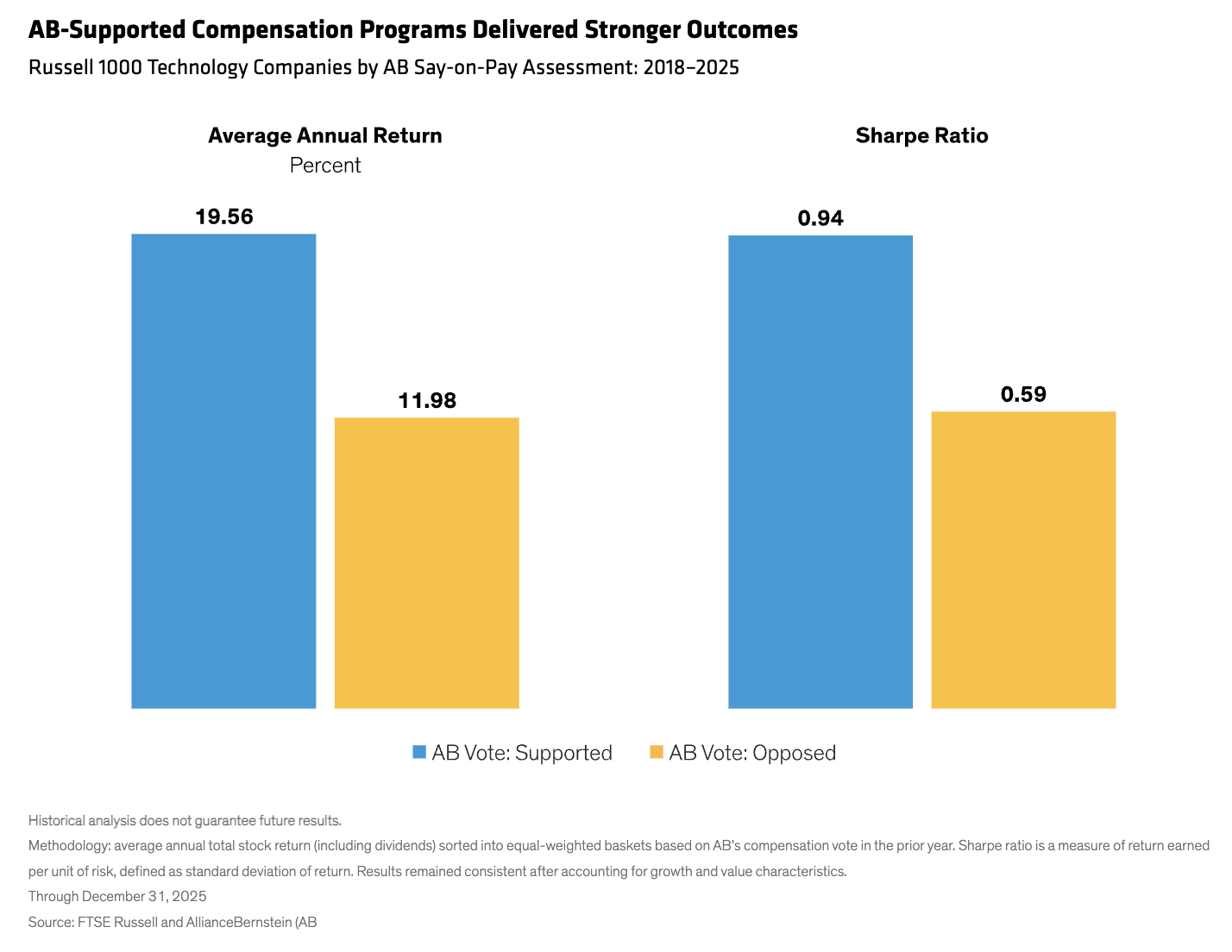
We examined the subsequent performance of Russell 1000 technology companies based on our proprietary say-on-pay assessment. Since 2018, companies whose compensation programs we supported have generated stronger returns and better risk-reward characteristics than those whose programs we opposed (Display).
Compensation design alone cannot predict stock returns. But the relationship suggests that a well-constructed pay program may reflect broader attributes of corporate quality, including disciplined target setting, accountability and a willingness to invest for the future.
See more: Three Forces Carrying Biotech into 2027
A 3D View of Compensation
Our experience reviewing thousands of tech-sector pay proposals points to three dimensions that may help investors distinguish stronger programs from weaker ones: disclosure, direction and duration.
Disclosure establishes whether investors can understand what management is being paid to accomplish. Strong disclosure includes quantitative performance measures, targets communicated in advance, a clear goal-setting process and an appropriate peer group. It also makes clear how financial, operational and strategic objectives—and both revenue growth and profitability—figure into the compensation plan. These elements allow investors to evaluate the rigor of the plan rather than simply accept the board’s characterization of it.
Poor disclosure does not necessarily mean incentives are poorly designed, but it limits investors’ ability to judge them. That opacity may also indicate weaknesses in accountability or decision-making elsewhere in the business.
Direction considers whether executive rewards align with long-term shareholder outcomes. Compensation should reflect management’s performance against meaningful financial, operational and strategic goals, while ensuring that executives share in the upside and downside experienced by shareholders. This does not require investors to oppose large awards following strong performance. In some cases, high pay for exceptional results may demonstrate that the plan is working as intended.
Direction also helps identify asymmetric structures in which executives capture substantial upside but remain insulated from downside. Such arrangements can weaken accountability and encourage decisions that benefit management without creating commensurate value for shareholders.
Duration may be especially important in technology. Technology companies derive much of their value from intangible assets, including intellectual property and human capital. Investment in these assets often appears as a current expense even when it is intended to support growth over many years. Compensation plans that emphasize three-year financial measures at the expense of longer-term strategic objectives may encourage executives to limit research and development or other reinvestment to improve near-term results.
Longer-horizon incentives can help preserve the investments required to maintain technological leadership. They also keep executives exposed to whether today’s strategic decisions ultimately produce durable competitive advantages.
Case Study: The Three Dimensions in Practice
A leading semiconductor equipment company illustrates how the three dimensions can reinforce one another. The company’s long-term incentive plan clearly identifies the financial and strategic outcomes expected from management and assigns a defined weighting to each, providing the necessary disclosure.
The plan also demonstrates direction. When the company’s share price fell sharply in 2022, CEO compensation declined. When the stock rebounded the following year, CEO pay increased. This illustrates that the plan exposes executives to changes in shareholder value, although stock-price movements alone don’t establish management’s contribution to those outcomes.
But duration is where this pay plan really stands out. Unlike the US semiconductor peers in our review, the company explicitly incorporates innovation into its incentive structure. Its return-on-adjusted-invested-capital measure uses a target level of research-and-development (R&D) spending,* reducing the incentive to boost near-term returns by cutting investment. A Technology Leadership Index also rewards progress against the company’s forward-looking technology roadmap.
Equity awards carry an additional two-year post-vesting holding requirement, which none of the US peers reviewed included. Together, these provisions support continued investment in innovation while extending management’s exposure to the results.
The Bottom Line on Executive Pay
When it comes to pay, a single dimension such as size doesn’t tell investors much. A large award is not necessarily bad for shareholders, just as a small award is not necessarily shareholder-friendly. Compensation has multiple dimensions, so investors’ evaluative framework should too. Our 3D lens offers a practical way to assess compensation design.
In an industry shaped by continuous technological disruption, sound incentive practices can help keep management focused on the ingredients that create long-term value.
*Three-year average calculated using income after taxes at target R&D spending, divided by average invested capital.
The authors wish to thank Peter Højsteen-Ljungbeck, ESG Data Research Analyst, and Felipe De Mello E Souza, Investments Rotational Associate, for their invaluable contributions to this research.
The views expressed herein do not constitute research, investment advice or trade recommendations, do not necessarily represent the views of all AB portfolio-management teams and are subject to change over time.
Bob Herr is a Senior Vice President and Director of Corporate Governance within the Responsible Investing team.
Lei Qiu is a Senior Vice President and Head of Thematic Equities, responsible for the AB Global Disruptors, Global Technology, Strategic Research and Strategic Research Balanced Strategies.
Ryan Oden is a Senior Vice President and a Co–Portfolio Manager and Senior Research Analyst for US Growth Equities.
A message from Advisor Perspectives and VettaFi: Discover something new! Click here to register for our upcoming webcasts.
© AllianceBernstein
More Volatility/Downside Protection Topics >