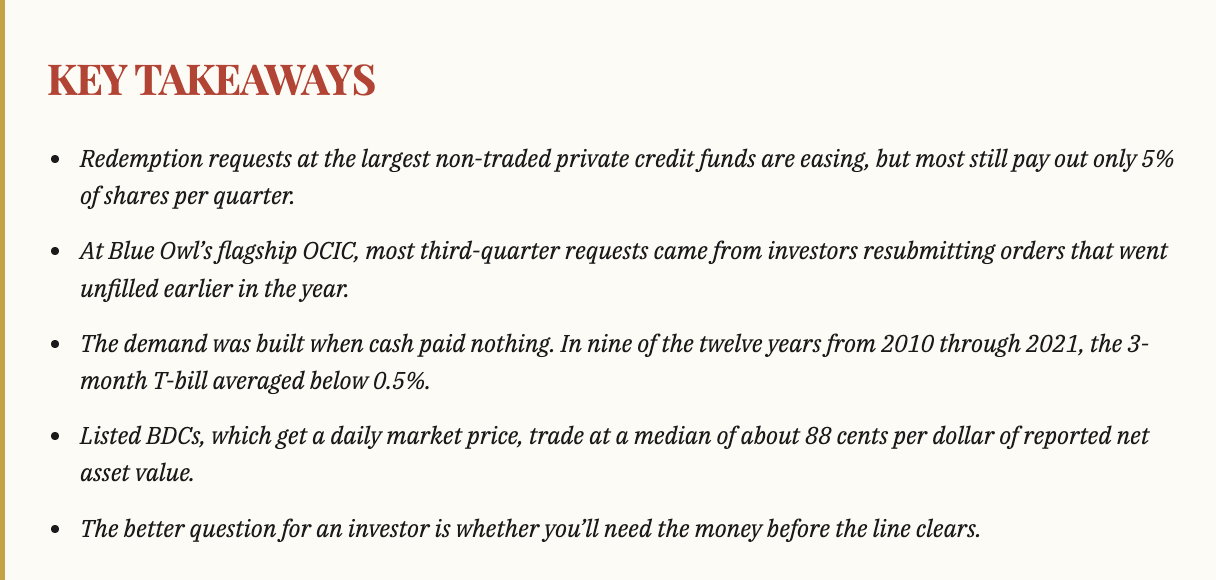
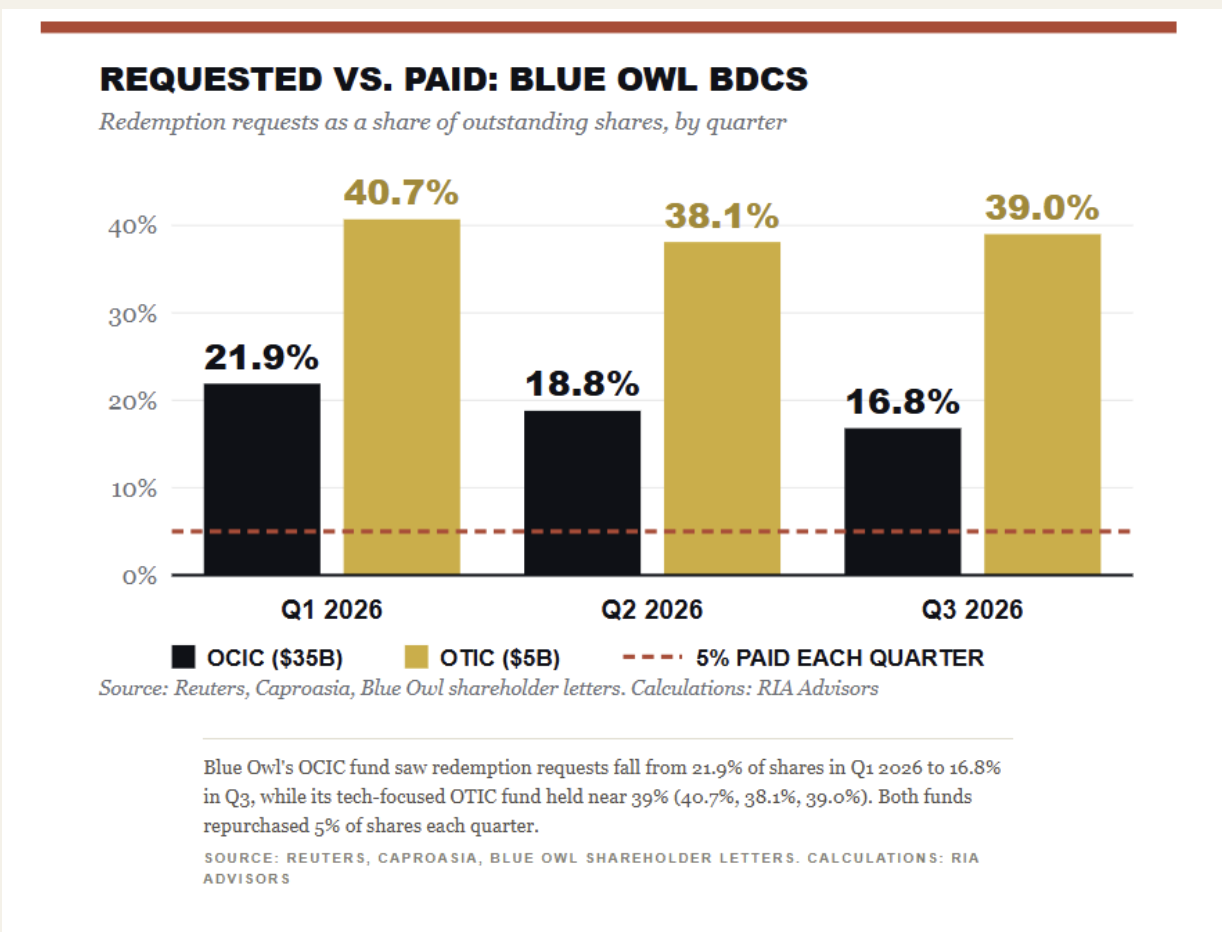
The headlines say private credit redemptions are easing. They are. In the third quarter, investors asked to pull $4.2 billion from Blue Owl’s two largest non-traded credit funds, down from $4.7 billion in the second quarter and a record $5.4 billion in the first.1 However, both funds still bought back just 5% of their shares, the same as every other quarter this year. Such is the part of the story most coverage skips. Fewer investors are heading for the exit, but the ones already in line are still standing there.
That matters to anyone who owns one of these funds or got pitched one over the last few years. The pitch was income with “semi-liquid” access. Income has shown up. For a lot of people, access hasn’t.
“Semi-Liquid” Means Liquid Until Everyone Wants Out
Non-traded business development companies (BDCs) and interval funds don’t trade on an exchange. You get out when the fund offers to buy back your shares, usually once a quarter. That offer is typically capped at 5% of shares outstanding. When requests exceed the cap, the fund prorates. In other words, everyone who asks gets the same fraction of their request filled, and the remaining shares stay put.
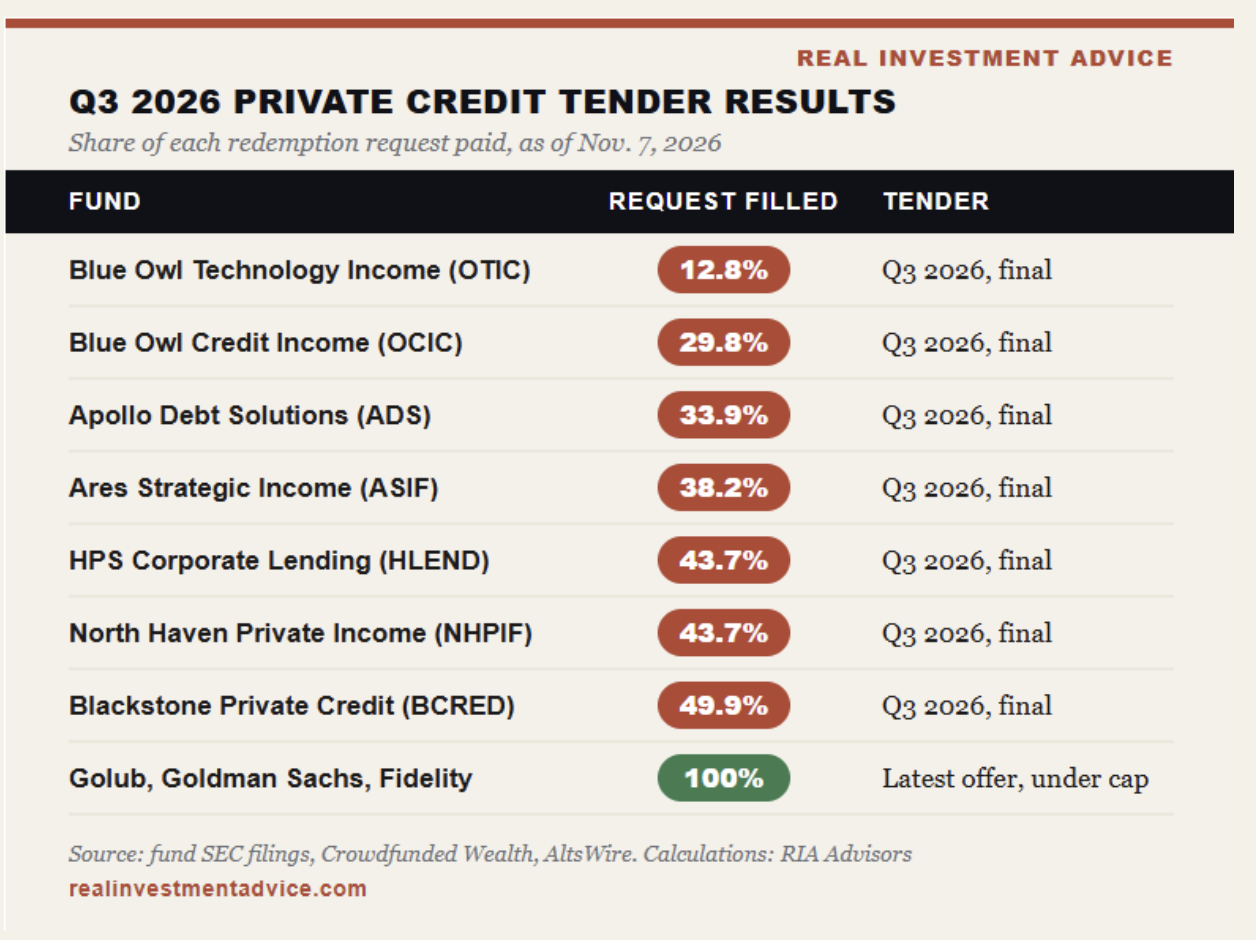
Ares Strategic Income Fund shows how that works in practice. In its third-quarter tender, investors submitted roughly 50.4 million shares, and the fund bought about 19.3 million of them, or 38.2% of each request.2 Holders with fewer than 100 shares got paid first. Everyone else waited.
Seven of the ten non-traded BDCs tracked by Crowdfunded Wealth prorated their latest completed offering, filling between 12.8% and 49.9% of investors’ requests.3 The three that paid in full simply had fewer people asking. Notice that none of this is a default. The gate is NOT a malfunction. It’s written into the prospectus. And it’s working exactly as designed, which is precisely the issue if you need the cash. A gate that protects the fund from a fire sale, by forcing it to sell loans into a weak market at whatever price a buyer will offer just to meet withdrawals that came in faster than the loans can mature, is the same gate that keeps you from your money. It cuts both ways.
See more: Stock Market Correction 2026: Is It 2018 All Over Again?
Why Are Private Credit Redemptions Still Being Prorated?
A question that keeps landing in my inbox goes something like this: “If requests are falling, isn’t the problem fixed?” Not quite. Fewer requests mean a shorter line. They don’t mean a wider door.
Look at Blue Owl Credit Income Corp. (OCIC), a $35 billion fund. Requests ran at 21.9% of shares in the first quarter, 18.8% in the second, and 16.8% in the third.1,4 That’s improvement. Yet Reuters reported that most third-quarter requests came from investors resubmitting tenders that hadn’t been filled earlier in the year.1 Such is how a queue works. The people asking to leave in September are largely the same people who asked in June.
For a better understanding of what this means, let’s run the arithmetic. At a 5% quarterly cap, a 16.8% line takes roughly three and a half quarters to clear. That assumes nobody new joins it. OTIC, the smaller tech-heavy sibling, saw requests hold near 39% of shares. At the same pace, that’s nearly two years. Blackstone’s BCRED, the largest of the group, received tenders for about 181 million shares in its third-quarter offer, roughly 10% of shares outstanding. It bought back about 90 million of them, or 49.9% of each request, for $2.13 billion.5
There are exceptions. KKR’s FS Income Trust Select saw requests of 5.06% and paid every one, stretching slightly past its cap.6 That’s a fund with under $1 billion in net assets and a small overage. The arithmetic changes when the line is three times the door.
How TINA Built The Line At The Exit
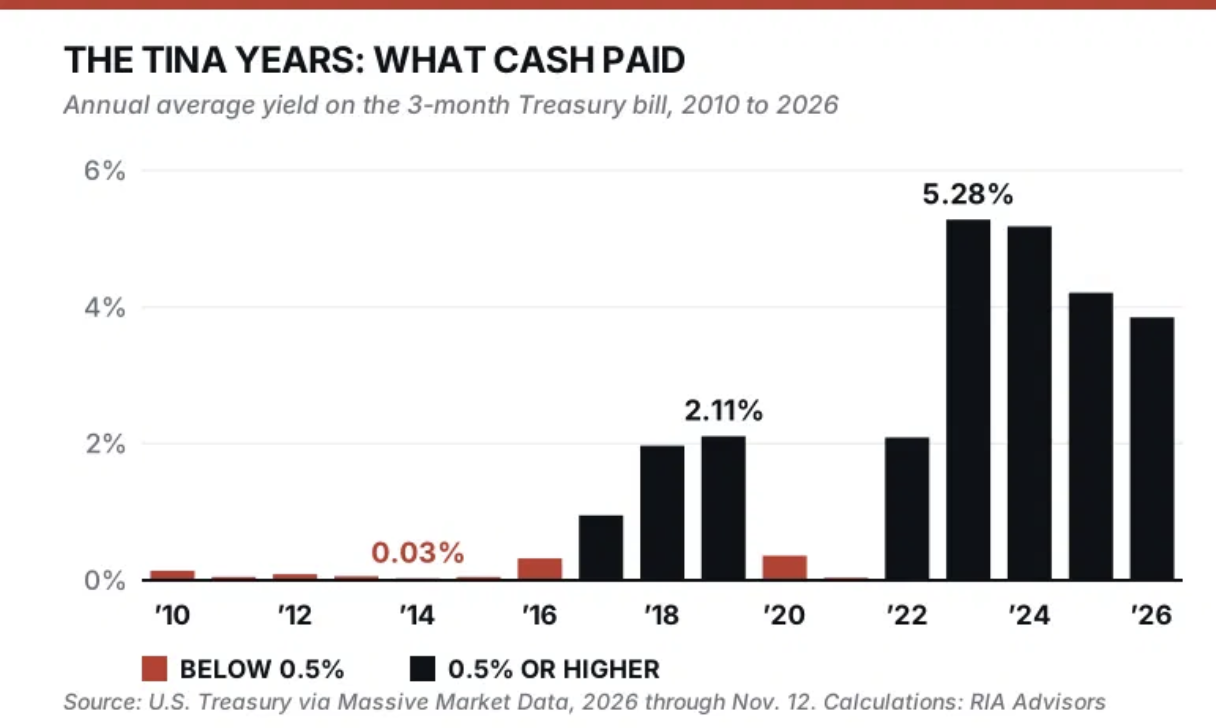
To understand why the line formed, you have to go back to where the money came from. For most of the decade after the financial crisis, the Fed held short rates near zero. Savers who needed income had two choices: accept nothing on cash or seek “yield” elsewhere. Wall Street called it “TINA,” for “there is no alternative.” It pushed a generation of conservative money further out on the risk curve than it had ever been.
As is always the case, when there is a LOT of investor demand, Wall Street will find a way to capitalize on it. Private credit was the perfect product for that environment. It paid high single-digit to low double-digit distributions. The reported value barely moved because the loans weren’t marked to market every day. Investors saw a “smooth” line and concluded it was safe. That’s the confusion. Low reported volatility and low risk are different things, and illiquidity is the cost that never shows up in the monthly statement. Howard Marks put the general version of this better than anyone:
“The riskiest thing in the world is the widespread belief that there’s no risk.” – Howard Marks, Oaktree Capital Management
Now flip the setup. As of November 12, the 3-month bill yields 4.32%.7 My colleague Michael Lebowitz recently laid out how investors have moved from TINA to TIGA: “there is a good alternative”. When cash pays four percent with daily liquidity, the extra few points from a gated loan fund look a lot less compelling. Some of today’s private credit redemptions reflect credit worry. Much of it, I suspect, is investors doing that math for the first time.
The Strongest Case For Staying In
The other side of this debate has real merit. The underlying loans are mostly performing. At Ares Capital, the largest listed BDC, loans on non-accrual were 2.4% of the portfolio at cost as of September 30, up from 1.8% at year-end but hardly a collapse.8 The Fed called the risks tied to private credit redemptions “manageable” back in May.9 Evercore’s Glenn Schorr said the industry “it appears that the industry has successfully isolated the direct lending wound.”1
The gate also protects the investors who stay. Back in March, I made this case in Subprime Crisis 2.0: Will Private Credit Be The Trigger? Gating and a mostly institutional investor base, I argued, make this look more like a painful credit cycle than a 2008-style collapse. I still think that’s right. Distributions keep arriving while you wait, and nobody is forced to dump loans at distressed prices.
“A gate is a promise kept to the fund. It’s a promise deferred to you.”
So the case for staying is real. The cost is just as real: you’ve handed the timing of your exit to a tender schedule. For an investor with a long horizon and no near-term need for the money, that may be a fair trade. For one who planned on this as a source of spending money, the trade looks very different.
What Listed BDCs Say About Private Credit Redemptions
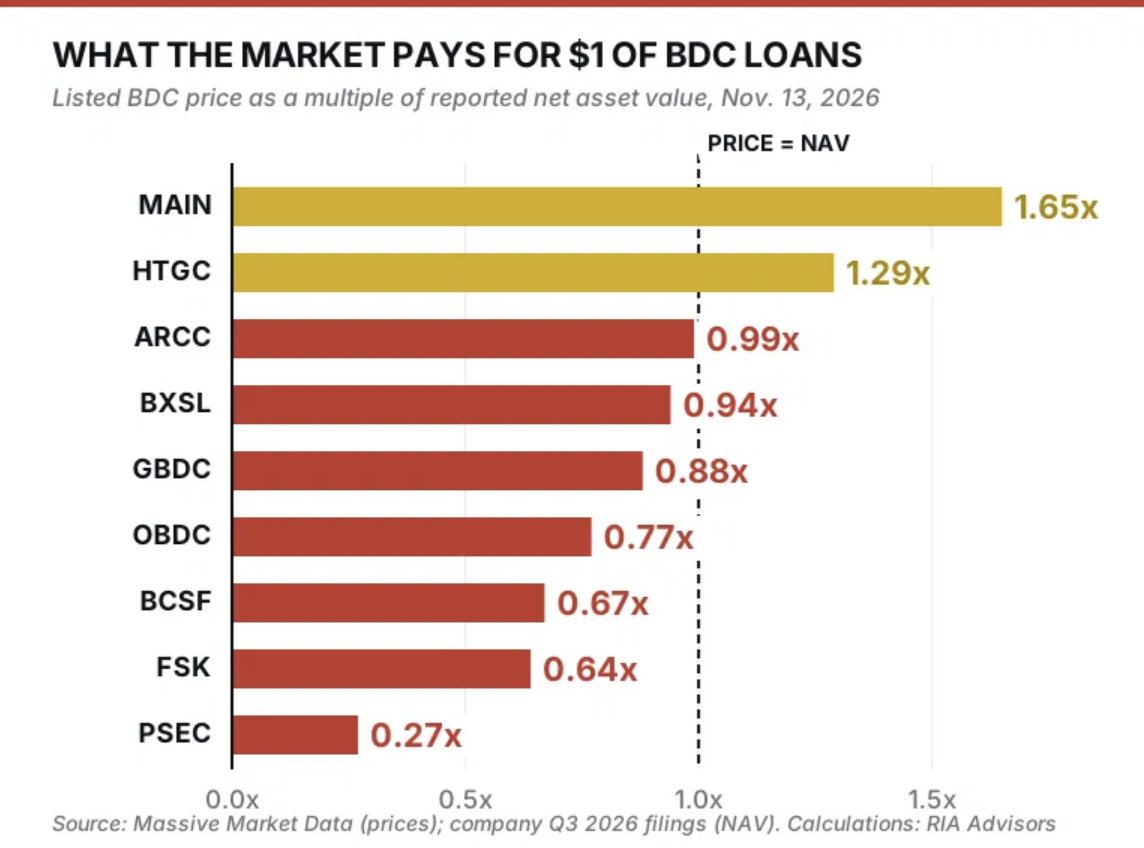
There’s a useful cross-check here. Listed BDCs hold the same kind of loans to the same kind of middle-market companies. The difference is that they trade on an exchange every day. Their price shows what investors will actually pay for a dollar of those loans today. A non-traded fund’s reported NAV can’t tell you that.
The detail that jumps out is Blue Owl’s own listed BDC, OBDC. It reported a net asset value of $14.32 a share at the end of September and closed November 13 at $10.97, or about 77 cents on the dollar.8,10 Its non-traded siblings transact with redeeming investors at reported NAV, when they transact at all. That doesn’t prove the non-traded marks are wrong. Listed prices carry their own fear premium, and a discount can say as much about sentiment as about the loans. But when the market price and the reported price differ by 10% to 25%, the investor who can only exit at the reported price, 5% at a time, is relying on marks the market won’t confirm.
Buyers are putting their own marks on these loans as well. In November, BC Partners’ listed BCP Investment Corp. agreed to buy Investcorp Credit Management BDC at 90% of its adjusted net asset value. It’s part of a wave of consolidation as smaller lenders look for scale. Ares Capital agreed to acquire MidCap Financial Investment Corp. in late October. When a professional buyer pays 90 cents per dollar of reported loans, that’s information, too.
My colleague Michael Lebowitz walked through why not all BDC yield is created equal, and the same discipline applies here. A discount is information. Deciding whether it’s an opportunity takes more work.
Is Private Credit Safe For Your Portfolio?
The word “safe” is the wrong focus. The much better test is whether the money you invest can sit idle for as long as it takes the line to clear. Start with the timeline. If you may need these funds in the next two years, the queue matters more than the yield. If the money truly is long-term, the gate is an inconvenience rather than a crisis.
More importantly, you should also focus on just how much of your liquid net worth sits behind a gate. A small sleeve of private credit in a large portfolio is one thing. A retirement income plan built around one is something else. Will a tender schedule ever be convenient? No. However, will knowing your exposure keep a gate from becoming a forced decision somewhere else in the portfolio? Absolutely.
Finally, ask what your plan assumes about a bad year. Retirees selling assets during a drawdown already face the problem I described in Sequence of Return Risk: The Math That Breaks Retirements. If the “liquid” sleeve you planned to draw from is gated, you sell whatever else is liquid. Often, that happens at the worst moment. Such is the hidden cost of illiquidity: it rarely hurts the asset that’s locked. It hurts the assets that aren’t.
None of this argues for rushing to tender. It also says nothing about whether any particular fund is a good or bad holding for you. It argues for knowing exactly what you own: the tender calendar, the cap, how proration works, and how long your share of the line might take to clear. Right now, the consensus says the private credit scare is over. It may be. The line is still there either way.
Private credit redemptions are easing, but the 5% door hasn't widened, so any money behind a gate should be money you won't need until the line clears.
The yield was real. So was the lockup, and plenty of investors are only now reading that part of the brochure.
Sources & Notes
- Reuters, “Blue Owl flagship fund withdrawal requests slow as private credit turmoil eases,” October 2, 2026, republished by WHTC.
- Ares Strategic Income Fund, Schedule TO-I/A final amendment, September 25, 2026.
- Crowdfunded Wealth, “Private Credit Fund Redemptions Tracker,” updated November 7, 2026, and “BDC Tender Offer Results, Q3 2026.” Blue Owl fill rates were replicated by dividing the 5% repurchase by each fund’s Q3 request rate (5% / 16.8% = 29.8% for OCIC, 5% / 39.0% = 12.8% for OTIC) and match the funds’ final filings of October 26, 2026. ADS (33.9%) confirmed by AltStreet. HLEND and NHPIF (43.7%) confirmed by AltsWire, November 4, 2026.
- Caproasia, Blue Owl Q1 2026 redemption requests, April 4, 2026. Q1 request rates also reported by Yahoo Finance.
- Blackstone Private Credit Fund final tender results (filed November 2, 2026), reported by Blue Vault and AltsWire: 181,287,647 shares tendered, 90,421,325 purchased (about 49.9%), $2.13 billion at the September 30 NAV of $23.51 per share.
- Private Equity Wire, “KKR private credit fund exceeds 5% redemption cap to meet investor withdrawals,” October 6, 2026.
- U.S. Treasury yield data via Massive Market Data, daily 3-month yields January 2010 through November 12, 2026. Annual figures are simple averages of daily observations. 2026 is a partial year.
- Ares Capital Corporation September 30, 2026 results and MidCap Financial acquisition, via Zacks, October 28, 2026 (NAV $19.31 per share, non-accruals 2.4% at cost). Blue Owl Capital Corporation, September 30, 2026 financial results, November 4, 2026 (NAV $14.32 per share).
- Bloomberg, “Fed Sees Private Credit Redemptions as ‘Manageable’ Risks,” May 8, 2026.
- Price-to-NAV ratios calculated by RIA Advisors from November 13, 2026 closing prices (Massive Market Data) divided by each company’s latest reported NAV per share: ARCC $19.31, BXSL $25.25, OBDC $14.32, FSK $18.28, HTGC $12.26, BCSF $16.49, PSEC $5.36 and MAIN $34.22 (midpoint of its preliminary $34.18 to $34.26 estimate), all as of September 30, 2026, and GBDC $14.25 as of June 30, 2026. GBDC reports September 30 results on November 17.
- Private Equity Wire, “BC Partners to acquire Investcorp BDC at 10% discount to NAV,” November 12, 2026, and Reuters, “Private credit roundup: Lenders consolidate, seek scale as earnings pressure builds,” November 13, 2026.
- Additional reading: Private Equity – Why Am I So Lucky and Is Private Equity A Wolf In Sheep’s Clothing.
Lance Roberts has spent more than 30 years analyzing markets, Federal Reserve policy and the economy. He writes the weekly Bull Bear Report and the Daily Market Commentary, and hosts The Real Investment Show, broadcast live weekday mornings. His commentary appears regularly on CNBC, Fox Business and Bloomberg. His work starts with managing risk, because the math of loss is unforgiving.
A message from Advisor Perspectives and VettaFi: Discover something new! Click here to register for our upcoming webcasts.
© Real Investment Advice
Read more commentaries by Real Investment Advice