Sometimes, change comes at you so fast that you forget to congratulate yourself on what you’ve achieved.
Take the switch of the world’s electricity grids from fossil fuels to clean power. The transition to renewables will “require generations of perseverance” and be harder than previous shifts between wood, coal, oil and gas, which took half a century or more, energy economist Vaclav Smil wrote in 2014. The costs of reducing emissions using existing technologies would be “beyond astronomical,” Smil’s acolyte Bill Gates warned the following year.
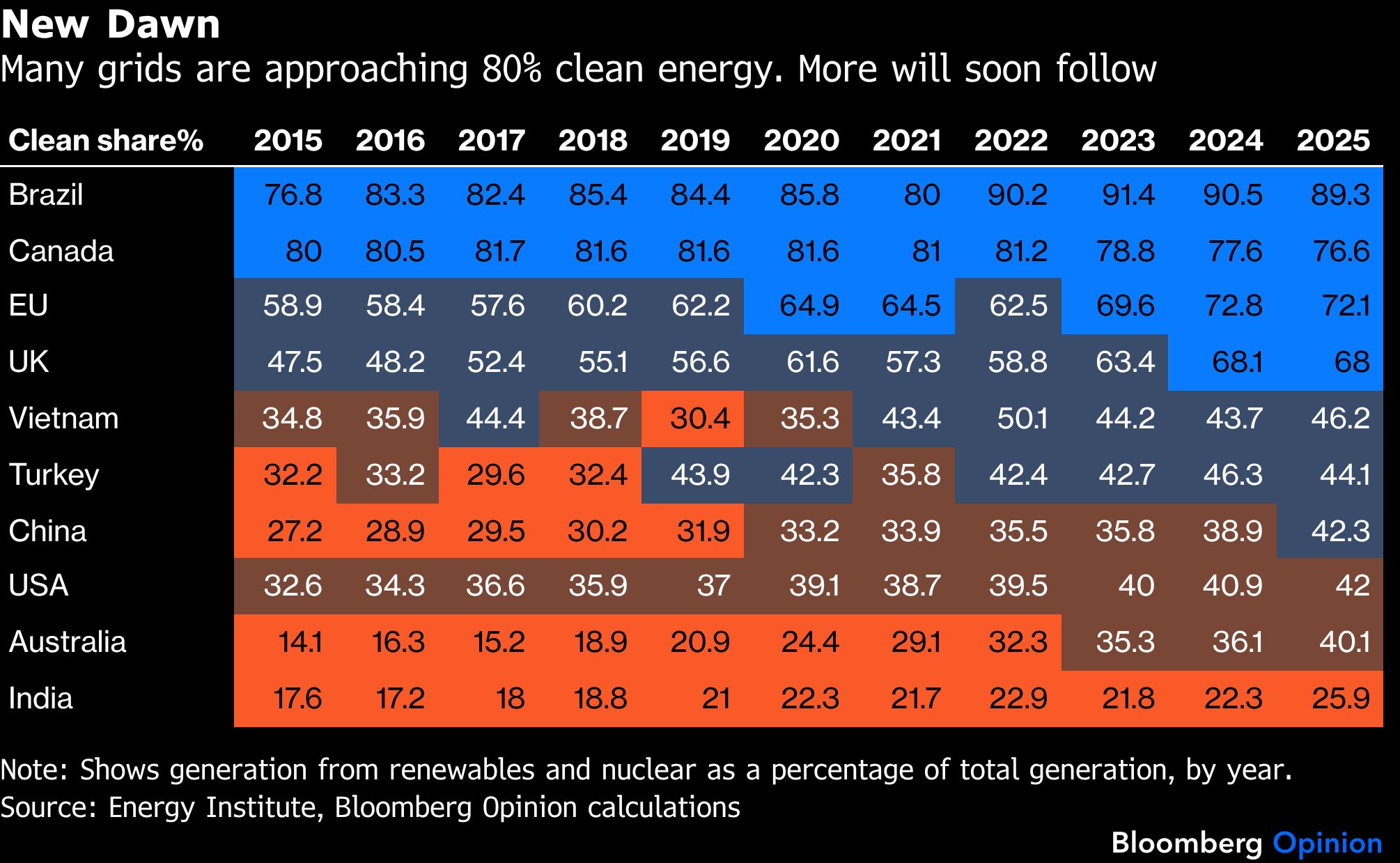
In practice, we cracked the biggest chunk of the problem in a decade. Last year, clean energy sources generated about as much electricity as the entire world consumed as recently as 1996. About half came from wind and solar power. Once the current pipeline of wind and solar projects is completed in the next two to three years, the UK and European Union are likely to join hydro-dominated Brazil and Canada as rare markets where about 80% of electricity comes from non-emitting sources.
See more: The Active Decisions Inside Every Passive ESG Fund
Australia looks on track to join them around 2030, and Turkey and Pakistan may reach the same point around 2035. Even China, the biggest emitter, may not be far behind: Coal fell below 50% of generation in the first half of this year, and a recent study reckoned the country could be as much as 80% clean by 2035, if renewables are built roughly in line with current targets.

As nations gather in the Turkish city of Antalya for the United Nations COP31 climate conference this week, those milestones should prompt celebration, but also a reset. Cleaning up the world’s grids is going to prove the easy part of the energy transition. Turning that electricity into the default way to power everything else in our modern industrial societies will be harder.
It’s astonishing what has already been achieved. The great energy battle of the 2000s and 2010s — whether renewable electricity could ever compete on its own terms with fossil fuels — has been settled in the transition’s favor. Some 82% of the increase in electricity production since 2021 has been zero-carbon.
On every imaginable cost metric, clean power is now cheaper across most of the planet. In Saudi Arabia — a perennial obstructionist at UN climate conferences — tens of gigawatts of solar projects have now signed contracts to sell electricity at never-seen-before low prices, well below two cents per kilowatt-hour. India, projected to have the biggest increase in emissions over the coming decade, can now provide solar-wind-battery power that matches the 24-7 performance of fossil generators at a 10% discount to coal.
Building brand-new solar and wind farms backed up by batteries is cheaper in many Asian and European countries than just continuing to run an existing, fully-depreciated gas plant. Coal is heading in the same direction in many places. In Turkey, renewables fell below the operating costs of coal generators in 2023, even as its main solid fuel suppliers in Russia and Colombia operate mines at a loss.
That success prompts a whole new set of problems, however. One reason many of the most aggressive decarbonizers in the EU and the UK are suffering such angst around their electricity systems right now is that they’re running up against a version of the Pareto principle, whereby 80% of problems can be traced back to 20% of factors. Decarbonizing the last 20% of generation will be far more difficult than flushing fossil fuels out of the first 80%.
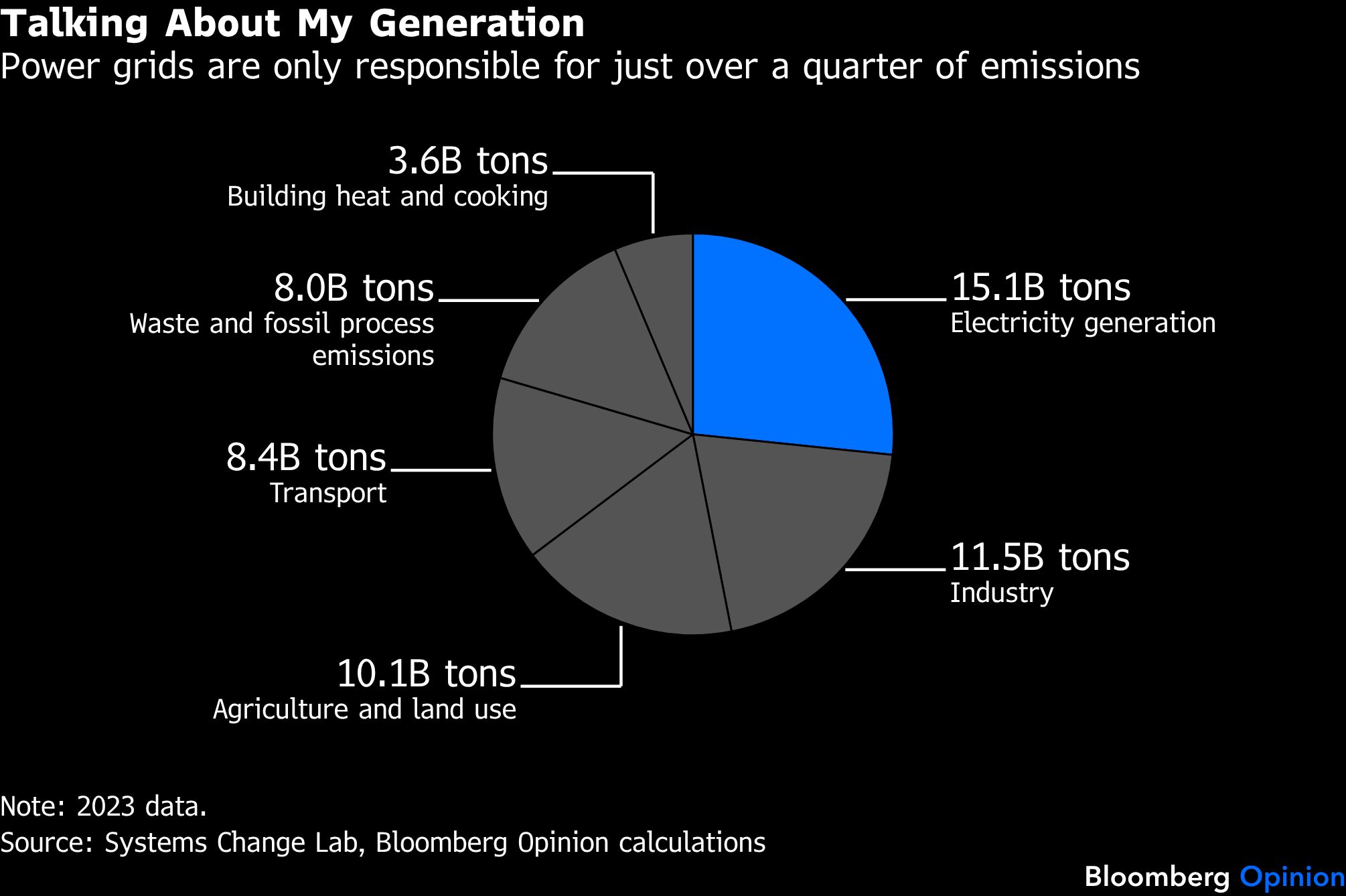
That requires a rethinking of where we stand in the energy transition. Power grids are the biggest slice of carbon pollution, but still only make up about a quarter of all emissions. As a result, the priority for the 2030s should be different from the 2010s. Instead of concentrating on squeezing the final tons of carbon from electricity, governments need to make abundant clean power cheap enough to drive fossil fuels out of everything else — in particular, electric cars and trucks, home heating systems, and the sort of low-temperature heat used in food and paper manufacturing.
Electricity itself is now one of the biggest hurdles on that front. In many countries, the green policy experimentation of the 2000s dumped a pile of legacy charges onto household and industrial bills, making plug power paradoxically costly to consumers, even when it’s cheap to generate. The greenest sector of most European industries, the grid, is the one that pays the highest carbon prices. In Germany and Austria, changing this regulatory set-up could have cut costs by 25% to 30% during the 2022 energy crisis, according to one study this year.
Fixing those problems is essential — not least because we need grid power to be cheaper if it’s to do its job of cleaning up the rest of our industrial society. That will require us to replace fossil-fired vehicle engines, gas boilers and coal furnaces with electric motors and heat pumps instead.
Building clean power grids was supposed to take generations. We’re doing it in less than one. Now comes the harder task: running everything else on electricity, too.
A message from Advisor Perspectives and VettaFi: Discover something new! Click here to register for our upcoming webcasts.
Bloomberg News provided this article. For more articles like this please visit
bloomberg.com.
More ETF Topics >