This article will outline the key steps and best practices financial advisors should take to become trusted advisors in the realm of cybersecurity.
With 2024 continuing to see uncertainty, advisors need strategies to help address hard-to-predict markets. Join Fidelity Investments Institutional Portfolio Manager Michael Hagopian for this 30-minute LiveCast to hear how Fidelity’s Enhanced ETFs are constructed to identify both traditional and non-traditional long-term drivers of risk and return to achieve a differentiated, low-cost source of potential alpha.
Norinchukin Bank is best known outside of Japan as an investing whale in the market for bonds that package up loans to private equity businesses, known as collateralized loan obligations.
Declines in foreign direct investment in China bolster the thesis that global companies are turning away from the world’s most-important production hub, continuing the trend of decoupling that has policymakers and corporate leaders looking for alternative manufacturing bases. The truth of the nation’s deteriorating importance isn’t so simple.
Every now and then, a company comes along that is so dominant and is growing so quickly that it feels like the only stock anyone cares about. I’m referring, of course, to Nvidia Corp., the chip giant powering artificial intelligence. Its stock has surged 4,000% over the past five years, making it one of the three most valuable businesses in the world alongside heavyweights Microsoft Corp. and Apple Inc.
Nvidia Corp. shares showed signs of steadying after a $430 billion selloff sent traders searching for signals as to where the bottom may be.
Some experts believe investment-grade corporate bonds remain an opportunity-rich corner of the fixed income market.
This year's tale of two markets has underscored resilience at the index level but considerable weakness at the individual member level, leading to massive performance divergences.
Financial markets have posed a number of vexing questions to investors over the past two years, not the least of which included the height to which interest rates could rise without negatively impacting US economic activity.
Market expectations for Federal Reserve rate cuts in 2024 have shifted dramatically, from six cuts expected at the start of the year, to barely one or two at this writing. Here’s why we think the US economy’s resilience and the year-to-date increase in yields may prolong an attractive opportunity in fixed income.
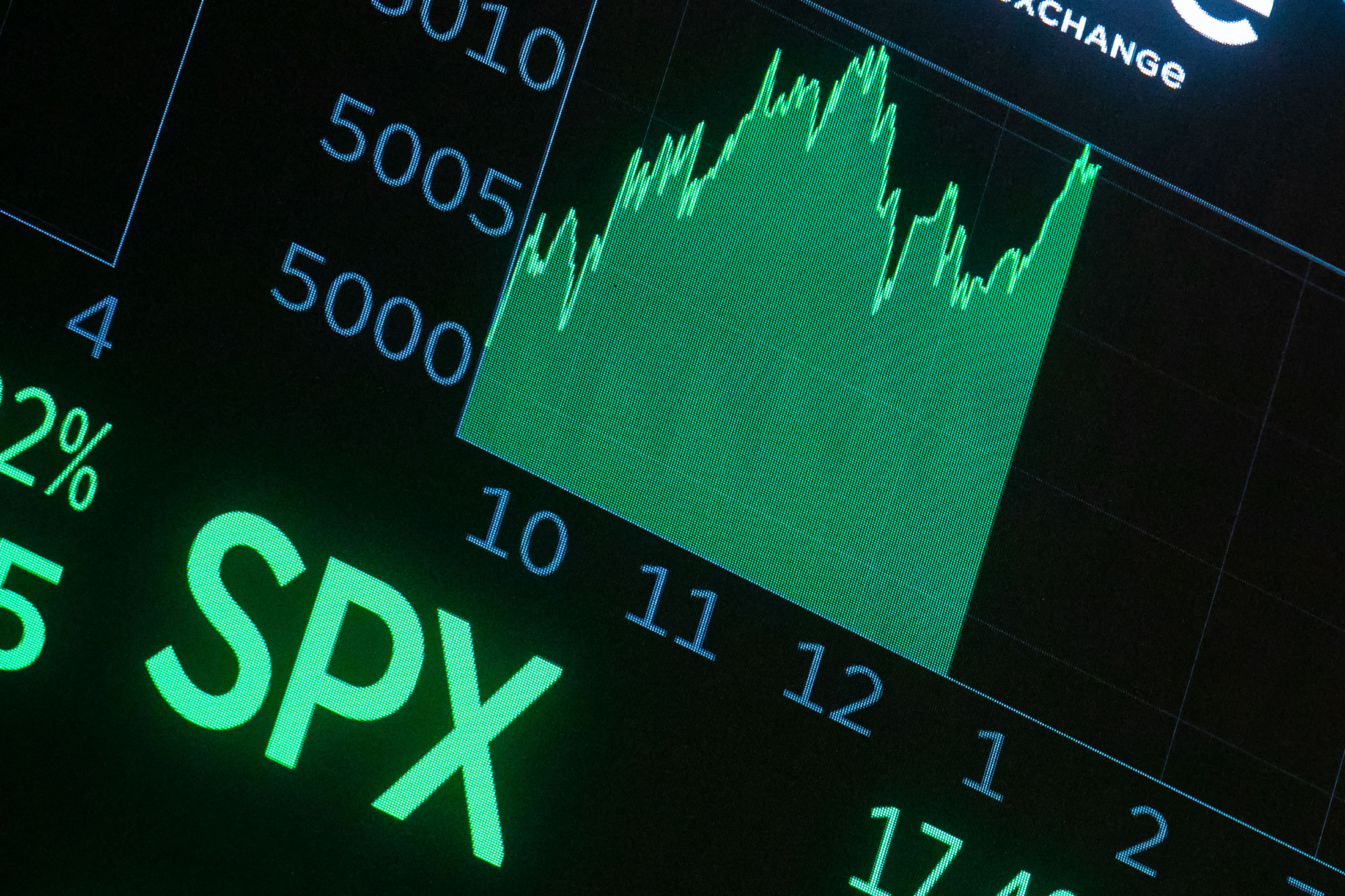
After the S&P 500’s incredible run—up 57% from its October 2022 lows and with an election on the horizon, its normal for investors to wonder whether to take some chips off the table or hold off on investing to see what happens.
Will the energy transition, from fossil fuel to other sources of energy, happen? It seems almost sacrilegious to suggest that it might not, or that the transition will be halting and incomplete.
The U.S. is clearly a leader in terms of regulatory enforcement. However, its regulators also have an important role to play in informing and shaping regulatory policy on an international scale. industry, this role is only likely to become more important.
I may as well just say it. Based on the present combination of extreme valuations, unfavorable and deteriorating market internals, and a rare preponderance of warning syndromes in weekly and now daily data, my impression is that the speculative market advance since 2009 ended last week.
In the early 2000s, Alok Nanda’s new colleagues called him the “bumper guy.”
On this episode of the “ETF of the Week” podcast, VettaFi’s Head of Research Todd Rosenbluth discussed the BondBloxx CCC-Rated USD Yield Corporate Bond ETF (XCCC) with Chuck Jaffe of “Money Life.” The pair talked about several topics regarding the fund to give investors a deeper understanding of the ETF overall.
New home construction slumped to the weakest level in four years in May, confirming a trend that’s been evolving for the past few months — residential construction is once again acting as a drag on economic growth in the US.
The S&P 500 Index has likely logged most of the gains it will see this year as investors are growing increasingly nervous about the stock market’s rich valuations, according to the latest Bloomberg Markets Live Pulse survey.
Signs of cooling inflation are bringing bond bulls back as the Federal Reserve recently kept interest rates unchanged yet again.
Economic indicators are released every week to provide insight into the overall health and performance of an economy.
Just as optimism is growing among investors that a rally in US Treasuries is about to take off, one key indicator in the bond market is flashing a worrying sign for anyone thinking about piling in.
A well-thought-out long-game thesis can stay intact for long periods with slight adjustments when needed. Like a long and straight drive in golf, when your macroeconomic thesis proves correct, a good portion of your investing job is done.
Maximizing tax alpha for clients is not just a niche strategy but a vital component of comprehensive financial planning. It empowers advisors to capture their piece of the $600 billion opportunity and differentiate their practice, while providing unparalleled service and value to their clients.
The latest consumer survey data from the New York Federal Reserve had interesting data.
Bitcoin could be headed for the stratosphere, according to a new report by Bernstein. The global investment firm is predicting that the world’s top digital asset could hit $200,000 by 2025, $500,000 by 2029 and—no, you’re not seeing things—$1 million per token by 2033.
On the latest edition of Market Week in Review, Director and Senior Investment Strategist Alex Cousley discussed recently released economic data from China, including home prices and credit numbers. He also covered the Bank of England’s (BoE) recent rate decision and provided an update on U.S. retail spending during May.
Artificial intelligence startup Anthropic is releasing a new AI model that it calls its fastest and most capable yet in a rivalry with OpenAI.
We are excited to announce that Ian Bremmer will once again headline Exchange, happening on March 23-26, 2025 in Las Vegas.
Senior loan ETFs have gained traction as elevated rate expectations spill over into the second half of the year.
Private credit investors in Europe are abandoning leveraged plays to try to get ahead of a potential wave of defaults.
The nonpartisan Congressional Budget Office ramped up its estimate for this year’s US budget deficit by 27% to almost $2 trillion, sounding a fresh alarm about an unprecedented trajectory for federal borrowing.
As Russian President Vladimir Putin and Chinese Premier Li Qiang wrapped up separate meetings in Southeast Asia this week, the two partners in the BRICS economic bloc encountered a region keen to join a group seen as a hedge against Western-led institutions.
This summer, countless bankers and financiers will get away to the Hamptons or vacation in Europe. And a handful will be traveling nearly every weekend — to play lacrosse.
Small cap performance has been a hot topic lately, with many pundits declaring the small cap premium on life support or dead altogether.
Bitcoin slumped to a more than one-month low with this year’s record-breaking rally showing signs of fatigue in the absence of fresh market catalysts.
Blockchain is relatively young, but it’s increasingly becoming a political hot spot. That’s worth examining.
When it comes to stocks with the artificial intelligence (AI) label, Nvidia (NVDA) arguably takes the cake.
After being on the frontline of the pandemic, then grappling with an edgy public and a spike in shoplifting, its been a tough few years to work retail. But for Walmart Inc. managers, at least, things are looking up.
First-generation low carbon equity benchmark indices were developed almost a decade ago with the goals of mitigating climate risk and preparing for the transition to a low carbon economy.
Nadeem Meghji was on honeymoon in late 2022 when the biggest storm to have rocked Blackstone Inc.’s property business hit its peak.
Bonds surged after business activity across Europe encountered an unexpected setback, prompting traders to amp up wagers on monetary easing.
Market indexes can be a useful barometer of long-term performance. But the investment opportunity set need not start and end there. Fundamental Equities investor Alister Hibbert uses an unconstrained approach in seeking to identify those rare companies that stand out from the pack.
Silicon Valley’s “move fast and break things” mantra propelled tech innovation for the internet age. In the era of artificial intelligence, it should take a leaf out of Japan’s playbook and slow down.
Take out the few big tech companies that keep pushing the S&P 500 Index to all time highs and it looks like the engine is running on fumes.
It could be an opportune time to take advantage of core bond exposure now before a potential rally despite latest Fed-speak.
New research highlights how active management may be more beneficial than passive strategies for avoiding overvalued securities.
The Federal Reserve policy can set the tone that drives interest rates across the maturity range but an earlier market rate downturn can occur as a signal of investor perception of a slowdown in the economy.
In the past decade, investors have started to factor in the cost of a product when they make decisions. Issuers have responded by lowering expense ratios, but there are other factors that can contribute to a product’s total cost. Tracking error and trading expense can also impact the total cost of a given ETF, for example.
Join the experts at Vanguard on June 20th at 2pm ET and learn all about the benefits of reducing all costs associated with an ETF.
Today’s unusual market creates enormous headwinds for many investors. Fixed income uncertainty, rising US national debt, and other challenges are making finding reliable liquid income challenging. Close-End Funds (CEFS), Business Development Companies (BDCs), Real Estate Investment Trusts (REITs) and Energy Master Limited Partnerships (MLPS) are all compelling, non-correlated income generators.
Recently, James Grant, editor of the Interest Rate Observer, was asked about his outlook for interest rates. He sees interest rates moving in a cyclical pattern, potentially rising for another multi-decade period.