What's the debt ceiling? Learn how the debt ceiling works and how a default on federal debt could impact the U.S. stock market and economy.
To anyone going through a breakup, just remember this lyric from Bernadette Peters: “If I’m patient the break will mend and one fine morning the hurt will end.”
With the world order in flux, investors can look to fortify portfolios by diversifying across global markets and capitalizing on attractive, high quality yields.
Despite the recent volatility, the S&P 500 remains at record-breaking levels of concentration
This video examines the ratio of unemployment claims to the civilian labor force and its effectiveness as a recession indicator.
Financial institutions shouldn’t underestimate the depth of regulatory complexity coming their way. A misstep in just one area — whether it’s KYC, AML or elsewhere — could unleash severe consequences.
US Treasuries surged as easing US consumer inflation prompted traders to increase their wagers on more than one Federal Reserve interest-rate cut this year.
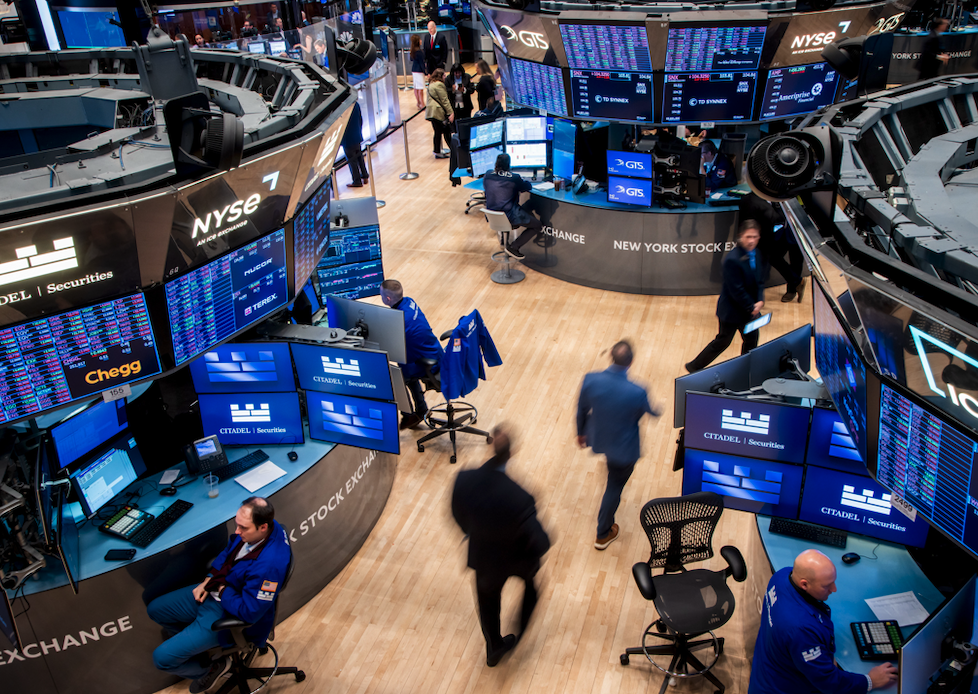
Back in 2016, Intercontinental Exchange Inc., the owner of the New York Stock Exchange, revealed that it was considering an offer for the London Stock Exchange Group Plc.
Wall Street analyst outlooks are typically bullish. If you aggregate every price target on every S&P 500 Index company and weight them to match the index, it’s exceedingly rare for the overall number to fall.
US stocks oscillated between small gains and losses on Wednesday, as traders look past an upbeat report on cooling consumer prices and assess the outlook for global trade.
Underlying US inflation rose in May by less than forecast for the fourth month in a row, suggesting companies are largely holding back on passing higher tariff costs through to consumers.
Transitioning away from your current firm is always a big step, but leaving a non-Broker Protocol firm comes with unique complexities — and potential legal pitfalls — if you're not fully prepared.
The right custodian will be more of a partner than a vendor. Here are some things to consider when making your selection.
While the immediate path for tariffs may drift lower, the U.S. legislative branch is hammering out a tax and spending bill that seems to favor tax cuts over lower spending, reviving worries over the U.S. budget deficit and a growing debt burden that cannot be ignored.
Advisors looking to add or enhance existing gold exposures in their portfolio have a range of strategies to consider within the ETF vehicle.
The global economy is continually evolving due to inflation, interest rates, and geopolitics. How could these and other factors influence the major asset classes over the coming decade?
If we lived in a world where mobile signals were visible, the sky would shimmer like a storm—layers of frequencies rolling over rooftops, crossing oceans and saturating valleys.
Long-time Kestra ecosystem firm SilverStar Wealth Management combines with existing Bluespring partner LifeBridge Financial Group, strengthening Texas-based presence
The U.S. economy and stock market face a confluence of challenges in the second half of the year, keeping the bar relatively (but not restrictively) high for outperformance.
Doug Drabik discusses fixed income market conditions and offers insight for bond investors.
Robotics was one of the earliest examples of a disruptive technology. It enjoyed some time in the investment community limelight. But it was rapidly usurped by other innovative technologies, including AI.
The US housing market remains in a state of inertia. Despite the arrival of the spring selling season, both new and existing home sales continue to underwhelm.
In recent years, “buying the dip“ and more vulgar variations have often been equated to “dumb money” or retail investors, who are presumed to always make a mistake. However, as investors, we need to rethink how we view “buying the dip” because the whole goal of investing is to “buy low and sell high.”
Diversification of portfolios using international equities can reduce volatility and enhance risk-adjusted returns, especially given recent geopolitical shifts that decrease correlations between U.S. and international markets. Despite some investor skepticism, and as we discuss below, the benefits of international diversification can be significant and should be considered in investment strategies.
In this video, Chuck Carnevale, Co-Founder of FAST Graphs, aka Mr. Valuation will do a comprehensive analysis of Autoliv Inc (ALV), the world’s largest automotive safety supplier.
Virtually all the marketing activities are exactly what other advisors are doing as well. Never follow the crowd.
When it comes to selecting a person to be a healthcare proxy, here are a few characteristics that advisors can encourage their clients to consider.
Advisors can help clients and their families plan for the rising costs of tuition and other educational expenses by knowing the benefits of 529 plans — and staying up-to-date on evolving rules around these investment vehicles.
A college degree may be a milestone that represents one possible career path. But it’s not your only route toward a future that is both financially sound and deeply fulfilling.
Small-cap stocks tend to offer greater growth potential than their large-cap peers, but those returns have yet to materialize consistently. What will it take to turn the tide?
Stablecoins are a special flavor of cryptocurrency. Unlike Bitcoin or countless wildly traded memecoins, whose values rise and fall based on market moods, the most popular versions of these digital tokens are supposed to always be worth $1 each.
Blackstone Inc. is planning to invest as much as $500 billion in Europe over the next 10 years, underlining the continent’s growing appeal to investors during a period of geopolitical flux.
Analysts at firms including Barclays Plc and JPMorgan Chase & Co. see further upside for US stocks, in part because they expect institutional investors to abandon their cautious stance and ramp up exposure to equities.
My unifying theory of finance is that everything goes seriously wrong when people start seeing something — a bond, a mortgage-backed security, a crypto exchange — as risk-free when it isn’t.
The Fear Trade is what most Western investors are familiar with. It’s the flight to safety during times of uncertainty, driven by concerns over inflation, interest rates, geopolitical risk and more.
I spent the last two weeks of May catching up with partners and clients in Malaysia, Singapore, China, and Hong Kong. Following are some reflections on those conversations.
Here’s the blunt truth: Many great investment strategies fail because of poor implementation. Robust capabilities in trading, transition management, overlays and currencies are critical to executing a strategy.
Investors looking to move big blocks of corporate bonds have long relied on exchange-traded funds listed on stock exchanges to jump in and out of positions. But now, they’re increasingly trading directly in the debt market.
The push to put private assets in the hands of individual investors is breathing new life into a relatively quiet corner of the asset management industry: interval funds.
Investors may revisit international exposure in their portfolios amidst reduced market reactions to tariff announcements, uncertain U.S. policy and lagging U.S. stock performance.
For the first time in five months, gold-backed ETFs globally reported modest outflows in May as investors took profits.
Markets may be fretting over Federal Reserve policy and economic soft landings, but a handful of momentum ETFs have quietly been stealing the show. Across the array of factor funds, momentum has performed best this year.
After falling 0.7% in April, the S&P 500 gained 6.3% last month, marking the index’s best May return since 1990 and its best monthly return since November 2023 (see the chart).
Back during the Financial Panic of 2008, clickbait media kept screaming “Hyperinflation.” We consistently pushed back against this theme, and argued inflation would not accelerate.
Last week’s employment report was an important stabilizer for the markets. After concerning revisions and weak ADP numbers raised recession alarms, Friday’s payrolls print calmed fears on labor market deterioration.
As we head into the second half of the year, US markets seem to be turning around, with economic data that is still coming in mixed. The major US indices were up the first three days of last week, dipping on Thursday after weaker back-to-back readings of the US labor market.
In this webinar, we’ll explore how the Oakland A’s used a “Moneyball” strategy—favoring data over instinct—to beat the odds. And we’ll show how the same principle can be used to build stronger, more resilient portfolios.
Carolyn McPhillips, President of MFDF, sheds light on the evolving role of ETF directors and their growing importance as investment products become more complex – particularly in emerging areas like crypto and private assets. VettaFi’s Zeno Mercer explores artificial intelligence ETFs, highlighting new launches and offering tips to help investors navigate this rapidly expanding category.
VettaFi’s Head of Research Todd Rosenbluth discussed the Fidelity Enhanced International ETF (FENI) on this week’s “ETF of the Week” podcast with Chuck Jaffe of “Money Life.”
Investors nearing or in retirement who are currently defaulted into TDFs need to stop defaulting and move to safety now.