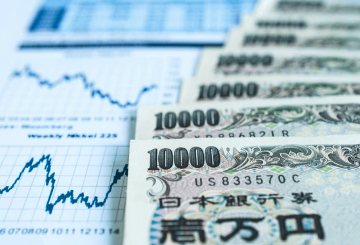
The selloff in Japan’s long-dated bonds is drawing international investors, who expect the securities to rebound as global trade turmoil abates.
Saudi Arabia is ramping up efforts to lure high frequency trading firms — a campaign that’s already brought in major players from Citadel Securities to Hudson River Trading — as it looks to bolster activity on the Middle East’s largest stock market.
Gold steadied as investors pulled away from risky assets and waited for more clues on the Federal Reserve’s rate path.
Our overarching theme for U.S. fixed income has been, and will continue to be, based on the premise that interest rates will stay at more historically “normal” levels, but that, within this backdrop, investors will face heightened volatility.
In this video – Part 2 – Extreme Risk of High Valuation – Chuck Carnevale, Co-Founder of FAST Graphs, aka Mr. Valuation discusses the volatility of the stock market, using the S&P 500 (SPY) as a proxy.
By the end of April, the S&P 500 rallied its way back, recovering nearly all the declines notched in the opening days of the month when President Trump's "Liberation Day" tariff plans tipped markets towards bear territory.
Are you trying to grow a stable team of advisors and retain top talent? Young advisors are looking for RIA firms that offer remote work flexibility, a clear path toward advancement and role transparency.
Explore the performance journey of the S&P 500, Nasdaq, and Dow Jones since their peaks in 2000. This video analyzes how these key U.S. stock market indexes have navigated over two decades of economic shifts and technological change, revealing their distinct paths through April 2025.
A solution that merely saves time on administrative tasks will quickly become stale as the business grows. Success lies in determining how the AI tool you are implementing will have a lasting effect on the advisor’s workday routine.
Equity investors pushed back into the market by a relentless rally are about to find out that the real challenge is just beginning.
Retail investors have won again. When trade tensions flared in early April and about $6.6 trillion in market value vanished from US stocks in just two business days – the fifth-worst two-day drop since the S&P 500’s creation in 1957 – they didn’t panic.
Flows of gold into Asian ETFs exploded in April, driving global ETF gold holdings higher for the fifth straight month.
Assessing a bear market rally proves challenging when you experience it firsthand. It is only in hindsight that the complete picture reveals itself to investors. Of course, after a bear market rally, investors tend to review their investments and speculate on what they should have done differently.
In this video, Chuck Carnevale, Co-Founder of FAST Graphs, aka Mr. Valuation discusses the volatility of the stock market, the truth about the S&P 500’s valuation, using the S&P 500 (SPY) as a proxy.
Alexandra Levis, Founder & CEO of Arro Financial Communications, provides an in-depth look at how ETF issuers should think about approaching marketing. VettaFi’s Roxanna Islam breaks down some of the year’s top-performing ETFs, from international plays to precious metals.
Despite the recent volatility, the S&P 500 remains at record-breaking levels of concentration. At the same time, the S&P 500 Equal Weight’s tracking error is high and growing, introducing significant active risk in portfolios. The new S&P 500 Historical Weight ETF (DSPY) solves both these issues by using historical concentration levels.
In 2025, liquidity is not a background variable — it's a front-line risk factor, one that’s being tested repeatedly as global markets navigate a web of geopolitical uncertainty and macroeconomic signals.
US inflation rose by less than forecast in April amid tame prices for clothing and new cars, suggesting little urgency so far by companies to pass along the cost of higher tariffs to consumers.
Global AI, a US tech firm, plans to collaborate with a Saudi Arabian artificial intelligence venture, Humain, in an agreement expected to be worth billions of dollars, according to a person familiar with the mattter.
A wave of municipal-bond sales scheduled for this week will test a recent rebound in buyer demand after investors sold their holdings during April’s market rout.
Tariff talk has been at a fever pitch for the past three months. Its dominance of the news cycle has crowded out discussion of other important economic issues, such as the sustainability of America’s national debt.
The roller coaster continues! A stronger than expected first quarter earnings season and encouraging signs on the trade front—highlighted by the US-UK trade deal—helped lift the S&P 500 from its April 8 near-bear market lows, reversing nearly all post-Liberation Day (April 2) losses.
The April plunge in stocks ushered in a huge washout in investor sentiment, but more so on the attitudinal side as opposed to the behavioral side.
The Q1 2025 earnings season heads into its final peak week with mostly positive results from S&P 500 companies thus far. With 90% of companies from the index now reporting, 78% have beaten Wall Street’s expectations, slightly better than what we’ve seen historically.
For my entire decades-long career in capital markets, I’ve made the case that gold is not just a shiny relic of the past, but a serious, strategic asset for modern investors. After years of pounding the table, it feels pretty good to say that the world’s central banks—and now the U.S. banking system—are finally catching up.
With the latest Fed meeting leaving rate cuts in doubt, advisors might want to look to active managers to navigate the fixed income space.
Kevin Flanagan, head of fixed income at WisdomTree, joined a VettaFi panel to break down the most attractive fixed income strategies.
On this episode of the “ETF of the Week” podcast, VettaFi’s Head of Research, Todd Rosenbluth, discussed the Unlimited HFGM Global Macro ETF (HFGM) with Chuck Jaffe of Money Life. The pair discussed several topics related to the fund to give investors a deeper understanding of the ETF overall.
Today Tesla is not trading based on car sales but on future dreams of self-driving robo-taxis, robots, semis, and whatever else Elon dreams up. The car company may be worth $100 billion to $180 billion; the rest is what investors are willing to pay for Elon’s dreams.
Are you prepared to adjust your portfolio in the coming months for the possibility that calm, tranquil markets and a resumption of the bullish trend emerge?
Fixed income investors who want to diversify their portfolios in a challenging market environment shouldn't overlook CLOs.
As April’s volatility storm fades into memory, traders are left balancing calmer markets and the ever-present risk of a fresh round of headline shocks.
The dollar soared and Treasuries fell as the trade war between China and the US eased, stoking appetite for risk assets.
With Wall Street kicking off another rally, American stocks are now trading like Donald Trump’s “Liberation Day” shock never happened.
Chief Economist Eugenio J. Alemán discusses current economic conditions.
While coming in much stronger than expected, the latest employment data confirmed what we already suspected: the economy is slowing.
Warren Buffett opened his 60th—and final as CEO—Berkshire Hathaway annual meeting with the same understated clarity that has defined his career: "This is my 60th annual meeting... I think it'll be the best yet."
As the effects of US import tariffs begin to emerge, we shift our stance on equities to underweight.
Last week featured a light economic calendar, with the Fed holding its benchmark interest rate steady for the third consecutive meeting.
Financial advisors will be working with millennials and Gen Z, either as new clients or as family members of existing ones.
China drove the surge in retail investment demand, charting the second strongest quarter on record.
US equity investors will be watching closely as trade talks kick off between the Trump administration and China, with trillions of dollars hanging in the balance for American companies.
Major tech companies lobbying to salvage a tax deduction for research and development are warning they may pull back from high-profile pledges of new US investments if Congress doesn’t fully reinstate the break.
The culture clash between Bitcoin enthusiasts and gold bugs is about to be played out in the world of exchange-traded funds.
The federal government recently resumed student loan collections after a multi-year pause. This affects millions of borrowers who have been in forbearance since March 2020. Our Bill Cass outlines some options for borrowers in default.
As investors wait for updates on trade deals during the pause in tariff implementation, the focus for many has turned to economic growth and the conflicting data surrounding it.
The US said it’s developing a fast-track process for screening foreign investments in the US, an effort Trump administration officials expect could smooth the way for billions from wealth funds in the United Arab Emirates, Saudi Arabia and Qatar.
Once again, the Federal Open Market Committee (FOMC) decided to keep rates unchanged at today’s meeting, leaving the Fed Funds trading range at 4.25%-4.50%, keeping the level for overnight money 100 basis points (bps) below last year’s peak reading.
S&P 500® earnings per share estimates have come down sharply. According to FactSet, calendar year 2025 is now expected to show $266 in operating EPS for the Index.
The current geopolitical climate has injected an extra dose of unpredictability into the economy.