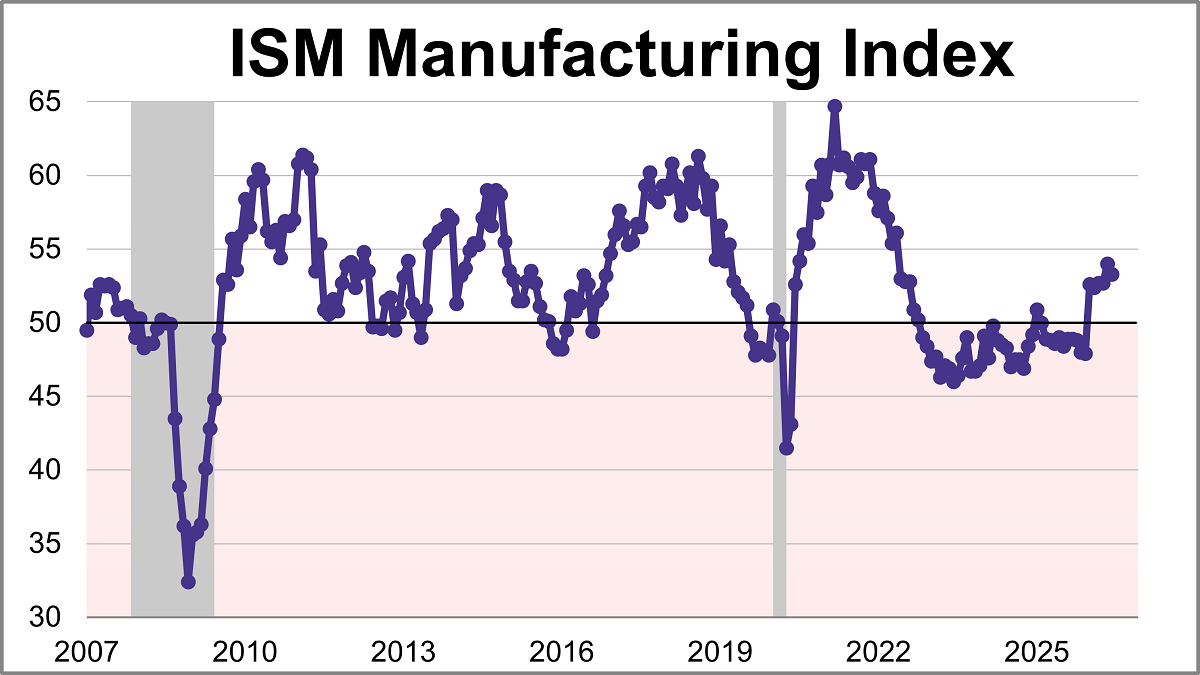
The Institute for Supply Management (ISM) manufacturing purchasing managers index (PMI) came in at 53.3 in June, down from 54.0 in May, marking slightly slower growth. The latest reading was just below the 53.8 forecast and is the index's sixth straight month in expansion territory.
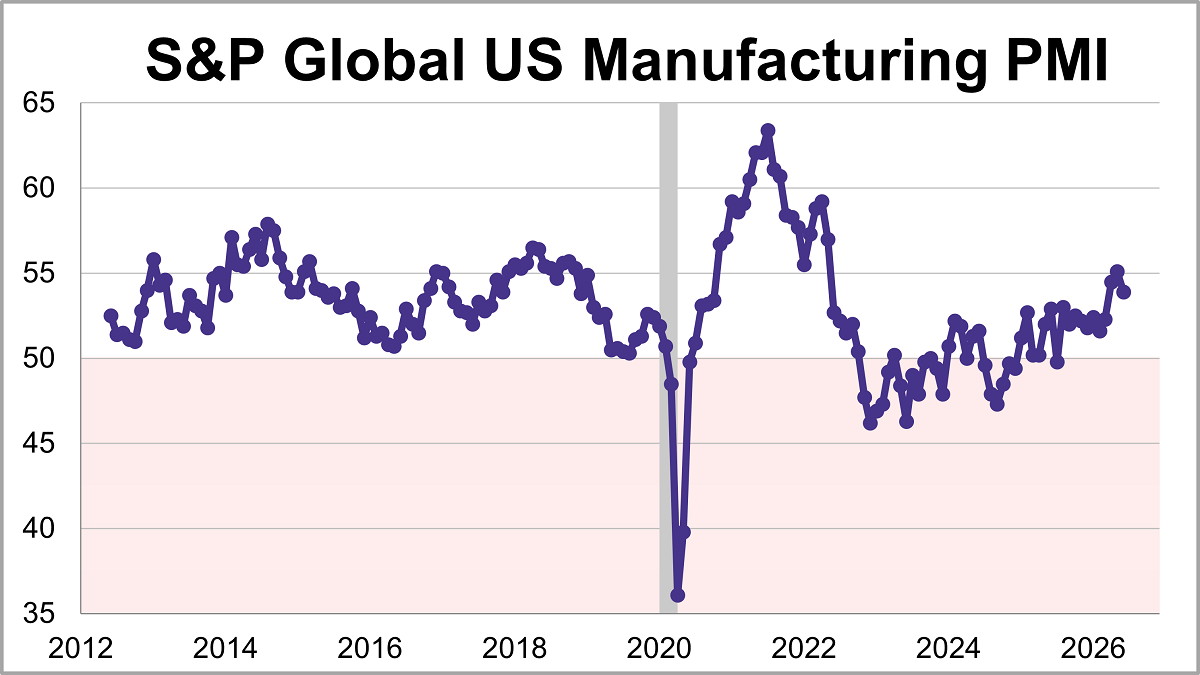
U.S. manufacturing expanded for an eleventh straight month in June but the growth eased to its lowest level in three months. The S&P Global PMI fell 1.2 points to 53.9 last month, falling short of the 55.7 forecast.
The firms that operate rigorous vendor evaluation will compound two advantages simultaneously: They buy the right tools now, and their advisors trust them when the next generation of AI arrives. In a decade that will be defined by the industry's capacity to do more with fewer people, that trust is a strategic asset.
July is a great time to buy stocks. In fact, it’s been the best month for the S&P 500 Index in the past two decades. Bulls are finding comfort in that history ahead of what stands to be an eventful stretch.
A strong quarter across major indexes. The second quarter is winding down and what a quarter it has been with the S&P 500 up 12.6% quarter to date, while the Nasdaq-100 and Russell 2000 are both up over 20%. Despite some twists and turns, the path of least resistance for stocks broadly remained up and to the right for much of the last three months.
Benchmarks are broken. That was the premise established in a conversation with Samarth Sanghavi, head of fixed income index product at TMX VettaFi, when the problem was first addressed in a previous article. TMX VettaFi creates innovative index solutions, and with the premise established that benchmarks are indeed broken, here is the fix.
The US Securities and Exchange Commission is signaling a potential rethink of how it oversees exchange-traded funds after a recent wave of filings for prediction-market ETFs prompted fresh scrutiny of the existing regulatory framework.
For decades, financial advisors have built strong relationships by helping clients manage IRAs, taxable accounts, and rollover assets after they leave an employer. Meanwhile, a significant, often the largest pool, of client wealth has quietly remained out of reach: assets inside workplace retirement plans.
The ETF ecosystem is always changing and growing. Thanks to the ETF’s flexibility, transparency, and tradability, it can help investors achieve plenty of bespoke goals. That even includes investing with an eye towards philanthropic causes as with philanthropic ETFs ASD and DUTY.
Oil headed for the biggest quarterly decline since the pandemic as flows through the Strait of Hormuz accelerated following progress on a peace deal, with Morgan Stanley warning of a potential glut ahead.
Chip stocks are heading for their best quarter ever, extending an extraordinary start to the year driven by insatiable demand for artificial intelligence equipment. But after recent jitters sent the stocks tumbling, investors are wondering how much further the rally can go.
Meme mania swept through Wall Street in 2021. Retail investors gathered on social media and coordinated trading strategies to short squeeze high-profile hedge funds.
The money is REAL. The question was never whether it exists. It’s who’s spending it, and what they borrowed to do it. When the wall of cash and the bottom half finally commit to risk at the same moment the Fed turns hawkish, that’s not the start of something. That’s the part of the cycle where the careful investor gets paid to be careful.
Ten years ago this week, the world watched the United Kingdom vote to walk away from the European Union. While the political class was clutching its pearls and every talking head on television was promising Armageddon by Christmas, I told you something different.
What has started to stand out more recently is not the opportunity itself, but the behavior forming around it. The conversation has shifted. It is no longer centered on understanding what is being built or how it will be monetized over time.
The top 10 active ETFs YTD by fund flows show some intriguing trends and successful names that may pique the interest.
Microsoft Corp. shares are heading for their worst month in years as investors continue to fret about how the software giant will fare in a world marked by artificial intelligence.
Markets have been hyper-focused on AI, crypto and buffer ETFs, but REIT ETFs have quietly staged an impressive comeback. The REIT terrain has shifted rapidly over recent years, and forward-looking investors and advisors have taken notice.
During the past month, the ETF market has seen a wave of excitement surrounding a concentrated group of companies. While investors still want exposure to the tech giants that have dominated the past few years, the successful launch of SpaceX in early June created widespread anticipation for planned IPOs like Anthropic and OpenAI.
Last week’s data reaffirmed that inflation pressures remain the defining narrative across the economic landscape.
Before your firm starts using AI across operations, client service, reporting, or advisor workflows, there’s one basic question leadership needs to answer: what kind of AI are we talking about?
Investors now have more optionality when looking for Nasdaq 100 exposure. State Street Investment Management (SSIM) just launched the State Street SPDR Portfolio Nasdaq 100 ETF (QNDX). It will invariably go heads up with the Qs, namely the Invesco QQQ ETF (QQQ) and the Invesco NASDAQ 100 ETF (QQQM).
GraniteShares and VettaFi are coming together for a state-of-the-category briefing: the flow data behind the surge, the structural reasons advisors are making room in income sleeves, how the category has held up across different rate and volatility regimes, and the diligence questions worth asking before adding it to a model.
This roller-coaster week for tech stocks from Seoul to New York fueled by extreme investor positioning and worries over chip demand is sending a strong signal: the case for the artificial-intelligence trade is still strong, but the days of everything going up in a straight line appear to be over.
Bitcoin’s collapse is forcing crypto veterans to confront the question every bear market eventually asks: when does mass panic create a buying opportunity? The answer, according to many of the investors and analysts who have lived through previous boom-and-bust cycles, is: not yet.
Private credit is having a moment in the headlines. Higher interest rates and a pullback in certain types of bank lending have pushed more financing activity into private markets. Investors may be left with a simple question: What exactly is private credit?
AI is both a foundational technology and the ultimate replacement product, which we believe explains why it has attracted unprecedented levels of capital and why the investment opportunities are so compelling.
New Fed Chair Kevin Warsh is already reshaping policy communication by reducing forward guidance, questioning the dot plot’s future and emphasizing real-time data, potentially increasing Treasury market volatility.
The ETF landscape includes plenty of exciting ETFs. Not all, however, can claim to combine high current income and outperformance. The ProShares Russell 2000 High Income ETF (ITWO) has done just that so far this year with its innovative approach to covered calls.
VettaFi currently has index products tied to ETFs issued by American Century, Victory Capital, and ALPS ETFs, but the addition of RAFI products issued by Invesco and PIMCO that are fundamentally weighted is really exciting, according to Rosenbluth.
What if the debt crisis investors have feared is not still ahead, but already here, unfolding in plain sight? In his June insight, Richard Bernstein, Global Head of Macro & Customized Investing, makes the case that the market may already be penalizing U.S. fiscal excess, not through a dramatic collapse, but through a slow burn with real consequences for investors and the broader economy.
Alphabet Inc.’s addition to the Dow Jones Industrial Average marks another step in the benchmark’s effort to catch up with a market increasingly defined by Big Tech.
The international ETF landscape has become quite popular with investors over the last year. Investors flocked to ex-U.S. equity opportunities over the last 12 months, driven by high domestic valuations and persistent concentration risk. By contrast, emerging and international markets have both offered lower costs and healthy diversification.
In broad terms, there appears to be little headline risk facing advisors and income investors mulling municipal bonds. All 50 states carry investment-grade credit ratings, confirming that their credit quality remains solid.
US technology stocks rebounded, lifting key indexes, after the latest flareup of concerns about the scale of the artificial-intelligence-fueled rally wiped nearly $1.3 trillion from the market capitalization of Nasdaq 100 companies over the first two days of the week.
THOR builds upon the success of the firm’s Thornburg Investment Income Builder Strategy, bringing that same income generation expertise into a flexible, actively managed ETF.
While the market-cap methodology has been the guiding principle for equity index creators, it’s increasingly viewed as a structural error in the world of fixed income. Today, TMX VettaFi is helping to spearhead a growing movement of index innovators who are inclined to challenge the fixed income status quo.
The corporate world is awash in capex. Leaders in the artificial intelligence (AI) arms race are pouring hundreds of billions of dollars into tech projects, and uncertainty surrounds their profitability. For now, the market rewards this use of cash, but it’s not without pitfalls. Share buybacks, for instance, are seen as a net loser, while the S&P 500® dividend yield has sunk toward all-time lows near 1%.
Here’s the setup most investors are underrating right now. Over the next two weeks, the tape will trade on plumbing rather than fundamentals. We just cleared the largest options expiration in history. Quarter-end pension selling comes next, and then July 1 reopens the passive-money firehose into a market that already routes forty cents of every S&P 500 dollar into ten stocks.
Nouriel Roubini, the economist known for predicting the 2008 financial crisis and later for his sharp criticism of crypto, is putting one of his investment products on the blockchain.
SpaceX launched a demonstration mission Tuesday to send a reusable capsule into space and then recover it, part of a new program that may allow the Elon Musk-led company to tap into the emerging market of in-space manufacturing.
All of this is a warning to other developed markets with debt levels on the verge of exceeding their gross domestic product. Following the Truss chaos of four years ago, the market has decided to approach the UK through a lens of always assuming the worst, a default that continues to cost British taxpayers in the form of higher interest rates.
The fixed income environment continues to project uncertainty, as higher-for-longer interest rates persist amid sticky inflation. Investors may want to lean on the expertise of active managers when deciding between an active and indexed fund.
A real, potentially lasting U.S.-Iran deal appears to be on the horizon for the first time in many weeks of on-, then off-again negotiations. Should this be the deal that does it, or another one in the near term, oil prices will respond. In fact, they’ve already dropped in response to the news that the Strait of Hormuz will reopen.
Important investment decisions should always be based on investment principles, not predictions. Principles form the foundation of a sensible long-term financial plan and are timeless rules.
The advisory profession is entering a new era. AI will not replace advisors — but advisors who use AI will replace those who don’t. And the actuarial approach is uniquely well suited to this transition.
Humanoid robots grab headlines, but they are just a fraction of the physical AI ecosystem. Autonomous robots, drones, cobots, and eVTOLs are rapidly scaling across industrial and defense sectors.
On Monday, President Donald Trump announced that the U.S. and Iran have reached a peace deal to reopen the Strait of Hormuz, the 21-mile chokepoint through which roughly 20% of the world’s oil supply normally flows.
Chris Galipeau discusses high-conviction insights that go beyond media headlines.
Discover why DoubleLine's Jeffrey Gundlach is urging a structural defensive rotation into emerging markets and international assets.