May saw 148 new ETF launches in May alone – although launch figures were partially driven by a 37-fund rollout from Corgi Insurance Services.
As shareholders rush to pull money from private credit funds over troubling questions about software exposure, opaque loan values and non-payments, some bond investors are doing the opposite: buying their debt.
For more than four decades, PIMCO’s Secular Forum has provided a disciplined framework for stepping back from short-term market noise to assess the structural forces that will shape the global economy and markets over the next five years. Yet rarely has this exercise been more consequential than it has recently.
Equity issuance is all the rage. The SpaceX (SPCX) IPO on Friday, Alphabet’s (GOOGL) up-sized secondary announced last week, and a slew of other major go-public names over the remainder of 2026 (Anthropic, OpenAI) buck the years-long trend of intense buybacks and shareholder-friendly activities by the world’s most valuable companies.
With the latest CPI report showing that inflation is likely here to stay, it could be time to pivot towards ETFs with downside protection.
The first-ever autism ETF and the continued rise of quantum computing were both in the spotlight on this week’s ETF Prime. Host Nate Geraci welcomed Sylvia Jablonski, chief investment officer of Defiance ETFs, to discuss the firm’s latest launch and one of the market’s top-performing funds. Defiance has grown from roughly $1 billion in total assets in late 2022 to over $13 billion today.
Sentiment in the US stock market has shifted quickly from fear of missing out to fear of getting wiped out.
Building resilient portfolios in markets delivering mixed messages can be a challenging affair. In our ongoing engagement with the retail and advisor community at VettaFi, we hear first-hand just how investors are tackling that challenge this year.
Markets have treated AI as a gold rush of LLMs, chips and cloud applications, but as the industry shifts from chatbots to agentic systems — AI that autonomously runs workflows and makes decisions — hyperscalers are now facing a brutal physical bottleneck.
In his new book, “Risk & Reward: How to handle market volatility and build long-term wealth,” Ben Carlson relies on history to defend investing in U.S. stocks. Carlson calls the U.S. stock market “the greatest wealth-building machine ever created,” and nudges his readers into thinking its success will continue.
Crypto has clearly matured considerably as an asset class, and it's exciting to hear more advisors speak about the opportunity it presents — without being scared away by its volatility. The real question today is how much of a portfolio allocation is appropriate given their specific objectives and constraints.
Interest rates remain one of the primary concerns for investors as Kevin Warsh has officially assumed leadership at the U.S. Federal Reserve (Fed). While we believe the possibility of a rate cut has diminished considerably, we are not yet expecting additional rate hikes.
Interactive Brokers Group Inc. is offering exchange-traded funds from BlackRock Inc. in savings plans in Europe, the latest platform to provide the booming product that’s become increasingly popular with mom-and-pop investors on the continent.
It’s no secret that investors are on the lookout for opportunities in their fixed income portfolios. This is especially true in today’s shifting landscape. Equities are hot, perhaps too hot, and many investors want strong performances out of their bonds in order to keep up.
In case you’ve been living under a rock for the past few months, three of the world’s largest and most consequential private companies—SpaceX, Anthropic and OpenAI—are preparing to go public in the same year. Together, they could add nearly $4 trillion in market cap to public markets.
In this episode of ETF of the Week, host Chuck Jaffe sits down with Todd Rosenbluth, Head of Research at VettaFi, to discuss the NEOS Enhanced Income 1-3 Month T-Bill ETF (CSHI).
In light of all this, our own view is that markets remain well positioned to continue to rally over the medium term, though given their stratospheric rise of late, a bit of a pullback might be in order in the short term.
Confirming that the bar is high for artificial intelligence (AI) semiconductor makers’ earnings reports, shares of Broadcom (AVGO) plunged 12.59% on June 4, a day after the chip giant delivered quarterly results. The results weren’t the problem. It was a lack of a positive update regarding AI semiconductor demand.
In my more than two decades covering index funds, I have never seen anything quite like the frenzy surrounding the SpaceX IPO. The sheer scale and market anticipation of this pending debut this week have done something rare. It has encouraged index providers to re-evaluate how they build and maintain benchmarks that are tracked by trillions of dollars.
The U.S. labor market took center stage last week as three major labor market indicators outperformed forecasts. Robust payroll additions in both the public and private sectors, paired with a massive surge in job openings, point to a workforce on solid footing.
For years, the retirement industry has framed the challenge the same way: Participants aren’t engaged enough. Employers need better communication. Advisors need to educate more.
On June 4, Vanguard launched the Vanguard U.S. High-Yield Corporate Bond Index ETF (VCHY) on the Cboe BZX. VCHY provides ultra-low-cost exposure to higher-yield U.S. corporate bonds. It comes with an expense ratio of just five basis points.
Ride the momentum wave. Discover how tech-fueled factors propelled momentum and high-beta ETFs to historic, benchmark-crushing gains.
Bond ETFs secured a record $64 billion in monthly inflows, driving total fixed-income ETF assets above $2.5 trillion.
There are short duration bonds and corresponding ETFs. For advisors and fixed income investors who really want to minimize interest rate risk, there are ultra-short alternatives. Those products are worth considering this year.
The top-performing non-leveraged ETFs of 2026 span a distinct blend of digital assets, next-generation semiconductor technology, and localized international equity plays. For advisors assessing portfolio allocations heading into the second half of the year, these performance figures highlight a sustained risk-on appetite among investors.
It’s May 2026 and once again civilization and financial markets have made it 5-ish months into a new year without self-combusting like a Spinal Tap drummer. It is important to note that dozens of people and stocks spontaneously combust every year, but despite the increasing universality of AI, it’s “just not really widely reported.”
The rise in U.S. Treasury (UST) yields, specifically the ten-year note, since late February has captured the attention of global investors in a very visible fashion. Just a couple of weeks ago, headlines were blaring that the UST 10-year yield had reached its highest level since the beginning of 2025, leaving market participants to wonder: What comes next?
The top-performing non-leveraged ETFs of 2026 span a distinct blend of digital assets and localized international equity plays.
Join the experts at J.P.Morgan and VettaFi for a, 30-minute discussion on Thursday, June 4, at 2 p.m. ET as they explore the use case for MLP ETNs and an overview of the Alerian MLP Index ETNs (AMJB).
The closed-end fund landscape may be seeing a big change as regulations may be shifting at the SEC, per recent announcements.
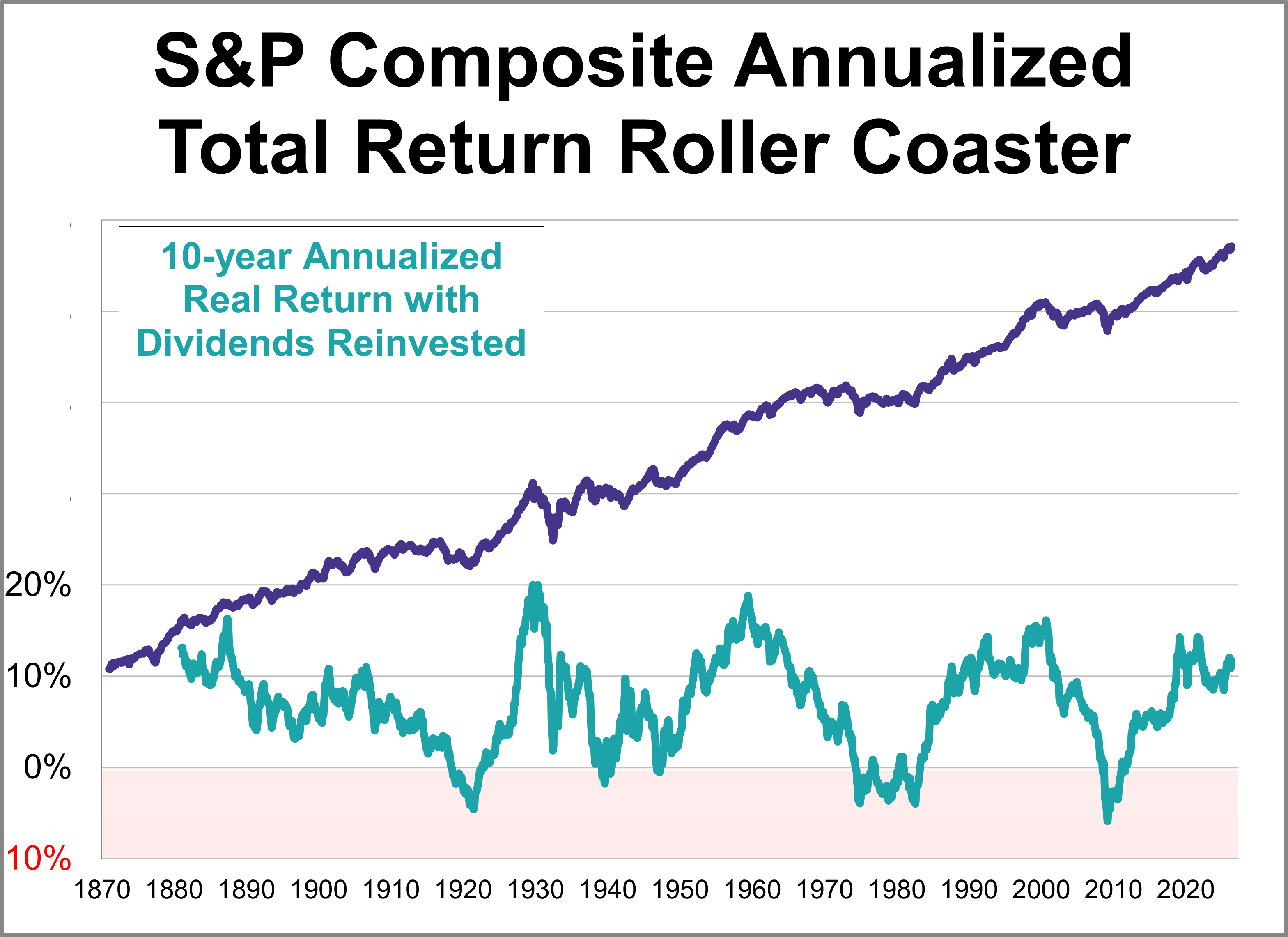
Here's an interesting set of charts that will especially resonate with those of us who follow economic and market cycles. Imagine that five years ago you invested $10,000 in the S&P 500. How much would it be worth today, with dividends reinvested but adjusted for inflation?
On Wednesday, June 3, Wellington Management and The Hartford announced that Wellington will be acquiring Hartford Funds. Once the acquisition is complete, Hartford Funds will operate under Wellington’s brand through the firm’s U.S. Wealth business.
The first phase of the artificial intelligence investment trade was relatively straightforward: if you wanted to capture the AI boom using familiar names, you bought semiconductors.
A seemingly endless appetite for buying US stock dips has propelled Vanguard Group’s S&P 500-tracking ETF past $1 trillion in assets, making it the first fund of its kind to reach a milestone once thought unimaginable for the ETF industry.
Foreign investors led by the likes of Stanley Druckenmiller and major Wall Street banks are returning to Argentine stocks this year after some had exited ahead of 2025’s volatile midterm election cycle.
Despite rising global yields and renewed inflation concerns, equities moved higher in May on the back of a strong US earnings season and continued momentum in AI-related stocks. The tech-heavy Nasdaq Composite gained 8.4% for the month, while the S&P 500 rose 5.3% and the Dow Jones Industrial Average was up 2.9%.
Emerging markets offer important exposure to economic growth through rapid industrialization, natural resource endowments, and strong demographic dynamics.
A strong business isn’t always a winning stock at every moment, and 2025 was a good reminder of that. Developed market equities finished the year up more than 20%, but quality stocks lagged. That’s why Parametric favors a multifactor approach to capture factor risk premia.
Get ready for a magnificent month, and then some. Mega-cap tech stocks dominate the corporate event calendar in June, already highlighted by NVIDIA (NVDA) CEO Jensen Huang’s keynote address at Computex 2026 in Taiwan earlier this week, one of many major conferences.
Given its focus, the launch presents a milestone for the asset management community. ASD blends a sophisticated index design with structural corporate philanthropy to create an ETF that resonates with those invested financially and emotionally.
Space ETFs have seen strong inflows coupled with standout performance, capturing significant market attention. For investors, the rapid pace of capital deployment into the space economy underscores a compelling investment opportunity. For this edition of Bull vs Bear, writers Zandile Chiwanza and Elle Caruso Fitzgerald debate the use cases for space ETFs in portfolios.
The top ETF launches of the past decade were the focus on this week’s ETF Prime. Host Nate Geraci and Cynthia Murphy, director of research at VettaFi, counted down the 10 most successful debuts by current assets. Murphy noted that the S&P 500’s roughly 13% annualized gain over that span helped shape many of the performance stories on the list.
As billions of dollars leave Bitcoin and Ether funds, money is flowing into a corner of crypto that promises something investors have long struggled to find in digital assets: a clearer path from economic activity to token value.
Join Dan Chung, CFA, CEO at Alger, as he explains how his role as Chief Investment Officer makes him uniquely positioned to see across all of Alger’s product portfolios to identify the “best ideas” for ATFV.
Investors are about to get a read on the durability of the soaring rally in cybersecurity stocks when two of the industry’s major players report earnings in the coming days.
Caution has become the most expensive position on Wall Street. A hot inflation reading this week — sending the annual gauge to its highest in about three years — landed alongside fresh strikes in the Persian Gulf and enduring expectations that the Federal Reserve may need to keep policy tight.
Investors are pouring money back into municipal bonds as higher yields and the approaching summer reinvestment season draw cash into the tax-exempt market.
If you’re not familiar with the name Leopold Aschenbrenner, you should be. A 24-year-old wunderkind, Aschenbrenner was hired by OpenAI in 2023 to work on the company’s “superalignment” team, essentially trying to figure out how to keep AI systems safe once they become smarter than the people building them.
The global defense industry continues to move rapidly from legacy, heavy-hardware platforms to agile, unmanned systems. Today, the Trump Administration announced that it’s pursuing funding deals for drone companies in an effort to increase domestic production in today’s defensive landscape.