Retail investors who spent the past week loading up on semiconductor stocks at the center of the artificial intelligence trade are getting pummeled amid Thursday’s rout.
VettaFi has been recognized as the Best U.S. Index Overall Provider at the ETF Express U.S. ETF Awards 2026, building on a standout year of index innovation, strategic acquisitions, and product milestone growth across the ETP landscape.
Kalshi Inc. is opening up a new frontier in its rivalry with traditional financial exchanges by pitching the world’s largest banks and hedge funds on a futures market tied to US inflation.
The number one question we tend to receive is: Where are long-term interest rates headed from here? Right behind it is: How do I invest in the bond market, not only for right now but also for the future? In our opinion, investors should be prepared for this elevated “normal” rate setting for the foreseeable future. We wanted to address both questions by examining how to prepare a bond portfolio for a 5% world.
The Federal Reserve is engaged in a well-documented battle with high inflation. So, many advisors and fixed income investors are evaluating Treasury inflation-protected securities (TIPS) and related ETFs.
The Magnificent Seven have dominated the technology trade, but investor attention is now shifting toward the MANGOS — a group of companies that place greater emphasis on artificial intelligence (AI) rather than traditional megacap technology.
Lockheed Martin Corp. lifted its full-year outlook as the company’s missile systems portfolio was buoyed by rising global defense spending.
It’s become one of the most reliable trades in the stock market as sentiment toward artificial intelligence swings wildly: Whatever AI stocks do, Apple Inc. does the opposite.
Investors are beginning to turn cautious on biotechnology stocks as a rapid rise in Treasury yields dents the appeal for shares of companies that are often viewed as risky all-or-nothing bets on breakthrough medical treatments.
Middle Eastern oil exports are approaching pre-war levels, but oil prices certainly aren’t. Brent remains above $100 a barrel, as the concern increasingly is not just how much oil is flowing today, but how much is left in reserve if supplies are disrupted again.
US stocks have continued to climb, but the gains have been far from uniform. In most sectors, a majority of companies have trailed the index. For investors, we believe the divide between a resilient index and uneven stock-level outcomes makes selectivity and fundamental research more important.
The boom is currently pushing interest rates up in two ways. First, the investment spending is boosting economic growth and straining the nation’s financing capacity. Second, the boom has been accompanied by a buoyant stock market, which is lifting household wealth and bolstering consumer spending.
As investors look beyond U.S. borders for fixed income diversification, Schwab Asset Management is entering the international bond ETF race with the Schwab International Bond ETF (SCIN). Expected to begin trading on the NYSE on October 21, 2026, SCIN pairs international investment-grade bond exposure with an ultra-low 0.06% net expense ratio.
The ETF industry has officially shattered last year’s record for annual product launches. A total of 1,159 new exchange-traded products have debuted year-to-date, eclipsing the full-year record of 1,143 funds set in 2025. With more than two months remaining in the year, the rapid pace highlights issuers’ relentless push to bring innovative strategies to market.
For the past two years, much of the conversation about artificial intelligence in wealth management has been hypothetical. Will advisors use AI? Will clients accept it? Will firms allow sensitive information to flow through large language models? Regulatory filings show that those questions are starting to be answered.
If you can channel energy into the best working relationship you could possibly have, that’s a good starting place. When it comes to cattiness and gossip, learn to walk away. Don’t do this in anger or as if you are better than they are. Instead, do it quietly and calmly.
A skeptical convert’s story transcends a snapshot and expands into a dynamic before-and-after. It speaks directly to the prospect who hasn’t been won over yet; the prospect searching your website or social channels for a good reason to stop their search.
In this webcast, we’ll explore how Buffer ETFs can complement traditional fixed-income allocations and help strengthen the defensive side of a portfolio.
Companies have postponed more than $5 billion in US and European debt sales this month as investors grow increasingly alarmed about rising interest rates, resurgent inflation, and potential cracks in the artificial-intelligence boom.
JPMorgan Asset Management has included Bitcoin in its long-term capital market assumptions for the first time, forecasting returns that could beat stocks, bonds and gold in a milestone for its Wall Street acceptance.
Elon Musk openly endorsed the prospect of combining SpaceX with Tesla Inc. in what would be the biggest-ever corporate merger, uniting assets from electric cars to AI data centers to rocket and satellite capabilities.
While don’t think of myself as being old, I can’t call myself young anymore. When I go to the gym, it takes me longer to stretch than to work out. People my age debate the best vitamin supplements, not the best burger joints. When I am asked for identification at the market, it isn’t to confirm I am old enough to buy beer; it’s to see whether I am eligible for a senior discount.
Corporate credit, monetary policy’s sleeping giant, is finally stirring. Cloud computing service provider CoreWeave Inc.’s bonds dropped this month, sending yields on its 2032 notes as high as 15%. Yields for junk and investment-grade debt reached the highest since 2025 and 2023, respectively.
Predicting the direction of interest rates is challenging enough when economic conditions are relatively stable. Add persistent inflation, a resilient economy, a cooling labor market, geopolitical uncertainty, and an expanding supply of Treasury debt, and the challenge becomes considerably greater.
The AI agent catalyst. Meta's September launch of Muse, a personal artificial intelligence (AI) agent designed to act on a user's behalf across digital workflows, crystallized the market's latest disruption narrative.
Fed rate hikes could climb further than markets expect, according to T. Rowe Price Capital Markets Strategist Tim Murray.
Narratives are almost always wrong: clever stories that explain the past and say nothing about the future. One may be right. AI may become the dominant technology of the century and render much of the present economy obsolete.
For many people, AI tools will be worth paying for. However, it is wise to decide, before any bills arrive, how much in very real money those tools are worth to you.
Chris Galipeau and Taylor Topousis discuss high-conviction insights that go beyond media headlines.
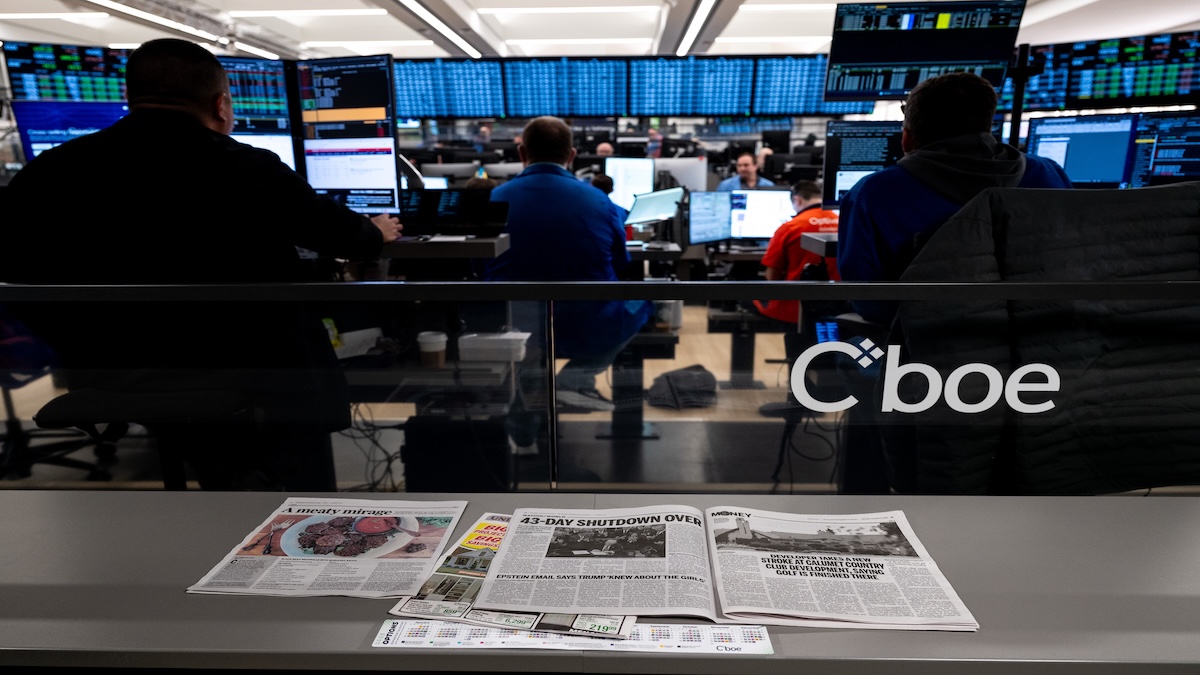
Cboe Global Markets Inc. launched pre-market trading in single-stock options, like those on ETFs tracking major stock indexes.
The Nasdaq-VettaFi Asset Allocation Summit this week included insights from leaders at key asset managers discussing the major decisions that advisors are facing. With costs rising and many investors at or near retirement, fixed income and income ETFs, specifically, took up a big part of the conversation. Leaders from BlackRock, WisdomTree, and Fidelity Investments all shared their views on both the fixed income outlook and the use cases for fixed income ETFs right now.
Artificial intelligence (AI) and the Federal Reserve rate hike have dominated headlines recently—and investors might be wondering how these things will affect them.
On July 24, China’s Ministry of Finance and State Taxation Administration announced that putting assets into an offshore trust, and earning income through one, are taxable events. The rate is 20%, and it applies not just when assets go in but also when they earn income and when the trust is wound down.
Fall is officially underway, heralding a season of change — and what a difference three months makes. The past quarter brought a dramatic Federal Reserve policy pivot and notable shifts in market sentiment and ETF trends. But within equities, the most striking reversal occurred inside the AI trade itself.
This review is, in part, about Eswar Prasad’s latest book, “The Doom Loop: Why the World Economic Order Is Spiraling into Disorder.” But it will also cover a seemingly unrelated article, Robert Kagan’s March piece in The Atlantic magazine, “America vs. the World,” and his 2018 book, “The Jungle Grows Back.”
Think interest rates are peaking? If so, agency mortgage-backed securities (MBS) deserve a look. Think rates have further to climb? MBS may still earn a place in your fixed-income allocation. In this article, I weigh the pros and cons of MBS at current yields, explain what will drive future returns, and share how individual investors can gain exposure.
Discover how strong corporate earnings, AI capex cycles, and 5%–10% fixed income yields outweigh midterm election and Fed rate uncertainties.
Many advisors first look to securitized assets for income, and for good reason. These sectors have often offered attractive spreads relative to similarly rated traditional fixed income securities. In many cases, those spreads reflect market complexity and specialized research requirements rather than simply higher credit risk.
S&P 500 investors have doubled their bets on the top 10 stocks, so their performance is twice as dependent on those 10 stocks. Is that a good bet? Who knows, but it is a large bet. Time will tell.
Gold slipped as bond yields stayed elevated despite falling energy prices, with traders assessing the outlook for the Federal Reserve’s interest-rate path.
Chips stocks and troubled artificial-intelligence bellwether CoreWeave Inc. are rising, helping stocks rebound after the worst week for the tech-heavy Nasdaq 100 Index since the tariff turmoil of April 2025.
United Airlines Holdings Inc. this month joined other major carriers in reducing the importance of frequent flying for its loyalty program. Status on United, Delta Air Lines Inc. and American Airlines Group Inc. now only comes from how much you spend, not how much you fly.
The third quarter of 2026 emphasized an increasingly divided macro regime for financial advisors and institutional allocators alike. On one end, broad market hopefulness drove steady capital deployment into broad-market beta, while on the other end, raised rate volatility and geopolitical tension forced strategic pivots across fixed income, real assets, and systematic strategies, according to BlackRock’s Q3 earnings call, released October 14.
Over the last decade, a series of policy decisions in DC support the reindustrialization of the United States. Key policy movers include investments in infrastructure, tax policy that allows significant tax benefits for corporate capital expenditures (capex) and domestic research and development, the CHIPS & Science Act and tariff policies, especially the sector-specific 232 tariffs.
In this commentary, we look at three themes shaping our thinking: a shift in who is leading the market, the return of income as a meaningful source of return, and an economy that, in our view, is growing steadily rather than heading toward either extreme.
Corporate bond yields are high, but spreads are low. Low spreads are supported by strong corporate fundamentals, and high yields might help offset potential price declines.
Matthew Bielski, founder and CEO of Defiance ETFs, recently joined Scarlet Fu and Eric Balchunas on Bloomberg’s ETF IQ to discuss the Defiance Autism Impact ETF (ASD) and the personal family experience that helped inspire its development.
Join the ETF experts at REX Shares for an educational webcast exploring the peptide economy.
In more normal periods like today, hiring broadly matches the labor force growth, and unemployment holds steady. Labor force growth has slowed to about 0.5% a year, so payroll gains have slowed too. Payrolls rose only 29,000 in September and averaged about 45,000 a month over the past year, yet unemployment is still a low 4.2%.
CoreWeave Inc. has become caught in a tug of war between investors who see rising bond yields as a potential rally killer for the AI trade and those who think demand for computing power will make those concerns seem passe before long.