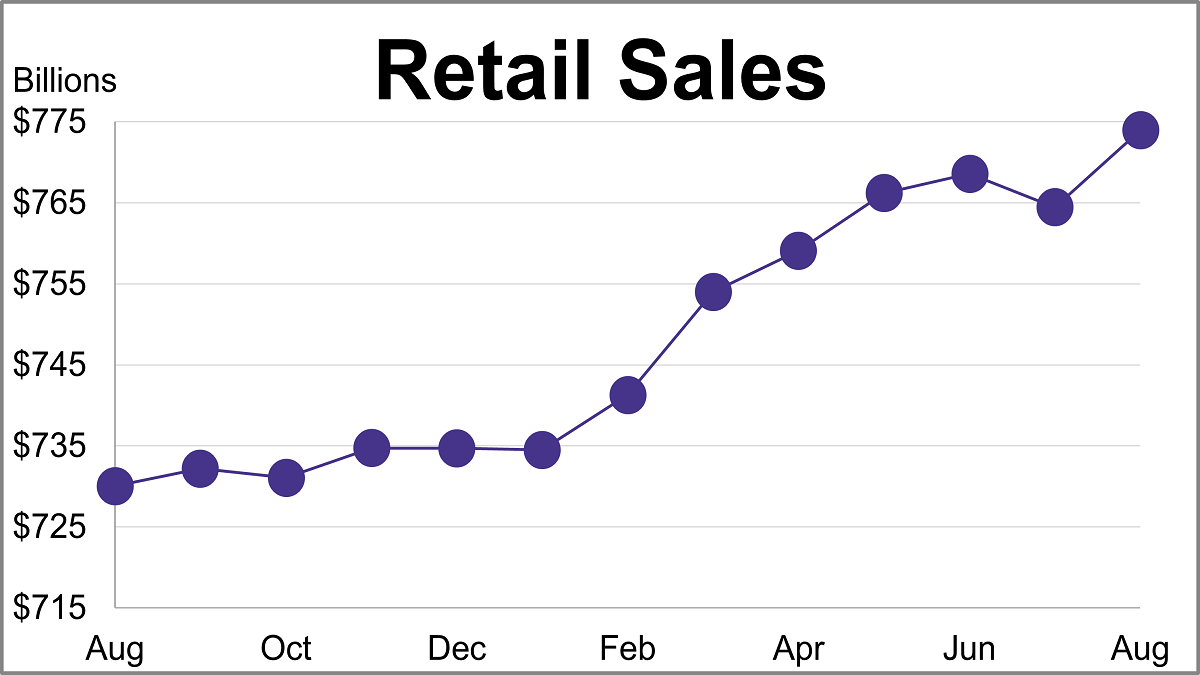
U.S. headline retail sales rebounded in August, up 1.2% to $773.9 in August, while core retail sales increased by 1.4%.
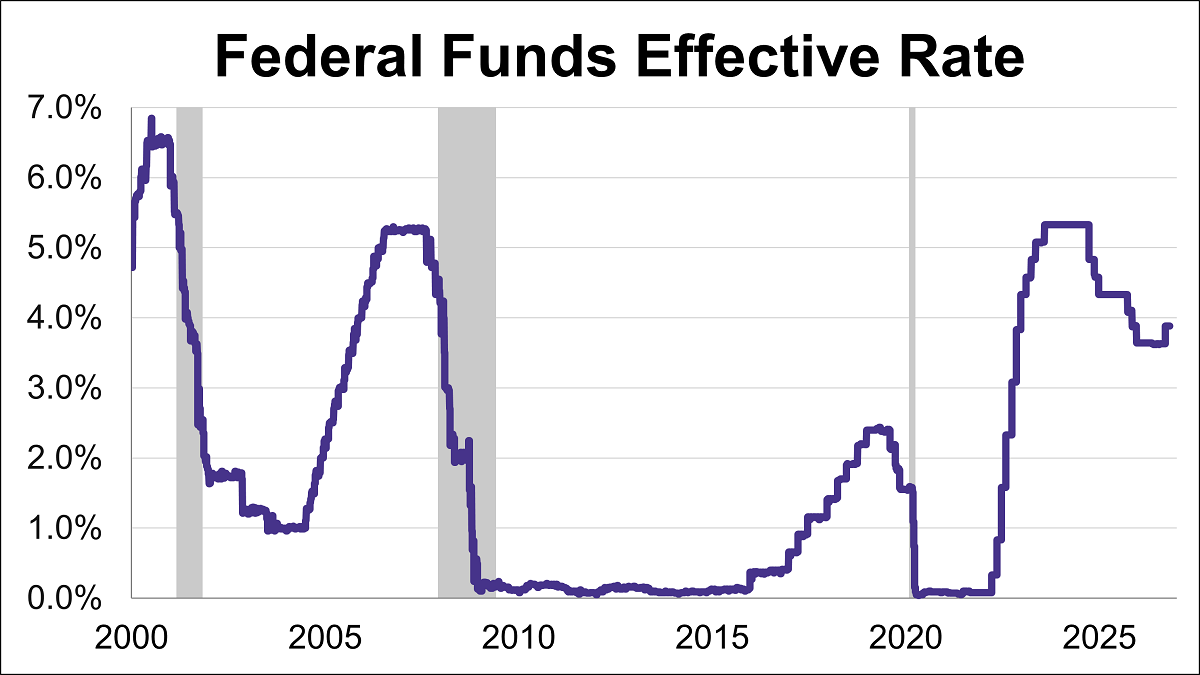
The Federal Reserve concluded its sixth meeting of the year by raising the federal funds rate (FFR) by 25 basis points to a target range of 3.75%-4%.
Join Fidelity for an educational webcast exploring derivative income in today’s market environment.
Clients value advisors who are knowledgeable about philanthropy as well as those who collaborate with philanthropic specialists when deeper expertise is needed. Advisors who coordinate deliberately with specialists, rather than working around them, are best positioned to meet those expectations.
With mass AI adoption across nearly every industry, a new challenge is emerging: When everyone has access to the same technology, everything starts to look and sound the same. Once you stop standing out and creating genuine connections with prospects, you face a big marketing problem.
In my years working with advisors, teams, and firms, I’ve had to confront the topic of compensation many times. It’s hard to grow when you don’t have the right incentives in place to encourage people to focus on actually doing it and hard to team effectively when people may think they are being treated unfairly.
US retail sales rose by the most in five months in a broad advance, showing consumers continued to spend despite rising gasoline prices.
One fear over the past few days is that an artificial-intelligence slowdown, whatever that looks like, might harm the stocks of chipmakers. If AI development takes a breather, the insatiable appetite that has propelled component makers to unprecedented heights would dissipate. Will AI companies still need all those data centers?
Every single sector in the S&P 500 is expected to deliver earnings growth for the third quarter, the first time since 2021, when corporate America emerged from the pandemic slump, Bloomberg Intelligence data shows.
Ed Yardeni, one of the biggest stock bulls on Wall Street, is slashing his year-end forecast for the S&P 500 Index a month after raising it, citing increasing risks of a downturn in the next three to six months.
Morgan Stanley’s investment manager secured $1.3 billion in capital commitments for a growth equity fund that’s already invested in startups including Databricks, Anduril Industries Inc. and Ramp.
Last December we published Riding the Wave: The Anatomy of Booms & Bubbles. In it, we argued that the AI spending boom would continue through 2026 without tipping into ‘bubble’ mania, and that the right posture was to stay overweight stocks while favoring US assets. Nine months on, we think that call has aged well.
Single-stock leveraged ETFs were unusual when they first arrived in the U.S. market just four years ago. Today, it might be hard to find a stock without one. Issuers are aggressively pushing beyond megacap tech into niche equities, pre-IPO registrations, and even experimenting with leverage levels and frequency.
With so much attention focused on what the Fed might do at its policy meeting this week, it’s a good time to look back at history to get a sense of how stocks might respond should policymakers hike rates as the market now expects. LPL Research had been characterizing the rate decision as a coin flip until Fed Chair Kevin Warsh’s hawkish comments at the Jackson Hole meeting and the strong August jobs report.
From the 2020 pandemic to today’s oil shocks, we’re often reminded in recent years that inflation can flare up unexpectedly. We’ve also likely entered an era in which higher inflation may linger for some time. As a result, bond-heavy and income-oriented investors may need to shore up their inflation defense, which we think should combine strategic positioning with tactical maneuvering.
The Consumer Price Index (CPI) data for August was generally in line with expectations. However, a slightly hotter-than-expected core CPI reading buoyed expectations of a rate hike at the Federal Reserve meeting in September.
The August employment report was much stronger than expected and reinforces my view that the U.S. economy remains remarkably resilient. Payrolls increased by 162,000, above every estimate, while revisions added another 55,000 jobs to the previous two months.
A rate hike on Wednesday is now very likely but would also be unusual, and perhaps dangerous, at least as far as the past generation of monetary policy goes.
AI-driven healthcare innovation is creating strong investment opportunities by improving efficiency, expanding access, and delivering better patient outcomes.
A week of rising oil prices and higher interest rates sent stocks lower across the board as investors increasingly priced in the likelihood that the Federal Reserve (Fed) will begin a rate-hiking cycle at its September 16 meeting. Following the August Consumer Price Index (CPI) report, futures markets implied an 88 percent probability that the Fed will, or at least should, raise rates at next week's meeting.
Bond prices and interest rates generally move in opposite directions. When interest rates rise, the market prices of existing bonds typically fall. When interest rates fall, existing bond prices typically rise.
Join the experts at Sterling Capital for an educational webcast covering a unique corner of the fixed income market.
Discover how autocallables provide steady income and downside risk protection in volatile markets, and how autocallable ETFs can help.
In what is a good sign, many discussions around automation generally and AI specifically are increasingly moving to questions about compliance and liability. Basically, people are asking whether the agentic coworker they just hired is smart enough to trust.
I’ve written before about why the federal debt may be less dire than the headlines suggest, and I still think much of that argument holds. You cannot know whether a national crisis is coming. You can, however, assess the risk of a crisis for your own budget and take action to reduce that risk.
Anthropic PBC is pitching financial advisers on a version of Claude that blends the chatbot with financial analytics and risk management technology run by BlackRock Inc., Vanguard Group Inc. and other firms.
An essay from Anthropic PBC’s Dario Amodei saying artificial intelligence companies must “pace the frontier” has got the world talking about a slowdown in their most cutting-edge research. OpenAI’s Sam Altman and SpaceX’s Elon Musk publicly agreed with the post.
Treasury yields are closing in on an inflection point where, historically, stocks and bonds have reinforced losses in one another. That points to a regime shift of higher bond and stock volatility and wider credit spreads.
Kevin Warsh has rightly called into question the effectiveness of the Federal Reserve’s communications — but his arrival as chairman only seems to have made the problem worse. To put this right after the next Fed meeting this week, he’ll need to rethink his approach to explaining where things stand.
The future of retirement planning is not a new model replacing an old one, but a more holistic approach that blends rigorous analytics with important client input. Advisors who adopt this integrated model will find that it deepens client conversations, clarifies tradeoffs, improves long-term decision-making.
The latest inflation report points to a hard truth: The US is not going back to a 2% inflation rate anytime soon. At least not easily.
Periods like this can feel especially tense, with higher stakes and more urgent headlines. Yet over time, markets have shown they are forward-looking and resilient, absorbing uncertainty rather than freezing in it. While today’s geopolitical backdrop may feel unsettling, it fits a long history of disruptions that markets have ultimately navigated.
On September 2, TMX VettaFi Head of Research Todd Rosenbluth appeared on the Schwab Network to discuss ETF inflows nearing record highs in 2026 and the 50th anniversary of the first-ever index fund, the Vanguard 500 Index Fund. The fund’s ETF share class, which trades under the ticker VOO, is a bit newer, having launched in 2010.
Chris Galipeau discusses high-conviction insights that go beyond media headlines.
Most coverage of Trump Accounts treats them as a parenting question, or a discussion comparing them to 529s. For founders and business owners the analysis of them is slightly more nuanced.
Demand for fixed income ETFs hit a historic high-water mark in September. Investors and advisors turned to fixed income ETFs at a record-breaking pace, driving 2026 net inflows of $446 billion past all-time levels with months to spare. The massive tide of capital arrives at a critical juncture.
In our final chapter for this series, we will dig into that exact question. Unfortunately, there is good and bad news, and it can be summed up in a single sentence.
Is the AI infrastructure buildout one big trade in credit? So far, the market seems to think so. Spread dispersion – differences in borrowing costs among issuers – across the financing chain remains limited despite sharp differences in underlying risk. This contrasts with equities, where performance has become increasingly differentiated.
Last week, the refining margin on European gasoil, the benchmark that sets the price of diesel and heating oil across much of the world, closed at roughly $94 a barrel over Brent crude, according to Bloomberg data. That figure is normally somewhere between $12 and $18.
As policymakers adapt to new leadership, navigate a challenging geopolitical backdrop and contend with meaningful internal debate over the path of interest rates, the stakes remain high. Below, we discuss what to expect from next week’s Federal Reserve (Fed) meeting and provide perspective on the recent rise of Treasury yields to multi-year highs.
Attractive yields and resilient credit conditions are creating opportunities across fixed income, but uncertainty around inflation and interest rates makes flexibility, selectivity and disciplined risk management especially important.
In Part III, the focus will center on practical applications of this discipline. In particular, how advisors can integrate the methodology into modern asset allocation, and why it offers an evolutionary leap for passive investing that’s available through exchange-traded funds (ETFs).
According to new data from J.P. Morgan Asset Management’s 2026 Defined Contribution Plan Participant Survey, 73% of savers said they wish they could hit an “easy button” and fully delegate their wealth management.
Join the experts at Swan Global Investments and VettaFi to explore active, uncapped defined risk strategies and how they can help advisors navigate today’s challenging market environment.
As I go through the strengths and weaknesses of each model, my goals are to point out where the models are strong and to point out potential weaknesses such as conflicts of interest, which are important to be aware of in working with clients. Although we are all fiduciaries, financial incentives matter because we are all human. I know great advisors across all fee models.
Heading into the September 16 FOMC meeting, the debate over whether the Fed should raise rates or hold is heated. To help you appreciate the range of views, I present this article as a courtroom exercise. I will let the prosecution make its case for a rate hike, and the defense for a hold.
ETF share classes represent a structural innovation that combines the benefits of mutual funds and exchange-traded funds (ETFs) within a single pooled portfolio. This evolution expands investor choice, offering both ETF and mutual fund shares under a unified investment strategy.
Many market participants have highlighted how value investing is back as the equity market rally broadened out beyond high-flying growth names. However, taking an index-based approach to the value style requires looking under the hood. Not all value ETFs are created equally.
Market madness has never been hard to diagnose. It’s almost two centuries since Charles Mackay published Extraordinary Popular Delusions and the Madness of Crowds. Benjamin Graham pioneered value investing in the 1930s by inviting everyone to think of “Mr. Market” as a manic-depressive who makes mistakes that can be exploited.
America’s data center boom will need $110 billion to build 45 gigawatts of new power generation through 2030, according to an analysis by Moody’s Ratings.